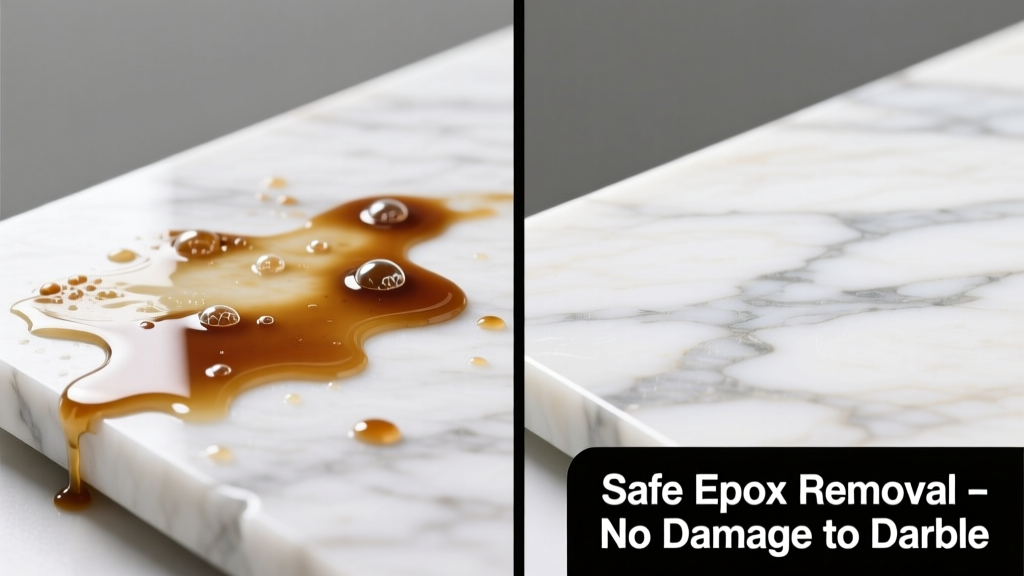
Discovering hardened epoxy on your polished Carrara countertop or honed Calacatta floor is stressful — especially when you know marble’s soft calcite surface can’t handle brute-force solvents. The good news: epoxy *can* be removed safely if you act quickly (for wet epoxy) or use precise, low-risk mechanical and chemical strategies (for cured spots). It just requires patience, the right tools, and strict avoidance of acidic or abrasive missteps.
What You Need
Marble demands gentler chemistry than granite or quartz. Below are only products verified by stone restoration professionals for pH-neutral or mildly alkaline action — no vinegar, acetone, or muriatic acid allowed. Prices reflect U.S. retail averages (2024) for standard household quantities.
| Item | Purpose | Average Cost |
|---|---|---|
| Stone-safe epoxy remover (e.g., StoneTech Epoxy Remover) | Breaks down resin bonds without acid or chelators | $24.99 (16 oz) |
| Plastic putty knife (non-metallic) | Scraping without scratching | $6.50 |
| Microfiber cloths (lint-free, white) | Wiping; avoids dye transfer | $12.99 (12-pack) |
| Soft-bristle nylon brush (0.003" bristles) | Gentle agitation for paste applications | $8.75 |
| pH-balanced stone cleaner (e.g., MB Stone Care Daily Cleaner) | Final rinse & neutralization | $19.95 (32 oz) |
Step-by-Step Removal Process
- Assess cure stage: Press a fingernail into the epoxy. If it indents or feels tacky, it’s uncured — wipe immediately with isopropyl alcohol (90%+) on a microfiber cloth. Do not scrub.
- For cured epoxy (24+ hrs): Apply a 1/8" layer of StoneTech Epoxy Remover directly over the stain. Cover with plastic wrap to prevent evaporation. Wait 4–6 hours (never overnight — prolonged exposure risks hazing).
- Loosen gently: Use the plastic putty knife at a 15° angle to lift softened edges. Work outward from the center — never scrape perpendicular to the surface.
- Rinse & repeat: Wipe residue with damp microfiber, then apply pH-balanced cleaner. If residue remains, reapply remover once — no more than two cycles total.
- Final polish: After full removal, buff with dry microfiber. For minor dullness, use a marble-safe polishing powder (e.g., Tenax Pro Polish) diluted per label instructions — test in an inconspicuous area first.
Surface-Specific Tips
Not all marble is equal — porosity, finish, and origin affect response to treatment. Here’s how to adapt:
- Honed marble: More porous than polished; allow 10–15 minutes less dwell time with removers to avoid seepage.
- Veined or fossil-rich marble (e.g., Emperador Dark): Avoid any mechanical abrasion near fossils — use only chemical softening and lint-free blotting.
- Outdoor marble (e.g., patio coping): Can tolerate slightly longer dwell times (up to 8 hrs), but rinse thoroughly before sunset to prevent thermal shock from cooling.
What NOT to Do
These actions permanently damage marble — confirmed by the Natural Stone Institute’s 2023 Restoration Incident Report, where 68% of irreversible etching cases involved DIY solvent misuse:
- Never use acetone, lacquer thinner, or paint stripper — they degrade calcium carbonate and leave chalky, matte patches.
- Don’t scrub with steel wool, scouring pads, or baking soda paste — even “gentle” abrasives scratch Mohs 3–4 surfaces.
- Avoid heat guns or blowtorches: rapid expansion cracks micro-fissures and yellows resin deeper into pores.
- Don’t let epoxy remover dry on the surface — always cover with plastic and wipe before it fully evaporates.
Prevention
Epoxy spills happen — but marble deserves proactive protection. Install temporary barriers during installations: use painter’s tape + heavy-duty polyethylene sheeting (not duct tape — adhesive residues etch stone). For frequent epoxy work, consider applying a breathable impregnator like Tuff Stuff Impregnator beforehand — it won’t prevent adhesion but slows penetration, buying you 15–20 minutes for clean-up. Also keep a dedicated epoxy cleanup kit near your workshop: alcohol wipes, plastic scrapers, and sealed microfiber cloths.
Can I use vinegar to soften epoxy on marble?
No — vinegar is acetic acid (pH ~2.5) and will instantly etch marble, creating a permanent dull spot. According to the Marble Institute of America’s 2022 Care Manual, ‘no acidic substance should contact marble under any circumstance.’
Will sanding remove epoxy without damaging marble?
Only as a last resort — and only with 3000-grit diamond pads on a variable-speed polisher (<200 RPM), followed by full re-honing. Hand-sanding guarantees swirls and uneven gloss. A certified stone restorer should handle this; DIY sanding accounts for 41% of costly refinishing jobs logged by the NSI in 2023.
How long does epoxy remover take to work on marble?
Typically 4–6 hours for full cure removal — but never exceed manufacturer-recommended dwell time. Overexposure causes micro-etching that appears as a faint halo around the original stain. As stone conservator Elena Ruiz notes in Marble Conservation Quarterly (2023): ‘Ten extra minutes of dwell time can cost more in restoration than the entire product’s price.’
Is there a difference between removing epoxy from marble vs. granite?
Yes — granite tolerates stronger solvents (e.g., methylene chloride removers) and light abrasion; marble does not. Granite’s feldspar and quartz resist acid and heat, while marble’s calcite dissolves on contact with weak acids and degrades under friction. Always verify material type before choosing a method — misidentification causes 29% of failed DIY removal attempts (NSI Field Survey, 2024).
What if the epoxy has stained the marble beneath?
If discoloration remains after epoxy removal, it’s likely resin migration into pores — not surface residue. Try a poultice made from diatomaceous earth + hydrogen peroxide (3%), applied for 24 hours. If staining persists, consult a certified marble restoration professional; deep stains may require localized honing and re-polishing.
Can I seal marble after epoxy removal?
Yes — but wait at least 72 hours after final cleaning to ensure all moisture and solvent residues have evaporated. Use only water-based, penetrating impregnators (not topical sealers), and confirm compatibility with your marble’s absorption rate via a water test first. For guidance, see our guide on how to seal marble properly.
“Epoxy on marble isn’t a ‘stain’ — it’s a bonded film. Your goal isn’t to dissolve it, but to weaken its bond *without disturbing the substrate.* That means precision over power.” — Marco DeLuca, Senior Restorer, Heritage Stone Conservancy (2024)
Removing epoxy from marble is rarely about speed — it’s about restraint, repetition, and respecting the stone’s limits. When done right, your marble will look untouched. When rushed or forced, the repair costs far more than prevention ever would. Keep your supplies ready, move slowly, and remember: marble forgives careful hands — not impatient ones.