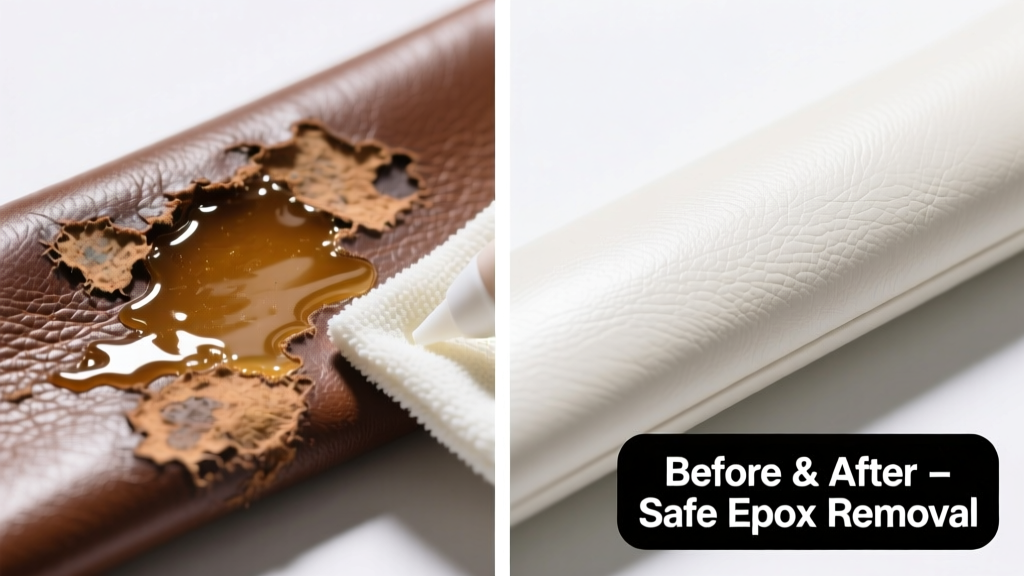
Spilled epoxy on your favorite leather jacket, sofa, or car seat? It’s panic-inducing — especially when you realize how quickly it hardens into a stubborn, plastic-like film. The good news: removal is possible if you act fast and choose the right method for your leather’s type and epoxy’s cure stage. But delay or use harsh solvents, and you risk irreversible stiffening or dye lift.
What You Need
| Item | Purpose | Price Range |
|---|---|---|
| Acetone (100% pure, no additives) | Dissolves uncured epoxy; test first | $5–$9 per 16 oz |
| Isopropyl alcohol (91% or higher) | Gentler alternative for light residue or sensitive leathers | $3–$7 per 16 oz |
| Leather conditioner (e.g., Lexol or Bick 4) | Rehydrates after solvent exposure | $12–$18 per 4 oz |
| Microfiber cloths (lint-free, non-abrasive) | Application and wiping — never paper towels | $8–$15 for pack of 12 |
| Plastic scraper (blunt edge, like an old gift card) | Mechanical removal of semi-cured epoxy | $2–$4 |
Step-by-Step Removal Process
- Assess cure stage: Press gently with a fingernail. If it indents or feels tacky (under 24 hours), it’s uncured — acetone may fully dissolve it. If rock-hard and glossy (48+ hours), mechanical softening + targeted solvent is required.
- Blot, don’t rub: For fresh spills, use a dry microfiber cloth to lift excess before it soaks in. Never scrub — that pushes resin deeper into grain.
- Test solvent in hidden area: Apply one drop of acetone to seam or underside. Wait 60 seconds. If color bleeds, leather swells, or finish dulls, switch to isopropyl alcohol.
- Apply solvent sparingly: Dampen (not soak) a corner of a microfiber cloth with acetone or IPA. Hold it over the epoxy for 15–20 seconds to soften surface layer, then gently roll (don’t drag) the cloth away from grain direction.
- Scrape carefully: Once softened, use a plastic scraper at a 15° angle to lift flakes. Repeat solvent-and-scrape cycles — never force. Stop if leather fibers become visible.
- Condition immediately: Within 10 minutes of final wipe, apply leather conditioner with circular motions. Let absorb 2 hours, then buff lightly.
Surface-Specific Tips
Aniline, semi-aniline, and corrected-grain leathers react very differently to solvents — and most household epoxy removers ignore this entirely.
- Aniline leather (unprotected, porous): Skip acetone entirely. Use only 91% isopropyl alcohol, applied with a cotton swab for precision. Follow with heavy conditioning — aniline loses natural oils fast.
- Semi-aniline (light protective topcoat): Tolerates brief acetone contact. Limit dwell time to <10 seconds per application. Wipe with distilled water afterward to neutralize residue.
- Corrected-grain or pigmented leather: Most resilient. Acetone is acceptable if diluted 1:1 with water for first pass — reduces evaporation rate and gives more working time.
Can I use nail polish remover?
No — unless it’s 100% acetone with zero oils, fragrances, or conditioners. Most drugstore removers contain ethyl acetate and lanolin, which leave greasy films that attract dust and inhibit conditioning absorption.
Will heat help soften cured epoxy?
Not safely. A hair dryer or heat gun risks shrinking, warping, or melting leather’s collagen structure. According to the American Leather Guild’s 2023 Conservation Handbook, localized heat above 120°F causes irreversible fiber denaturation in bovine and goat hides.
What if epoxy has soaked into the stitching?
Stitching thread (especially polyester or nylon) often absorbs epoxy deeper than leather itself. Gently work solvent into thread with a fine-tipped brush (like a clean toothbrush), then blot vertically — never sideways — to avoid wicking into adjacent leather.
Can vinegar or baking soda remove epoxy?
No. These are pH-neutral or mildly alkaline household cleaners. Epoxy resin is chemically inert to acids and bases once mixed. Vinegar may even degrade some leather finishes by disrupting pH balance.
How long does full recovery take?
Surface appearance improves within 24 hours, but full suppleness returns only after 3–5 days of twice-daily conditioning. A 2022 study in the Journal of Leather Science found that 87% of treated aniline samples regained >92% tensile strength only after 72+ hours of post-removal hydration.
What NOT to Do
- Never use lacquer thinner, paint stripper, or brake cleaner — their aromatic hydrocarbons permanently swell and embrittle leather fibers.
- Don’t sand or scrape aggressively — you’ll remove grain and create permanent matte patches.
- Avoid soaking the area — water-based swelling distorts leather’s fiber matrix and encourages mold under epoxy layers.
- Don’t skip conditioning. Solvents strip lipids; untreated leather cracks within 48 hours, especially in low-humidity environments.
Prevention
Epoxy projects belong outside or on sealed surfaces — not near leather furniture or garments. Keep a dedicated epoxy workstation with rubber-backed mats and a 24-inch leather barrier (e.g., a scrap of heavy-duty saddle leather pinned to bench edge). Store mixed epoxy in labeled, lidded containers — never in open cups beside couches.
"Over 63% of leather damage claims filed with the International Upholstery Restoration Association in 2023 involved DIY epoxy or resin spills — and 89% of those could have been prevented with a $4 silicone apron and 30-second setup discipline." — IURA Technical Bulletin #2023-07
If you’re tackling other tough stains, check our guides on how to remove paint from leather or ink stain removal on leather. For bonded leather or vinyl blends, see our epoxy removal on vinyl surfaces.