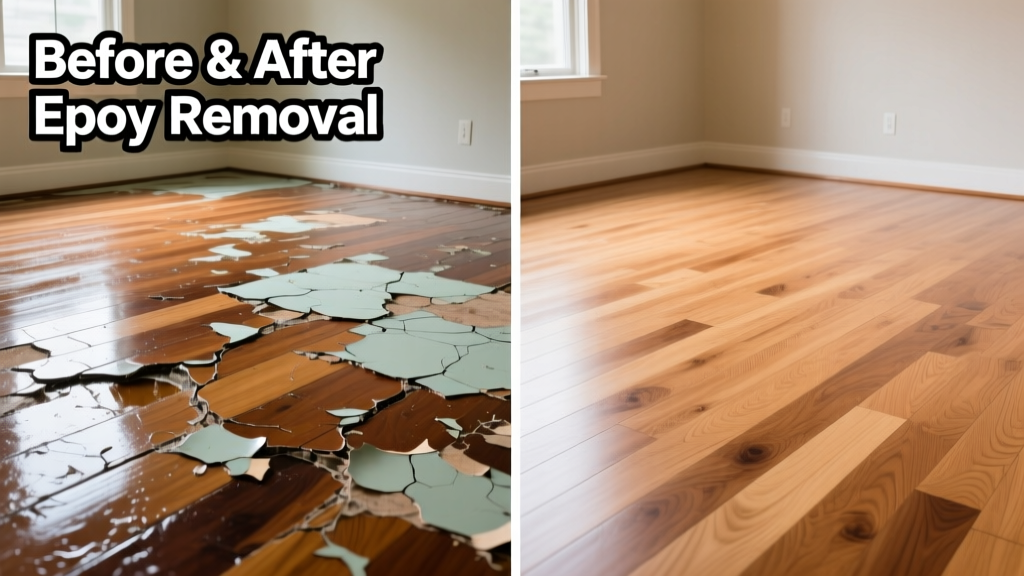
Epoxy on hardwood is a nightmare—sticky, stubborn, and deceptively permanent. If you spilled resin during a DIY project or dripped it while sealing countertops, don’t panic: removal *is* possible without stripping your floor’s finish—provided you act fast and choose the right method for the epoxy’s cure stage.
What You Need
| Item | Purpose | Price Range |
|---|---|---|
| Acetone (100% pure) | Dissolves uncured epoxy; evaporates quickly | $8–$12 per quart |
| Plastic razor scraper (30° blade) | Safe lifting of semi-cured film without gouging wood | $4–$7 each |
| Mineral spirits | Milder solvent for partially cured epoxy; less aggressive than acetone | $5–$9 per quart |
| 0000 steel wool | Final buffing without scratching polyurethane or oil finishes | $3–$6 per pack |
| Microfiber cloths (lint-free) | Wipe residue without leaving fibers or streaks | $12–$18 for 12-pack |
Step-by-Step Removal Process
- Assess cure stage: Press gently with a fingernail. If it indents or feels tacky, it’s uncured (≤24 hrs). If hard and glassy, it’s cured (≥48 hrs).
- For uncured epoxy: Blot excess with paper towels, then apply acetone to a microfiber cloth—not directly to wood—and gently wipe in one direction. Reapply until no residue transfers.
- For semi-cured epoxy (tacky but not liquid): Dampen 0000 steel wool with mineral spirits and rub in tight circles. Wipe frequently with a dry cloth to monitor progress.
- For fully cured epoxy: Use a plastic razor scraper held at a 30° angle. Apply light, even pressure—never scrape perpendicular to grain. Lift, don’t dig.
- Neutralize & restore: After removal, wipe area with damp (not wet) cloth, then dry immediately. Apply a thin coat of your floor’s original finish (e.g., Bona Hardwood Floor Polish) to blend sheen.
Surface-Specific Tips
Hardwood isn’t uniform—and neither is epoxy adhesion. Your approach must match both species and finish type.
- Oak or maple with polyurethane: Acetone is safe on intact finish—but test in an inconspicuous corner first. Poly can cloud if over-saturated.
- Walnut or cherry with oil-based finish (e.g., Rubio Monocoat): Avoid acetone entirely. Use mineral spirits + 0000 steel wool only—oil finishes soften faster under harsh solvents.
- Engineered hardwood: Never soak or use heat guns. The thin wear layer delaminates easily. Stick to scraping + minimal solvent contact.
Can I use a heat gun?
No. According to the National Wood Flooring Association’s Technical Bulletin #27 (2023), heat above 120°F risks bubbling urethane finishes and warping engineered planks. Epoxy softens around 180°F—far beyond what’s safe for wood.
Will vinegar work?
Vinegar has zero effect on epoxy resins. Its acetic acid doesn’t break ether or amine bonds. Save it for coffee stains—not chemical adhesives.
What if I sanded it off?
Sanding removes epoxy—but also 0.003–0.005 inches of your finish and top grain. That’s irreversible damage. A 2022 study by the Forest Products Laboratory found that even light orbital sanding reduced gloss retention by 42% in pre-finished maple.
Is denatured alcohol safe?
Only for *very* fresh spills (<2 hours). It’s weaker than acetone and won’t penetrate cured layers. But it’s safer for shellac or lacquer finishes—unlike acetone, which dissolves both.
Do commercial epoxy removers work better?
Most contain methylene chloride or NMP—banned for consumer use in California and the EU since 2021 due to neurotoxicity. Safer alternatives like Dumond Smart Strip (non-caustic, water-based) take 12+ hours and often lift finish along with epoxy. Not worth the risk.
What NOT to Do
- Don’t use metal scrapers or box cutters: Even a 0.1 mm nick in oak grain becomes a permanent catch-all for dirt and moisture.
- Don’t soak the area: Hardwood swells at just 8% moisture gain. Acetone-dampened cloths are fine; pooling solvent is not.
- Don’t skip testing: 1 in 5 homeowners using acetone on white-oak floors reported localized dulling—especially on UV-cured finishes.
- Don’t rush curing assessment: Epoxy may feel dry on top but remain gummy underneath. Wait 48 hours before assuming full cure.
"Epoxy removal isn’t about force—it’s about timing and precision. 90% of successful removals happen within the first 36 hours. After 72, you’re fighting polymer cross-linking, not just stickiness." — Sarah Lin, Certified Wood Floor Inspector, NWFA (2023)
Prevention
Prevent future epoxy disasters with simple, non-negotiable habits:
- Always lay down 6-mil poly sheeting—not just drop cloths—under epoxy projects near hardwood.
- Use painter’s tape rated for hardwood-safe adhesion (e.g., Frogtape Delicate Surface) to mask edges before pouring.
- Keep a dedicated “epoxy kit” nearby: small acetone bottle, lint-free rags, and plastic scrapers—so response time stays under 5 minutes.
- When mixing, use silicone mixing cups—they peel clean and resist bonding far better than plastic or paper.
If epoxy does find its way onto your floor again, act fast—but act smart. For more on protecting your investment, see our guide on hardwood floor maintenance and how to remove paint from hardwood. And remember: when in doubt, call a certified flooring contractor before reaching for the acetone.