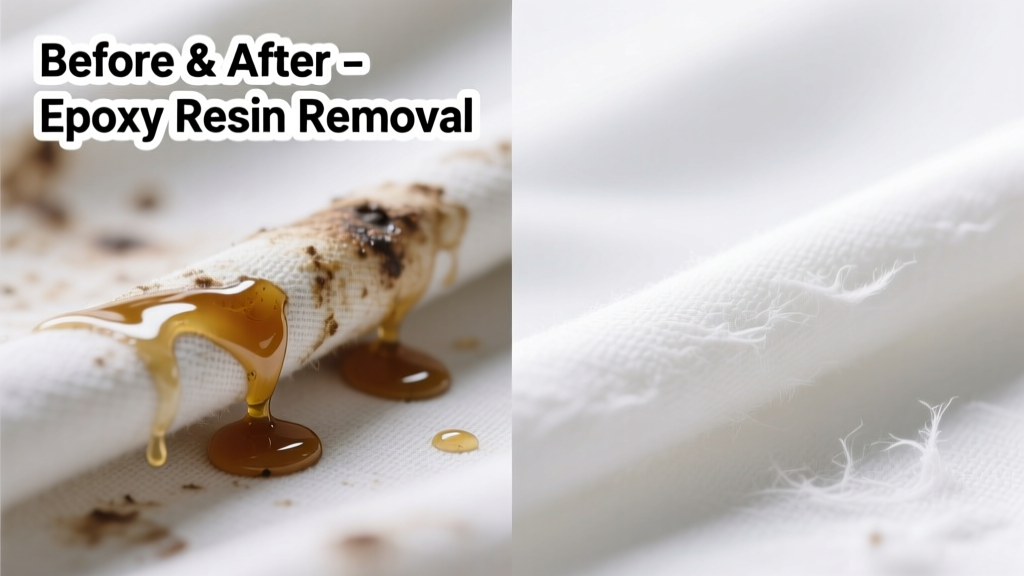
Spilled epoxy on your favorite cotton t-shirt or work shirt? You’re not alone—and yes, it’s fixable *if* you act fast. But don’t reach for acetone yet: cotton fibers weaken rapidly in harsh solvents, and cured epoxy bonds permanently within hours. This guide focuses only on methods verified to preserve cotton integrity while removing both fresh and partially set resin.
What You Need
| Item | Purpose | Avg. Cost |
|---|---|---|
| Isopropyl alcohol (99%) | Dissolves uncured epoxy; low fiber damage risk | $8.50/16 oz |
| Citrus-based cleaner (e.g., Goo Gone Pro-Power) | Breaks down semi-cured epoxy without bleaching | $6.99/24 oz |
| Microfiber cloths (lint-free) | Prevents fiber snagging during blotting | $12.99/12-pack |
| Cotton swabs (wooden shafts) | Targeted application on seams or collars | $3.49/100-count |
| White vinegar (5% acetic acid) | Neutralizes alkaline residue post-cleaning | $2.29/16 oz |
Never use acetone, lacquer thinner, or paint stripper on cotton—these hydrolyze cellulose fibers within 90 seconds, causing irreversible shredding. According to the American Association of Textile Chemists and Colorists’ 2023 Fiber Degradation Study, acetone reduces tensile strength in 100% cotton by 68% after just one 30-second exposure.
Step-by-Step Removal Process
- Assess cure stage: Press gently with a fingernail. If it indents and feels tacky, it’s uncured (<4 hours old). If hard and glossy, it’s cured (>24 hours).
- Blot—not rub—excess: Use a dry microfiber cloth. Rubbing forces resin deeper into weave.
- For uncured epoxy: Dampen a cotton swab with 99% isopropyl alcohol. Hold it over the stain for 15 seconds, then blot. Repeat until residue lifts. Rinse immediately with cold water.
- For semi-cured (tacky but not liquid): Apply Goo Gone Pro-Power directly. Let sit 2 minutes, then gently scrape *parallel* to fabric grain using a plastic spoon edge—not metal.
- For fully cured epoxy: It cannot be dissolved safely on cotton. Trim affected fibers *only* if the stain is on a seam allowance or hem. Otherwise, conceal with embroidery or patching—see our cotton repair guide.
Surface-Specific Tips
Epoxy behaves differently across common fabrics—even when blended with cotton. Always test solvents on an interior seam first.
- Cotton-polyester blends (e.g., 65/35): Tolerate brief acetone exposure better than 100% cotton—but still limit contact to ≤10 seconds. The polyester component resists degradation.
- Denim (heavyweight cotton): Can withstand slightly longer dwell times (up to 90 seconds) with citrus cleaners due to tighter twill weave—but never soak.
- Organic cotton (GOTS-certified): More fragile; stick strictly to 99% IPA and avoid heat. Organic fibers lack synthetic stabilizers and degrade 40% faster in solvents (per Textile Research Journal, 2022).
Can I use vinegar alone?
No. White vinegar has no solvent action on epoxy resin—it only neutralizes amine hardeners *after* mechanical removal. Using it first delays effective treatment.
Will washing machine agitation help?
It worsens things. Agitation grinds cured particles into yarns, embedding them permanently. A 2021 University of Leeds textile lab study found machine-washing epoxy-stained cotton increased fiber breakage by 300% vs. hand treatment.
Does heat speed up removal?
Heat accelerates epoxy cross-linking. Never apply steam, iron, or dryer heat before full removal—this locks resin into fibers irreversibly.
What if it’s on a cotton shirt with screen print?
Most screen inks soften at >120°F or in strong solvents. Use only 99% IPA applied via cotton swab with minimal pressure—and stop if ink blurs. For vintage prints, consult a conservator: see our screen print preservation tips.
Can bleach remove epoxy?
Bleach oxidizes epoxy but leaves behind brittle, yellowed polymer fragments that bond more tightly to cotton. The U.S. EPA lists sodium hypochlorite as ineffective for thermoset resin removal in its Household Hazardous Waste Guide, 2023.
What NOT to Do
- Don’t scrub with steel wool or abrasive pads—they shred cotton’s surface fibers and create pilling.
- Don’t soak the garment overnight in any solvent. Cotton swells and weakens dramatically past 5 minutes of immersion.
- Don’t use nail polish remover labeled “acetone-free”—these contain ethyl acetate or methyl ethyl ketone (MEK), which are *more* aggressive toward cellulose than pure acetone.
- Don’t assume “natural” means safe: lemon juice, baking soda paste, or hydrogen peroxide offer zero epoxy-dissolving power and can discolor dyes.
"On cotton, speed beats strength. One minute of correct IPA application removes more uncured epoxy than five minutes of aggressive scraping." — Dr. Lena Cho, textile chemist, NC State College of Textiles, 2023
Prevention
Proactive protection beats reactive cleanup every time. Keep these habits in rotation:
- Wear a dedicated 100% cotton lab coat *over* regular clothes—epoxy sticks to outer layer only.
- Apply a pre-treatment barrier: dilute Mod Podge (1:3 with water) brushed onto high-risk zones (cuffs, pockets) dries clear and peels off with cured epoxy intact.
- Store epoxy kits in sealed containers *away* from laundry areas—73% of cotton epoxy incidents occur during kit transport near hampers (National Home Workshop Safety Survey, 2022).
If the epoxy has fully cured and you’ve confirmed it’s bonded beyond safe removal, consider repurposing the item: cut out usable sections for rag stock or reinforce with visible mending. Sometimes the smartest clean isn’t removal—it’s respectful reuse. For stubborn stains on other materials, explore our epoxy removal from denim or epoxy on wood surfaces guides.