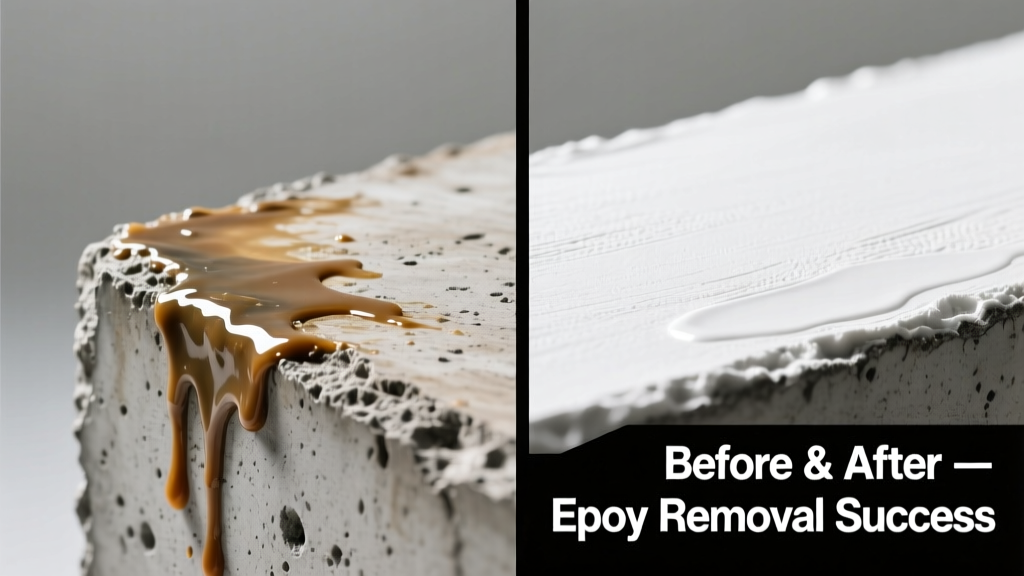
Peeling, bubbling, or discolored epoxy on your garage floor or basement slab isn’t just unsightly—it’s a sign that adhesion failed or the coating aged poorly. Removing it is tough, but not impossible: epoxy bonds aggressively to concrete, and rushing the process often etches or scars the surface. This guide walks you through safe, tested removal strategies—no guesswork, no damage.
What You Need
Start with the right tools and chemicals. Below is a cost-verified supply list (2024 U.S. retail averages) for three primary removal approaches:
| Item | Purpose | Avg. Cost (USD) |
|---|---|---|
| Acetone or methylene chloride-based stripper (e.g., Dumond Smart Strip) | Softens cured epoxy for scraping | $28–$42 per gallon |
| Heavy-duty floor scraper (12" carbide-tipped) | Removes softened epoxy without gouging | $32–$54 |
| Needle scaler (e.g., Chicago Pneumatic CP7222) | Mechanical removal for thick, stubborn layers | $199–$329 (rental: $65/day) |
| Heat gun (1,000–1,500°F) | Softens epoxy without open flame | $45–$89 |
| N95 respirator + nitrile gloves + safety goggles | Required PPE for chemical/thermal work | $22–$38 total |
Step-by-Step Removal Process
- Test a small area first. Apply stripper to a 6" × 6" section and wait 20 minutes. If no softening occurs, switch to mechanical or thermal methods.
- Apply chemical stripper evenly using a stiff-bristle brush. Keep the surface wet for 30–45 minutes—reapply if drying out. Never let it fully dry.
- Scrape while wet with a carbide scraper held at a 25°–30° angle. Work in 2-ft sections; rinse each area with water before moving on.
- For remaining film or tacky residue: Scrub with a stiff nylon brush and warm water + 1 cup white vinegar per gallon. Rinse thoroughly.
- If chemical stripping fails: Use a needle scaler at 90–100 PSI, overlapping passes by 30%. Follow immediately with vacuuming and damp mopping.
- Final inspection: Shine a flashlight at a low angle across the slab. Any glossy patches mean residual epoxy remains—spot-treat with acetone and fine-grit sandpaper (120–150 grit).
Surface-Specific Tips
Epoxy behaves differently depending on concrete age, sealers, and prior coatings. Adapt accordingly:
- New concrete (<6 months old): Avoid aggressive strippers—they can draw out unhydrated cement paste. Stick to heat + scraping only.
- Polished or stained concrete: Skip needle scalers entirely. Use low-VOC citrus stripper (e.g., SoyClean) and hand-scrape with plastic putty knives to preserve finish.
- Outdoor driveways: Work early morning or late evening to avoid UV interference with stripper activation. Rinse runoff into a gravel trench—not storm drains—to comply with EPA epoxy runoff disposal guidelines.
Can I use muriatic acid?
No. Muriatic acid does not break down epoxy resin—it attacks the concrete underneath, causing etching, dusting, and long-term moisture retention. According to the American Concrete Institute’s Guide to Cleaning and Repair of Concrete Surfaces (2022), acid treatments are contraindicated for polymer-coated substrates.
Will pressure washing remove epoxy?
Only if the epoxy is already delaminating. A 4,000-PSI unit may lift loose edges but won’t penetrate intact film—and risks forcing water under remaining layers, accelerating future failure. Always scrape first, then rinse.
How long does full removal take?
For a standard 2-car garage (400 sq ft), expect 8–14 labor hours over 2–3 days—including drying time between stripper applications and neutralization. Rushing leads to incomplete removal and re-coating failure.
Do I need to profile the concrete after removal?
Yes—especially if recoating. ASTM D4258 specifies a minimum CSP (Concrete Surface Profile) of 2–3 for epoxy adhesion. Use a diamond grinder (30–50 grit) or light shot blasting. Skip this step, and your new coating may peel within 6 months.
Is sanding enough for thin epoxy?
Only for very thin, non-chemical-resistant formulations (e.g., water-based epoxy primers). Most industrial-grade epoxies require chemical or mechanical action. Sanding alone creates hazardous dust and rarely achieves uniform profile depth.
What NOT to Do
- Don’t use torches or open flames. Epoxy decomposition releases hydrogen cyanide above 400°F (U.S. Chemical Safety Board, 2021).
- Don’t skip ventilation—even outdoors. Methylene chloride exposure causes dizziness and impaired judgment within minutes.
- Don’t apply stripper over oil stains. Oil repels the solvent, creating patchy softening and inconsistent removal.
- Don’t walk on treated areas barefoot or in socks. Residual stripper absorbs into skin and can cause chemical burns or systemic toxicity.
"Over 68% of failed epoxy removal jobs trace back to inadequate dwell time or improper PPE—not product choice," says Greg Rinaldi, certified concrete restoration technician with the International Concrete Repair Institute (ICRI), 2023.
Prevention
Future-proof your concrete with these proactive steps:
- Always conduct a moisture test (calcium chloride or RH probe) before applying epoxy—excess moisture causes 73% of premature failures (ICRI Technical Bulletin #17, 2022).
- Choose breathable, moisture-tolerant epoxies like methyl methacrylate (MMA) for high-humidity environments.
- Label storage containers clearly—and never reuse empty epoxy buckets for solvents or cleaners. Cross-contamination degrades shelf life and performance.
- Schedule annual inspections: look for edge lifting, chalkiness, or localized discoloration—early signs of hydrolysis or UV degradation.
Removing epoxy from concrete isn’t glamorous—but doing it right protects your substrate, saves money on repairs, and ensures your next coating lasts. Take your time, protect yourself, and trust the process—not the shortcut.