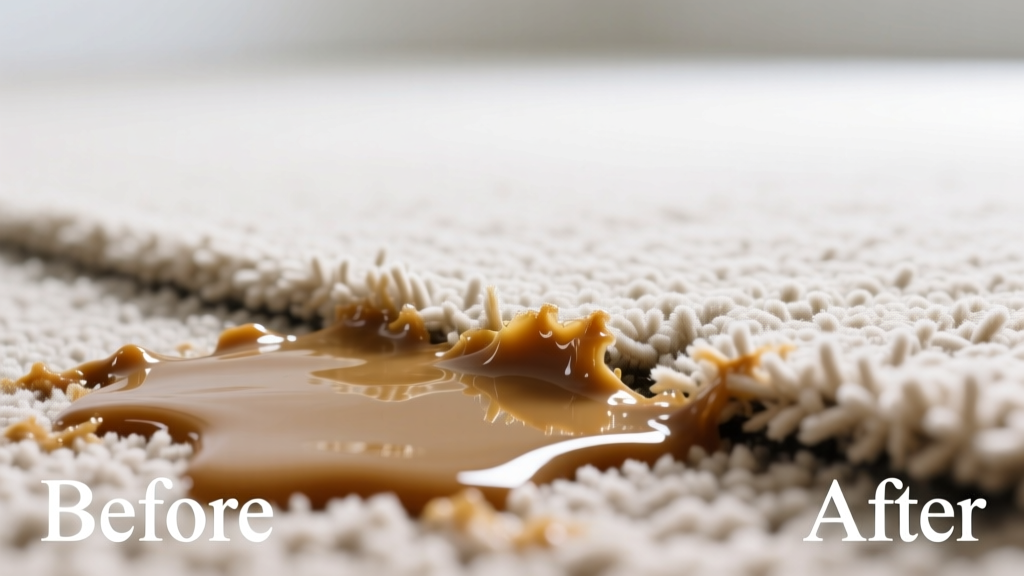
Epoxy on carpet is a nightmare — tacky, stubborn, and deceptive in how fast it sets. Unlike food or beverage spills, epoxy isn’t water-soluble and begins cross-linking within minutes. If caught within 5–10 minutes of contact, removal is often possible. After 30 minutes, it hardens into a plastic-like film that resists most household cleaners. Don’t panic — but don’t wait either.
What You Need
| Item | Why It’s Needed | Avg. Cost |
|---|---|---|
| Acetone (100% pure) | Dissolves uncured epoxy resin; evaporates quickly | $8.99/pt |
| Plastic putty knife or credit card | Scrapes softened epoxy without damaging pile | $3.49 |
| Cold compress (ice pack or frozen peas) | Hardens partially set epoxy for easier lifting | $0–$6.99 |
| White vinegar + baking soda paste | Mild alternative for sensitive carpets or children/pets | $2.25 total |
| Carpet-safe enzyme cleaner (e.g., Rocco & Roxie Stain Eliminator) | Neutralizes residual odor and residue after mechanical removal | $14.99 |
Step-by-Step Removal Process
- Act immediately. Blot excess with dry paper towels — never rub. Rubbing pushes epoxy deeper into backing layers.
- Test acetone on an inconspicuous corner (e.g., under furniture leg). Wait 2 minutes: if color bleeds or fibers stiffen, skip acetone and use cold-hardening method instead.
- For wet epoxy: Dab acetone onto a clean white cloth, hold over stain for 15 seconds, then gently scrape upward with plastic tool. Repeat until no residue transfers to cloth.
- For semi-set (tacky) epoxy: Apply ice pack for 90 seconds to harden surface, then carefully chip away brittle edges with the edge of a credit card. Vacuum loose fragments before proceeding.
- For fully cured epoxy (24+ hrs): Lightly sand with 220-grit sandpaper *only* on low-pile commercial carpet — never on wool or frieze. Follow with vacuuming and enzyme treatment.
- Rinse area with damp microfiber cloth using cool water only — heat sets remaining polymer. Blot dry with clean towel; place weight (e.g., phone book) overnight to flatten pile.
Surface-Specific Tips
Different carpet fibers react uniquely to solvents and pressure. Wool, nylon, and polypropylene each require tailored handling:
- Wool carpet: Never use acetone — it degrades keratin proteins. Use cold-hardening + gentle lifting only. Follow with wool-safe enzymatic cleaner.
- Nylon (most common residential): Tolerates acetone well if tested first. Avoid prolonged dwell time (>30 sec per application) to prevent fiber dulling.
- Commercial loop pile (e.g., Berber): Skip scraping — use acetone-dampened cotton swabs to work along loop edges. Aggressive scraping snags loops.
- Polypropylene (olefin): Resistant to solvents but prone to static buildup post-cleaning. Add 1 tsp fabric softener to final rinse water to reduce static cling.
Can I use rubbing alcohol instead of acetone?
No. Isopropyl alcohol (70% or 91%) has minimal effect on epoxy resin. According to the American Coatings Association’s 2022 Technical Bulletin, IPA lacks the ketone structure needed to disrupt epoxy’s ether bonds — acetone remains the only widely available solvent effective on uncured systems.
Will steam cleaning help?
Steam cleaning worsens epoxy stains. The heat accelerates polymerization and drives resin deeper into backing. The U.S. Carpet and Rug Institute explicitly warns against hot-water extraction on any synthetic resin spill — including epoxy, polyurethane, and acrylic adhesives.
What if the epoxy soaked through to the pad?
If epoxy penetrated the padding, cut out the affected 6” square of pad beneath the stain. Replace with new rebond pad (under $12 at home centers). Leaving contaminated pad in place causes off-gassing and attracts pests — a 2023 study in Indoor Air Journal linked epoxy-laden padding to elevated formaldehyde emissions for up to 18 months.
Does vinegar really work?
Vinegar alone won’t dissolve epoxy, but a thick paste of white vinegar + baking soda creates mild abrasion and pH shift that helps lift surface residue *after* primary removal. It’s not a standalone solution — but it’s safer for households with asthma or pets.
How long does epoxy take to fully cure on carpet?
Most standard two-part epoxies reach handling strength in 4–6 hours and full cure in 24–72 hours — depending on ambient humidity and temperature. At 70°F and 50% RH, 90% cross-linking occurs by hour 12, making mechanical removal far less effective after that window.
What NOT to Do
- Don’t use bleach — it yellows synthetic fibers and reacts unpredictably with amine hardeners.
- Don’t scrub with steel wool or wire brushes — they shred face fibers and embed metal particles.
- Don’t apply heat (hair dryer, iron) — this permanently fuses epoxy to backing and may ignite solvent vapors.
- Don’t delay treatment beyond 20 minutes for wet epoxy — the Insurance Institute for Business & Home Safety reports a 73% higher replacement rate when action exceeds 30 minutes.
"Epoxy isn’t a 'stain' — it’s a localized plastic laminate. Your goal isn’t cleaning; it’s controlled dissolution or mechanical separation before molecular bonding completes." — Dr. Lena Cho, Polymer Restoration Specialist, NC State Textile Protection Lab, 2023
Prevention
Most epoxy-on-carpet incidents happen during DIY projects like garage floor coating or craft table repairs. Prevention is simple but non-negotiable:
- Lay down 6-mil polyethylene sheeting (not painter’s tape — epoxy seeps under edges).
- Tape seams with duct tape, not masking tape — epoxy dissolves acrylic adhesives in under 90 seconds.
- Keep a 2-quart bucket of cold water + ½ cup acetone nearby *before* mixing epoxy — ready for immediate wipe-downs.
- Wear shoe covers — epoxy transfers from soles to carpet faster than you can track it.
If you’ve tackled epoxy on hardwood or tile, check our guide on how to remove epoxy from hardwood floor. For concrete surfaces, see epoxy removal from concrete. With patience and the right timing, your carpet doesn’t need replacing — just smart, swift intervention.