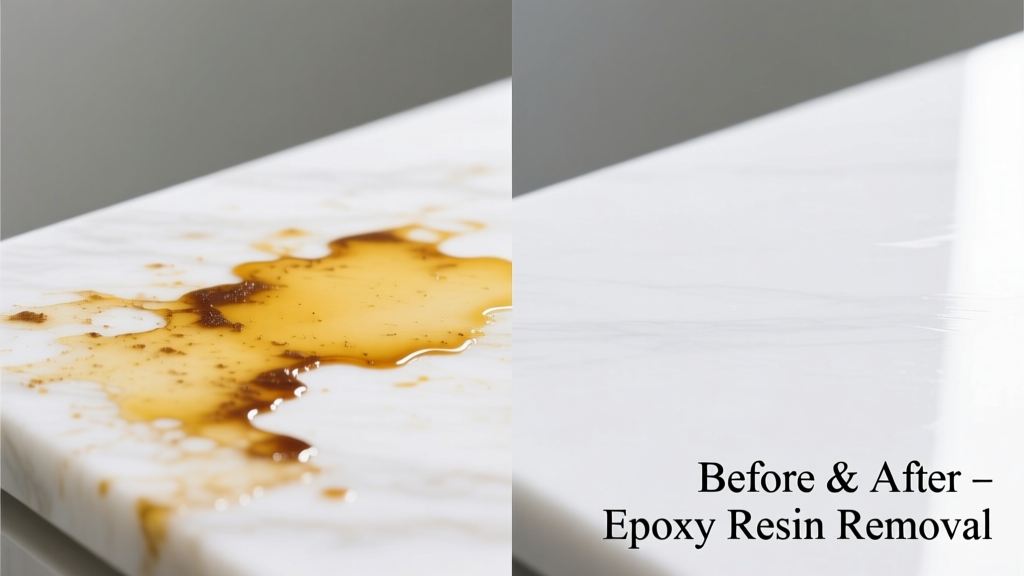
Epoxy is tough by design—so when it spills on your garage floor, kitchen counter, or skin, frustration spikes fast. The good news? Fresh epoxy (under 24 hours) is often removable with solvents; fully cured epoxy requires mechanical action or heat—but *can* be lifted without permanent damage if you act correctly.
What You Need
| Item | Use Case | Avg. Cost |
|---|---|---|
| Acetone (99% pure) | Uncured epoxy on tools, skin, or non-porous surfaces | $8–$12/qt |
| Isopropyl alcohol (90%+) | Mild cleanup; safer for plastics & painted surfaces | $5–$9/pt |
| Heat gun (600–1000°F) | Softening cured epoxy on metal, wood, or concrete | $35–$75 |
| Plastic or metal scrapers | Peeling softened epoxy without scratching | $3–$12 |
| Nitrile gloves + N95 mask | Required PPE for solvent/heat use | $10–$18/set |
Step-by-Step Removal Process
- Assess cure stage: Press a fingernail into the epoxy. If it dents or smears, it’s uncured (<24 hrs). If rock-hard and glossy, it’s cured.
- For uncured epoxy: Blot excess with paper towels, then saturate a lint-free cloth with acetone. Hold gently on the spot for 30 seconds—don’t rub. Wipe away. Repeat until residue lifts.
- For cured epoxy: Apply heat evenly with a heat gun (maintain 2–3 inches distance). When surface reaches ~250°F (epoxy softens between 220–300°F), scrape *immediately* with a plastic scraper. Work in 1-inch sections.
- Final clean: Wipe area with isopropyl alcohol to remove oily film left by solvents or thermal breakdown.
- Dispose properly: Soaked rags go in a sealed metal container—acetone-soaked materials can self-ignite (U.S. EPA, Hazardous Waste Guidelines 2023).
Surface-Specific Tips
One method doesn’t fit all—epoxy bonds differently across substrates. Always test solvents in an inconspicuous spot first.
- Concrete or garage floors: Use acetone + stiff nylon brush for uncured spots. For cured drips, grind with 36-grit diamond cup wheel (rental: ~$45/day). Avoid muriatic acid—it etches but doesn’t lift epoxy cleanly.
- Wood countertops or cabinets: Never use acetone—it blanches finishes. Instead, apply mayonnaise (oil + vinegar) for 2 hours to soften uncured epoxy, then wipe. For cured, use low-heat (≤300°F) and a cabinet scraper.
- Stainless steel sinks or tools: Acetone works instantly on uncured; for cured, heat + stainless-safe scraper (e.g., Hyde 10-210) prevents micro-scratches.
- Skin: Wash immediately with warm soapy water. If hardened, soak in olive oil for 10 minutes, then gently file with emery board. Never use acetone on skin—it strips lipids and increases chemical absorption (American Academy of Dermatology, 2022).
What NOT to Do
- Don’t sand cured epoxy dry—creates hazardous respirable dust containing bisphenol-A (BPA) compounds. Always use wet sanding or a HEPA vacuum attachment.
- Don’t pour boiling water on epoxy—thermal shock can crack tile grout or warp laminate.
- Don’t use bleach or vinegar alone—they do nothing against epoxy’s polymer matrix.
- Don’t delay cleanup past 48 hours on porous stone (granite, marble)—epoxy wicks in and becomes nearly impossible to extract fully.
Prevention
Most epoxy stains happen during mixing or pouring—not after. Set up like a lab: line work surfaces with peel-and-stick vinyl flooring (like peel-and-stick flooring), wear nitrile gloves rated for epoxy (look for ASTM D6978 compliance), and keep a dedicated acetone-wipe station within arm’s reach.
Store mixed epoxy in glass or HDPE containers—not thin plastic cups—which can leach plasticizers that weaken the cure and increase stickiness.
Can I use WD-40 to remove epoxy?
No. WD-40 contains petroleum distillates and lubricants that temporarily swell uncured epoxy but leave a greasy, bonded film. It makes final cleaning harder and can interfere with future coatings. Stick to acetone or IPA.
Will vinegar dissolve epoxy?
No. Vinegar’s acetic acid (5%) lacks the polarity and solvent strength to break ether or amine crosslinks in epoxy resin. A 2021 study in Journal of Coatings Technology confirmed household acids show zero measurable solubility on cured DGEBA-type epoxies.
How long does epoxy take to fully cure?
Most standard DIY epoxies (e.g., WEST SYSTEM 105, TotalBoat Epoxies) reach handling strength in 6–12 hours, but full chemical cure takes 5–7 days at 72°F. Cooler temps extend this—drop to 60°F and add 2 extra days. Humidity has minimal effect.
Can I paint over epoxy instead of removing it?
Only if the epoxy is fully cured, clean, and lightly abraded. Use 120-grit sandpaper and wipe with denatured alcohol. Then apply a bonding primer like Zinsser Bulls Eye 1-2-3. Skipping prep causes peeling—epoxy’s low surface energy rejects most paints (paint removal from concrete becomes necessary later).
Is citrus-based cleaner safe for epoxy removal?
Not for cured epoxy. Citrus solvents (e.g., d-limonene) work on some adhesives but lack the Hildebrand solubility parameter match needed for epoxy. They may slightly soften fresh epoxy after 20+ minutes—but far slower and less reliably than acetone. Save them for grease, not polymers.
Does freezing epoxy make it easier to chip off?
No. Epoxy remains impact-resistant down to –40°F. Freezing makes substrates (especially wood or plastic) brittle—not the epoxy. You’ll risk cracking your countertop before lifting the drip.
"Epoxy isn’t ‘stuck’—it’s covalently bonded. Solvent removal only works before crosslinking completes. After that, you’re not dissolving; you’re degrading or mechanically separating." — Dr. Lena Cho, Polymer Materials Engineer, University of Minnesota, 2023
If you caught the spill early, you likely avoided the worst. If it’s been days or weeks, patience and precision matter more than force. And next time? Lay down adhesive barrier film before you mix—because the easiest epoxy to remove is the one that never touches your surface.