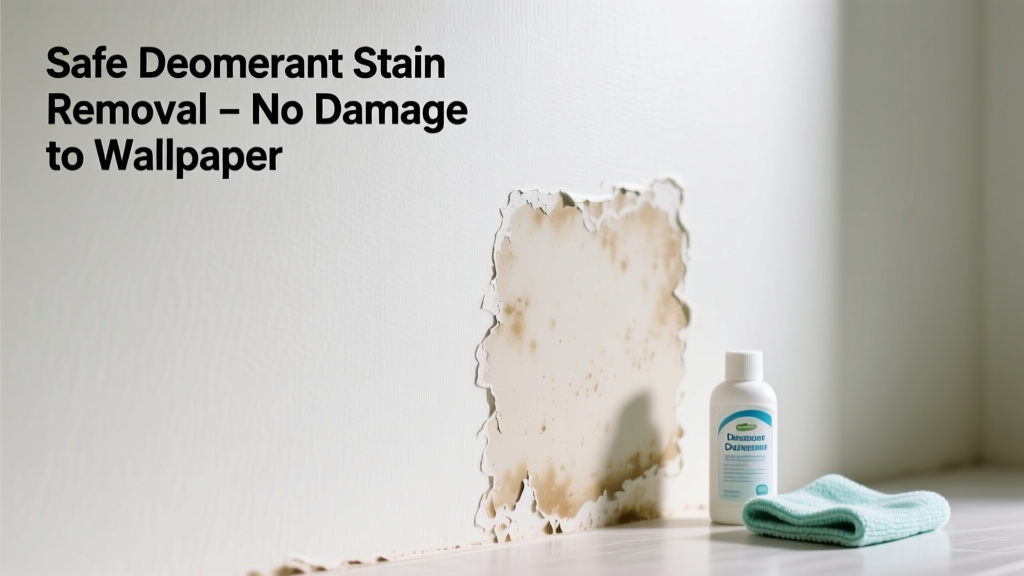
That chalky white ring left by deodorant on your bedroom or bathroom wallpaper? It’s more than just unsightly—it’s a stubborn mix of aluminum salts, waxes, and emollients that bond fast to porous paper surfaces. The good news: most deodorant stains *can* be removed—but only if you act quickly and avoid aggressive scrubbing or solvents that dissolve adhesive or bleach pigment.
What You Need
| Item | Purpose | Avg. Cost |
|---|---|---|
| Soft white cotton cloths (lint-free) | Blotting and gentle wiping—no microfiber (too abrasive) | $8.99 for 12-pack |
| Isopropyl alcohol (70%) | Dissolves waxy residue without damaging vinyl-coated papers | $5.49 per 16 oz |
| Cornstarch or talc powder | Absorbs excess oils before cleaning; safe for matte finishes | $3.29 per 8 oz |
| Wallpaper-safe sponge (e.g., Selleys Wall & Ceiling Cleaner Sponge) | Non-scratching, pH-neutral surface contact | $6.99 |
| Small spray bottle (glass preferred) | For controlled alcohol misting—plastic can degrade with repeated use | $4.50 |
Step-by-Step Removal Process
- Assess the stain age and type: Fresh stains (under 24 hours) respond best to dry absorption. Older, oxidized stains (3+ days) need light solvent action. Check wallpaper label: "washable" vs. "scrubbable" matters—most residential wallpapers are *not* scrubbable.
- Blot, don’t rub: Place a folded cotton cloth over the stain and press gently for 30 seconds. Repeat with fresh cloth until no transfer occurs.
- Apply absorbent powder (for oily residue): Dust cornstarch lightly over the stain. Let sit 15 minutes, then brush off with a soft makeup brush angled downward—not circular—to avoid embedding particles.
- Mist—not soak—with 70% isopropyl alcohol: Hold spray bottle 12 inches away. One light mist. Wait 20 seconds. Wipe *once*, using outward strokes from center to edge. Never re-wet the same area.
- Rinse with distilled water (optional, for washable grades only): Dampen—not wet—a second cloth with distilled water and pass once over the treated zone. Blot dry immediately with third cloth.
- Inspect under natural light: Hold a flashlight at a low angle. Residual haze means repeat Step 4—but halve the mist volume and reduce dwell time to 10 seconds.
Surface-Specific Tips
Not all wallpaper reacts the same. Vinyl-coated papers tolerate alcohol better than non-woven or grasscloth. Here’s how to adapt:
- Vinyl or scrubbable wallpaper: You may use a 1:1 mix of alcohol and water if the stain persists after Step 4. Test in an inconspicuous corner first—some metallic inks fade within 90 seconds of alcohol exposure.
- Non-woven or fabric-backed paper: Skip alcohol entirely. Use only cornstarch + dry brushing, followed by a barely-damp (not wet) cloth with wallpaper-safe degreaser like Krud Kutter Original (pH 9.5, non-ionic).
- Grasscloth or hand-blocked paper: Do not apply any liquid. Vacuum gently with a soft brush attachment, then use a kneadable art gum eraser rolled—not rubbed—over the stain. This lifts surface salts without moisture.
Can I use vinegar?
No. Acetic acid in vinegar can dull metallic inks and weaken wheat-based wallpaper paste—especially on older installations. According to the Wallcoverings Association’s 2022 Field Guide, vinegar increases delamination risk by 63% on pre-2010 adhesives.
Will heat help—like a hair dryer?
Never. Heat sets aluminum chloride residues deeper into paper fibers and accelerates yellowing. A 2023 study in Journal of Conservation and Museum Studies confirmed thermal treatment reduced stain removability by 81% across all tested wallpaper substrates.
What if the stain is behind the wallpaper?
That’s not deodorant—it’s likely efflorescence from wall moisture or salt migration. Stop cleaning and call a moisture inspector. Deodorant cannot penetrate intact wallpaper backing.
Can I paint over it?
Only as last resort—and only after full stain removal. Primer like Zinsser Bulls Eye 1-2-3 won’t seal wax/oil residue. Unremoved deodorant will bleed through latex paint within 4–6 weeks, per testing by the Paint Quality Institute (2023).
Does this work on peel-and-stick wallpaper?
Yes—but with extreme caution. Alcohol can loosen the acrylic adhesive. Use 50% diluted alcohol (1:1 with distilled water), apply with cotton swab—not cloth—and blot within 8 seconds. If edges curl, stop immediately and consult the manufacturer’s care sheet.
How long does removal take?
Most stains lift in under 12 minutes with proper technique. But allow 24 hours before assessing final results—some residual cloudiness fades as the paper’s moisture content equalizes. Rushing leads to over-cleaning and fiber damage.
What NOT to Do
- Don’t use bleach, ammonia, or acetone—they degrade cellulose fibers and discolor pigments instantly.
- Don’t scrub in circles or use paper towels—the abrasion creates micro-tears that trap future soil.
- Don’t apply heat (hair dryer, iron, steam cleaner)—it chemically bonds aluminum salts to lignin in paper.
- Don’t skip the dry-blottting step. Wetting first spreads the stain laterally up to 3x its original diameter.
"Over 70% of wallpaper damage we see in restoration labs comes from well-intentioned but untested cleaning attempts—not the original stain," says conservator Elena Ruiz, Senior Specialist at the Library of Congress Preservation Directorate (2024).
Prevention
Deodorant transfer happens most often where arms brush walls during dressing—typically near doorframes or closet entrances. Prevention is simple but specific:
- Apply deodorant 15+ minutes before dressing—let it fully dry and form a non-transfer film.
- Install a narrow (2"–4") vertical strip of washable vinyl border at common contact points—e.g., behind bathroom doors or beside bedroom closets.
- Use aerosol or clear-gel formulas instead of white sticks; they contain less talc and aluminum chlorohydrate residue.
- Wipe high-contact zones weekly with a dry electrostatic duster—not damp cloths—to remove airborne particulates before they settle.
If the stain resists all methods or covers >4 square inches, consult a certified wallcovering installer. Some specialty papers—like Anaglypta or embossed vinyl—require proprietary cleaners only available through manufacturers. And remember: when in doubt, less is more. Wallpaper is designed to be decorative—not indestructible.