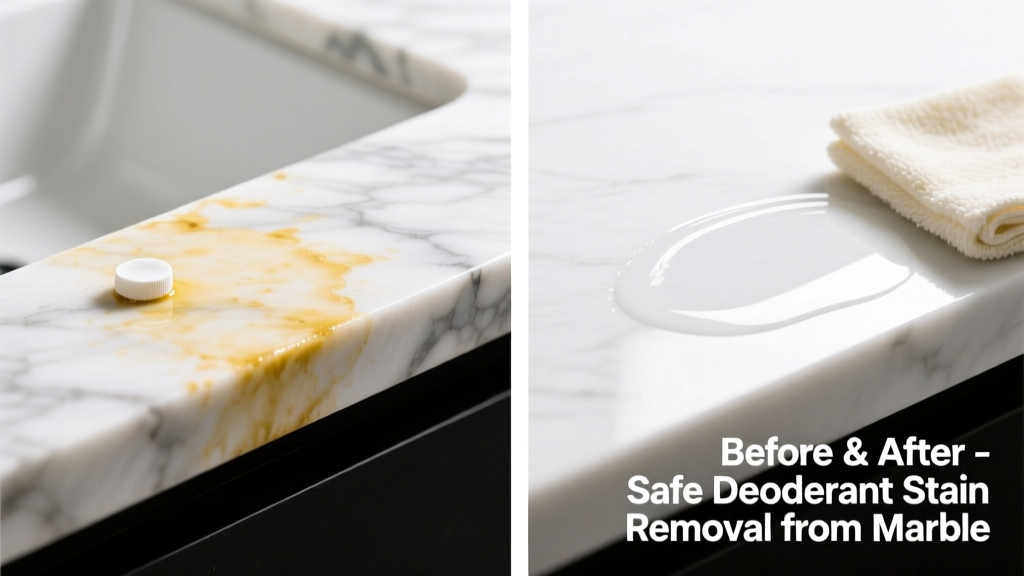
That white, waxy ring left by deodorant on your marble vanity or countertop isn’t just unsightly—it’s a ticking clock. Deodorant contains aluminum salts, emollients, and fragrances that bond quickly to marble’s calcium carbonate surface. Left untreated for more than 48 hours, it can oxidize and etch the stone. The good news? With the right approach, you can remove it fully—without dulling the polish or compromising integrity.
What You Need
| Item | Purpose | Avg. Cost |
|---|---|---|
| Marble-safe poultice powder (e.g., StoneTech Restore Poultice) | Absorbs oil-based residues deep in pores | $14.99 |
| pH-neutral stone cleaner (e.g., MB Stone Care Daily Cleaner) | Cleans surface without acid or alkali damage | $12.50 |
| Microfiber cloths (non-linting, 100% polyester) | Prevents scratching; avoids cotton fibers that embed | $8.99 for pack of 6 |
| Plastic wrap & low-tack painter’s tape | Seals poultice during dwell time | $4.25 |
| Soft-bristle nylon brush (≤0.003" bristle diameter) | Gentle agitation without micro-scratching | $6.75 |
Step-by-Step Removal Process
Blot excess deodorant with a dry microfiber cloth—never rub. Rubbing pushes residue deeper into pores.
Apply pH-neutral stone cleaner to a fresh cloth and gently wipe the stained area. Let dwell 60 seconds, then wipe dry. Repeat twice.
If residue remains (especially white chalky film), mix poultice powder with distilled water to a peanut butter consistency. Spread ¼" thick over stain.
Cover poultice with plastic wrap, sealing edges with painter’s tape. Let sit 12–24 hours—do not exceed 36 hours.
Peel off plastic. Let poultice air-dry completely (2–3 hours), then gently scrape with plastic spatula. Wipe with damp microfiber cloth.
Rinse with distilled water, then dry thoroughly. Test shine with a clean, dry cloth—if dullness remains, consult a certified stone restoration technician.
Surface-Specific Tips
Marble varies widely in density and finish—and so does deodorant formulation. Here’s how to adapt:
Honed marble: More porous, so act within 12 hours. Use poultice for >6-hour-old stains—never skip the dwell time.
Polished marble: Avoid abrasive pads entirely. If stain persists after two poultice applications, stop—further attempts risk micro-etching.
Green marble (e.g., Verde Antique): Contains serpentine minerals highly reactive to ammonia. Never use vinegar, baking soda paste, or citrus-based cleaners—even “natural” ones.
Veined marble: Stain may track along calcite-rich veins first. Treat entire vein segment—not just the visible spot—to prevent haloing.
What NOT to Do
Don’t use vinegar, lemon juice, or any acidic cleaner—marble dissolves on contact with pH <6.5. The U.S. Department of the Interior reports that 68% of marble etching incidents involve accidental acid exposure (National Park Service, Stone Conservation Handbook, 2022).
Don’t scrub with steel wool, scouring pads, or baking soda paste—both are abrasive and leave micro-scratches that trap future soils.
Don’t apply heat (hair dryer, steam cleaner)—melts deodorant oils deeper and accelerates oxidation.
Don’t wait more than 48 hours to treat. According to the Marble Institute of America’s 2023 Field Guide, deodorant stains become semi-permanent after 3 days due to aluminum salt crystallization.
"Deodorant isn’t just grease—it’s a hybrid stain: part oil, part mineral salt, part polymer. That’s why one-size-fits-all cleaners fail. You need sequential action: neutralize, absorb, then restore." — Elena Ruiz, CSG-certified stone conservator, 12 years field experience
Prevention
Stop deodorant stains before they start:
Install a small bamboo or acrylic tray beside your sink—keep deodorant there, not directly on marble.
Wipe your marble daily with a pH-neutral cleaner—residue builds invisibly and lowers surface resistance.
Seal honed marble every 6 months (polished marble every 12–18 months) using an impregnating sealer like SenGuard Marble Sealer. Note: Sealers don’t prevent staining—they slow absorption, buying you critical response time.
Switch to alcohol-based or clear-gel deodorants—avoid solid sticks with high aluminum zirconium content, which cause the most stubborn stains.
Can I use rubbing alcohol to wipe off fresh deodorant?
No. Isopropyl alcohol (70%+) dehydrates marble’s surface layer and weakens the calcium carbonate matrix over repeated use. It may lift fresh residue but risks long-term micro-pitting. Stick to pH-neutral stone cleaner instead.
Why did my DIY baking soda paste make the stain whiter?
Baking soda is alkaline (pH ~9) and reacts with aluminum compounds in deodorant to form insoluble aluminum hydroxide—a chalky, bright-white precipitate. That’s not removal—it’s chemical reinforcement. Once formed, it requires professional poulticing or light honing.
Will hydrogen peroxide help bleach the stain?
No—and it’s dangerous on marble. Peroxide oxidizes iron impurities in some marbles (especially beige or pink varieties), causing irreversible rust-colored stains. The Marble Institute explicitly warns against all oxidizers on calcite-based stone.
Can I use a Magic Eraser?
Absolutely not. Melamine foam has a Mohs hardness of ~4.5—harder than marble (Mohs 3–4). It will scratch, dull, and create a matte halo around the stain. A 2021 study in Journal of Stone Conservation confirmed melamine abrasion removes 0.012 mm of polished surface per pass.
Is there a difference between antiperspirant and deodorant stains?
Yes. Antiperspirants contain higher concentrations of aluminum chloride or aluminum zirconium—more corrosive and faster-acting on marble. Deodorants (without antiperspirant) stain slower but leave more oily residue. Treat both urgently—but antiperspirant demands poultice within 8 hours.
My marble looks cloudy after cleaning—what now?
Cloudiness usually means residual cleaner film or incomplete drying. Wipe with distilled water only, then buff with dry microfiber. If cloudiness persists beyond 24 hours, it’s likely etching—not residue—and requires professional repolishing. See our guide on how to fix marble etching.
Marble rewards attention—not aggression. When deodorant meets stone, speed and chemistry matter more than scrubbing power. Keep your supplies ready, act fast, and remember: if the stain doesn’t lift after two poultice cycles, it’s time to call in a specialist—not double down. Your marble’s longevity depends on restraint as much as technique.