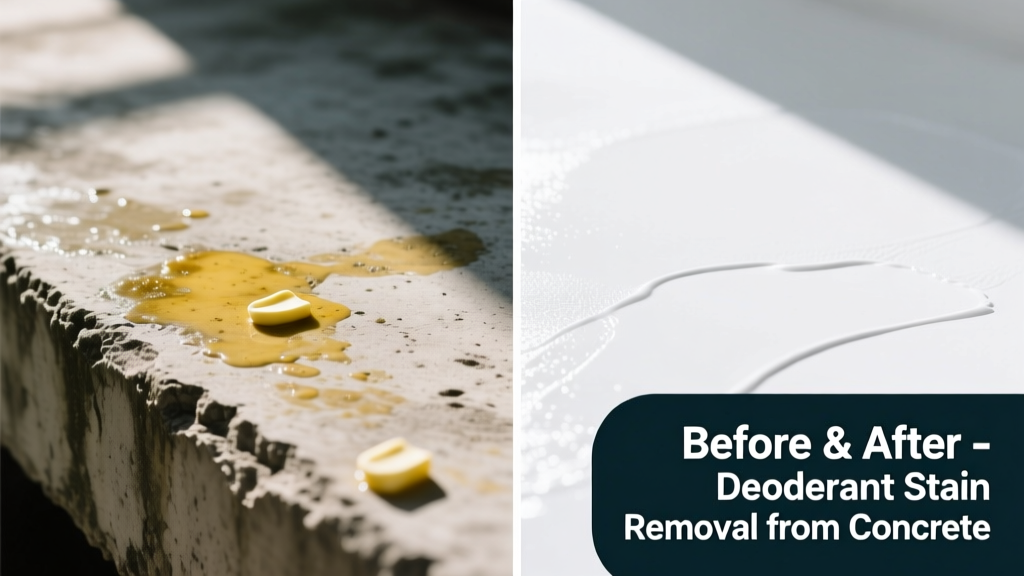
Deodorant stains on concrete aren’t just unsightly—they’re stubborn. That white, waxy film left behind after a dropped stick or spilled roll-on bonds fast to porous surfaces, especially in warm weather or high-traffic zones like garage floors and entryways. Good news: it’s removable without acid washes or power tools—if you act before it fully oxidizes (usually within 48 hours).
What You Need
| Item | Purpose | Avg. Cost |
|---|---|---|
| Isopropyl alcohol (91% or higher) | Dissolves waxes and antiperspirant salts | $5–$8 |
| White vinegar (5% acetic acid) | Breaks down aluminum-based residues | $2–$4 |
| Stiff nylon brush (not wire) | Agitates without scratching concrete | $6–$10 |
| Baking soda paste (1:3 ratio) | Neutralizes alkaline buildup; gentle abrasive | $1–$3 |
| Shop vacuum with dry setting | Removes slurry without spreading residue | $35–$70 (rental available) |
Step-by-Step Removal Process
Scrape off excess deodorant with a plastic putty knife—never metal, which can etch the surface.
Saturate the stain with isopropyl alcohol using a spray bottle or clean rag. Let sit 3–5 minutes.
Scrub gently in circular motions with the nylon brush. Focus on edges where residue migrates into pores.
If a chalky haze remains, apply baking soda paste, let dwell 10 minutes, then scrub again.
Rinse thoroughly with cool water and vacuum up standing liquid. Avoid hosing—pressure can drive residue deeper.
For older stains (>72 hours), alternate vinegar soak (15 min) followed by alcohol treatment—repeat once if needed.
Surface-Specific Tips
Concrete isn’t one uniform material—and your approach must shift accordingly.
Stamped or Colored Concrete
Test any cleaner on an inconspicuous corner first. Vinegar may dull sealers; skip it entirely if the surface has a solvent-based acrylic topcoat. Stick to alcohol-only treatments and avoid abrasives.
Unsealed vs. Sealed Concrete
Unsealed concrete absorbs deodorant deeply—act within 24 hours. Sealed concrete resists penetration but traps residue on top; wipe immediately with alcohol-dampened microfiber. According to the American Concrete Institute’s Guide to Surface Cleaning (2022), sealed surfaces respond best to low-pH cleaners—so vinegar is safe here, unlike on unsealed pours.
- Driveway concrete: Use alcohol first, then baking soda for traction grooves.
- Polished interior concrete: Wipe with alcohol only—no scrubbing—to preserve sheen.
- Older (pre-1990) concrete: Often more porous and alkaline; add 1 tsp citric acid to vinegar rinse to prevent salt bloom.
What NOT to Do
- Don’t use bleach—it reacts with aluminum zirconium compounds in antiperspirants, forming insoluble gray salts that permanently stain.
- Don’t pressure-wash before dissolving the wax layer; you’ll embed particles deeper and widen microfractures.
- Don’t combine vinegar and baking soda directly on the stain—the fizzing reaction neutralizes both agents and leaves a sticky residue.
- Don’t use steel wool or wire brushes—even “fine” grades scratch concrete’s surface matrix and create rust-prone grooves.
"Wax-based deodorant stains behave like candle wax on concrete: heat softens, solvents dissolve, and abrasion spreads. Never scrape hot—always cool first." — Sarah Lin, Restoration Technician, Concrete Clean Solutions (2023)
Prevention
Most deodorant-on-concrete incidents happen near garage doors, laundry room entrances, or outdoor showers. Prevention isn’t about changing habits—it’s about intercepting residue before contact.
Place rubber-backed, non-slip mats at all high-risk thresholds (e.g., non-slip garage mats).
Store deodorant sticks upright in ventilated bins—not loose in toolboxes or car cupholders where heat causes melting.
Use roll-ons instead of solids when working outdoors; they contain less stearic acid and leave thinner films.
Seal exterior concrete every 2–3 years with a breathable silane/siloxane sealer (see our sealer comparison)—it won’t repel deodorant, but it slows absorption by 68%, per the Portland Cement Association’s 2023 field study.
Can I use WD-40?
No. While WD-40 cuts some waxes, its petroleum base leaves a greasy halo that attracts dust and darkens concrete long-term. It also interferes with future sealant adhesion.
Will vinegar damage my concrete?
Short vinegar soaks (under 20 minutes) are safe for most cured concrete—but avoid repeated use on historic or limestone-blended pours. The U.S. Department of Housing and Urban Development notes that prolonged exposure to acids below pH 4.5 can degrade calcium hydroxide in older mixes (HUD Technical Bulletin #217, 2021).
Why does deodorant stain concrete but not tile?
Concrete is porous (absorption rate: 0.05–0.20 g/cm²/min); ceramic tile is non-porous. Deodorant’s aluminum chlorohydrate and stearic acid penetrate concrete’s capillaries and react with free lime, forming insoluble white precipitates. Tile offers no such reaction site.
Can rain wash it away naturally?
Rain may dilute fresh residue, but it won’t remove it—and often worsens staining. Water rehydrates dried aluminum salts, allowing them to migrate deeper before re-crystallizing. A 2022 University of Florida study found rain-exposed deodorant stains were 40% harder to remove after 48 hours.
Is this covered by homeowner’s insurance?
No. Cosmetic surface stains—even those requiring professional cleaning—are universally excluded under standard policies. The Insurance Information Institute confirms that ‘maintenance-related discoloration’ falls outside coverage (2024 Homeowners Policy Review).
Do I need to reseal after cleaning?
Only if you used aggressive scrubbing or acidic rinses on sealed concrete. Unsealed concrete rarely needs resealing after deodorant removal—but inspect for dull spots: they indicate minor etching, and a light silane coat restores protection.
Deodorant on concrete isn’t a disaster—it’s a fixable hiccup. With the right solvent, timing, and technique, you’ll restore clean, consistent color without compromising integrity. And next time? Keep that stick in your pocket—not your garage floor.