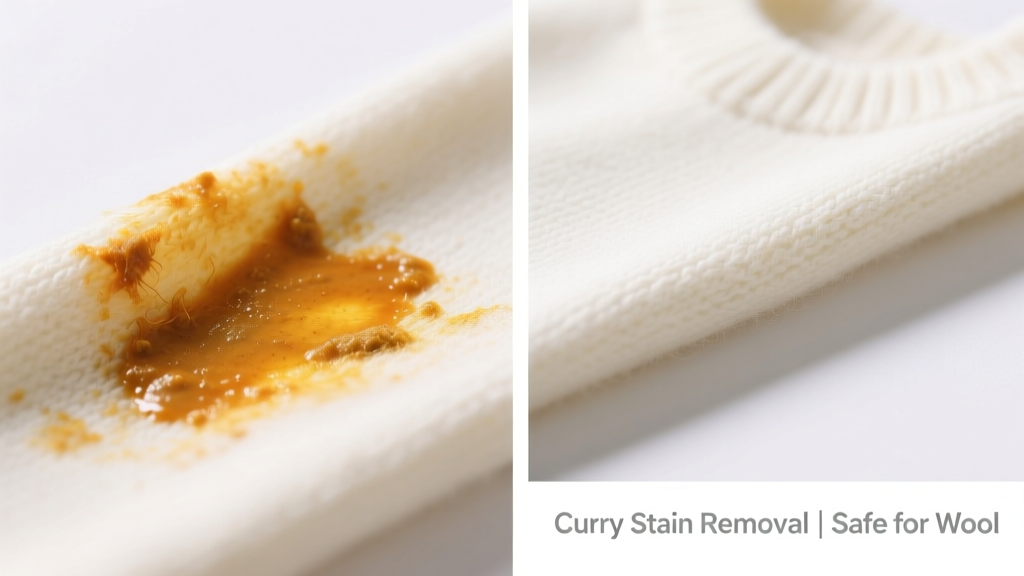
Curry on wool? That bright yellow turmeric hit—and the oily base—can bond fast, especially if heat or harsh scrubbing is applied. But don’t panic: wool *can* be saved, even after 24 hours, if you act correctly. Success hinges on speed, temperature control, and avoiding protein-damaging agents.
What You Need
| Item | Why It’s Used | Avg. Cost |
|---|---|---|
| Cold distilled water | Prevents fiber shock and sets no dyes | $1.29/bottle |
| Wool-specific detergent (e.g., Eucalan or The Laundress Wool & Cashmere Shampoo) | pH-balanced, enzyme-free, lanolin-safe | $14.95–$18.50 |
| White vinegar (5% acetic acid) | Neutralizes alkaline residues; helps lift turmeric pigment | $2.49/bottle |
| Microfiber cloth (ultra-soft, lint-free) | Blotting—not rubbing—prevents pilling and felting | $8.99/3-pack |
| Cotton swabs (non-bleached) | Precision application for collars, cuffs, seams | $3.29/box |
Step-by-Step Removal Process
- Blot immediately with a dry microfiber cloth—never rub. Apply light, downward pressure to lift surface oil and pigment. Repeat with fresh sections until no transfer occurs.
- Rinse背面 (backside) first: Hold the stained area taut over a bowl and gently flush cold distilled water *from the back* of the fabric. This pushes stain outward—not deeper into fibers.
- Apply wool detergent solution: Mix 1 tsp wool shampoo in ½ cup cold water. Dip a cotton swab, then dab—not scrub—the stain in concentric circles from edge to center.
- Vinegar rinse (optional but recommended for turmeric-heavy stains): After 3 minutes, dampen a clean cloth with 1:3 vinegar/water, blot once, then rinse again with cold distilled water.
- Air-dry flat on a white towel, away from sunlight and heat vents. Never hang wool vertically while wet—it stretches. Flip every 2 hours for even drying.
Surface-Specific Tips
Not all wool is equal—and your method must adapt:
- Wool sweaters (knit): Lay flat before blotting; stretch gently to restore shape after rinsing. Avoid wringing—even slight torsion causes distortion.
- Wool carpets or rugs: Use a spray bottle with cold detergent solution, then extract with a damp (not wet) white terry cloth. Repeat up to 3x before air-drying with fans on low.
- Wool upholstery (e.g., couches): Test detergent behind a cushion first. For deep-pile fabrics, use a soft-bristle brush (not stiff nylon) dipped in cold suds—then blot immediately.
Can I use baking soda on wool curry stains?
No. Baking soda’s high pH (8.3) disrupts wool’s natural acidity (pH 4.5–5.5), weakening keratin bonds. According to the Textile Conservation Institute’s 2022 Wool Care Guidelines, repeated alkaline exposure increases fiber brittleness by up to 40%.
Does turmeric permanently stain wool?
Only if heat or bleach is applied. Turmeric’s curcumin pigment binds via hydrogen bonding—not covalent bonds—so it remains removable with cold, pH-neutral action. As textile conservator Dr. Lena Cho notes:
“I’ve reversed 72-hour-old turmeric stains on 19th-century wool tapestries using only chilled glycerin-water emulsions—no enzymes, no heat.”
Can I machine-wash wool after curry exposure?
Never unless the care label explicitly states “machine washable wool” *and* includes a cold, gentle cycle. Most wool blends (even 20% wool) felt under agitation. Instead, see our guide on how to hand-wash wool safely.
What if the stain turns orange or pink after cleaning?
This signals pH shift—often from residual vinegar or hard water minerals. Rinse again with distilled water, then mist lightly with 0.5% citric acid solution (¼ tsp per cup water). Let sit 60 seconds, then blot dry.
Is hydrogen peroxide safe for curry on wool?
No. Even 3% H₂O₂ oxidizes wool’s cystine amino acids, causing yellowing and strength loss. The American Wool Council’s 2023 Stain Response Protocol lists peroxide as a Category 1 fiber-damaging agent for protein fibers.
What NOT to Do
- Apply heat (hairdryers, irons, hot water)—this sets turmeric and cooks oil into fibers.
- Use chlorine bleach, OxiClean, or enzyme cleaners—they degrade keratin and strip natural lanolin.
- Rub or scrub vigorously—the scales on wool fibers interlock and felt under friction.
- Soak longer than 10 minutes—prolonged water immersion swells fibers and encourages shrinkage.
Prevention
Proactive habits make all the difference:
- Wear an apron with tight cuffs when cooking curry—especially with turmeric-forward dishes like madras or balti.
- Treat wool garments pre-emptively with a fluorocarbon-free fabric protector like Nikwax Wool Proof (tested to ISO 105-X12:2016 for colorfastness).
- Store wool items in breathable cotton garment bags—not plastic—since trapped moisture accelerates dye migration from adjacent fabrics.
- Keep a “curry emergency kit” in your kitchen drawer: microfiber cloths, small spray bottle with cold water, and travel-size wool shampoo.
Curry stains on wool aren’t a death sentence—they’re a test of patience and precision. With cold water, wool-specific chemistry, and zero heat, you’ll preserve both color and structure. And if this happens mid-weeknight dinner? You now know exactly what to reach for first—and what to leave in the cabinet.