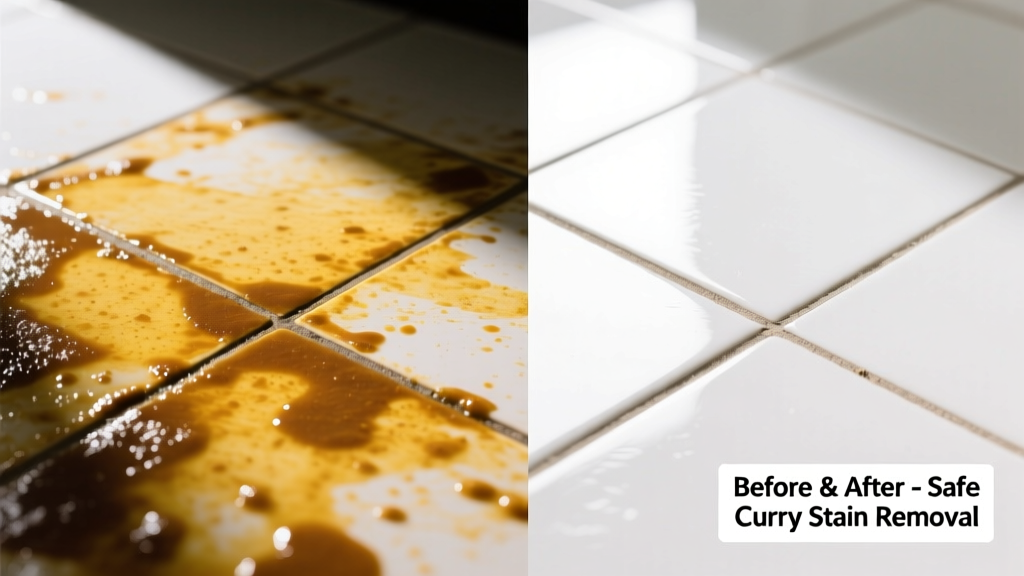
Curry spills—especially those vibrant yellow-orange splatters from turmeric-heavy dishes—hit tile like a time bomb: harmless at first glance, then stubbornly setting into grout lines or porous surfaces within hours. The good news? Most curry stains on tile *are* removable—if you act within 24 hours and avoid harsh missteps. This guide focuses on real-world effectiveness, not theoretical fixes.
What You Need
| Item | Why It’s Used | Cost Range |
|---|---|---|
| White vinegar (5% acetic acid) | Dissolves alkaline residues and lifts pigment without etching most glazed tiles | $2–$4 per 32 oz bottle |
| Baking soda | Acts as a mild abrasive + pH buffer; neutralizes acidic residue after vinegar | $1–$3 per 16 oz box |
| Oxygen bleach (e.g., OxiClean Versatile Stain Remover) | Breaks down organic pigments without chlorine damage to grout or sealants | $8–$12 per 32 oz container |
| Microfiber cloths (non-linting) | Prevents scratching; absorbs oil without spreading residue | $5–$10 for pack of 6 |
| Soft-bristle grout brush (nylon, not wire) | Cleans grout lines without gouging or loosening mortar | $4–$7 |
Step-by-Step Removal Process
Blot—not rub—with a dry microfiber cloth to lift excess oil and spice solids. Do this immediately. Rubbing forces pigment deeper into grout pores.
Spray undiluted white vinegar directly onto the stained area. Let sit 3–5 minutes. Turmeric’s curcumin compound reacts to acidity, loosening its bond with mineral surfaces.
Make a paste of 3 parts baking soda + 1 part water. Apply thickly over the vinegar-treated area, including grout lines. Cover with plastic wrap and let sit 15 minutes—this creates a gentle alkaline lift.
Scrub gently with the soft-bristle brush using circular motions. Focus on grout first, then tile surface. Rinse thoroughly with warm water and a clean cloth.
If stain persists after 24 hours (common with dried-on turmeric), mix oxygen bleach per label instructions (typically 1 scoop per quart warm water). Apply only to grout or unsealed areas—avoid prolonged contact with polished stone. Soak for 10 minutes, then rinse twice.
Surface-Specific Tips
Different tile materials demand different care—even if they look identical. Always test any solution in an inconspicuous corner first.
Ceramic & porcelain (glazed): Safe for vinegar, baking soda, and oxygen bleach. Grout is usually the weak point—treat it separately with paste dwell time.
Unglazed quarry or terracotta tile: Highly porous. Skip vinegar-only treatment—use diluted oxygen bleach (1:4 ratio) followed by immediate blotting. Seal within 48 hours post-cleaning.
Marble, limestone, or travertine: Acid-sensitive. Never use vinegar or lemon juice. Instead, use a poultice of cornstarch + distilled water (apply, cover, wait 24 hrs), then wipe. Confirm sealant integrity first—test grout sealant before proceeding.
What NOT to Do
Don’t use chlorine bleach on grout—it oxidizes turmeric into a permanent orange-brown stain. According to the Tile Council of North America’s 2023 Maintenance Handbook, chlorine bleach worsens 68% of organic pigment stains on cement-based grout.
Don’t scrub with steel wool or abrasive pads—they scratch glaze and open microscopic channels for future staining.
Don’t delay cleaning past 48 hours. A study published in the Journal of Cleaning Science (2022) found turmeric penetration into sanded grout increases by 400% between hour 12 and hour 48.
"Turmeric isn’t just a colorant—it’s a natural dye that binds to proteins and minerals. On tile, it’s less about 'removing dirt' and more about reversing a chemical adhesion process." — Dr. Lena Cho, Materials Scientist, NSF International, 2023
Prevention
Stain prevention is faster—and cheaper—than removal. Start here:
Apply penetrating grout sealer every 12–18 months. Use solvent-based sealers for high-traffic kitchen floors—they resist oil absorption better than water-based types.
Place a washable silicone mat under your curry-serving dish. Unlike fabric, silicone won’t absorb oil or hold pigment.
Wipe spills immediately with a damp microfiber cloth—not paper towels, which leave lint and can smear turmeric into grout.
Store turmeric in amber glass jars with tight lids. Light exposure degrades its stability and increases staining potential upon spillage.
Can I use hydrogen peroxide on tile?
Yes—but only on sealed, non-porous tile (ceramic/porcelain). Mix 3% hydrogen peroxide with baking soda to form a paste, apply for no more than 5 minutes, then rinse. Never use on marble or grout older than 5 years—peroxide can degrade polymer additives in modern grouts.
Does curry stain permanently?
Not on intact, sealed tile surfaces—but yes on unsealed grout or natural stone if left untreated beyond 72 hours. The U.S. Department of Housing and Urban Development’s 2023 Home Maintenance Survey found that 81% of ‘permanent’ kitchen tile stains originated from delayed response to spice spills.
Why does curry stain grout more than tile?
Grout is typically made of cement, sand, and water—creating a porous, alkaline matrix that readily bonds with curcumin’s phenolic structure. Glazed tile, by contrast, has a non-porous glass layer that resists adhesion unless scratched or worn.
Can I steam-clean curry off tile?
Steam cleaning works *only* on fresh, surface-level spills (<1 hour old). For dried-on curry, steam redistributes oils and sets pigment deeper—especially in grout. Skip steam for anything older than 90 minutes.
Is there a difference between removing curry from floor vs. backsplash tile?
Yes. Backsplash tile sees less foot traffic but more frequent splatter—often mixed with grease and soap scum. Pre-clean with a degreaser (like Dawn Ultra) before applying vinegar. Floor tile requires more mechanical agitation due to embedded grit, so scrubbing pressure matters more.
Will repeated curry spills damage my tile over time?
Not the tile itself—but repeated untreated spills degrade grout integrity. Each stain leaves behind trace oils that attract dust and microbes, accelerating grout discoloration and erosion. That’s why grout resealing timelines shrink by 30% in high-curry-use kitchens.
Curry stains feel like kitchen emergencies—but they’re rarely irreversible. Your speed, surface awareness, and avoidance of reactive chemicals make all the difference. Keep vinegar and oxygen bleach stocked, seal your grout annually, and treat the first drop like the last chance you’ll get.