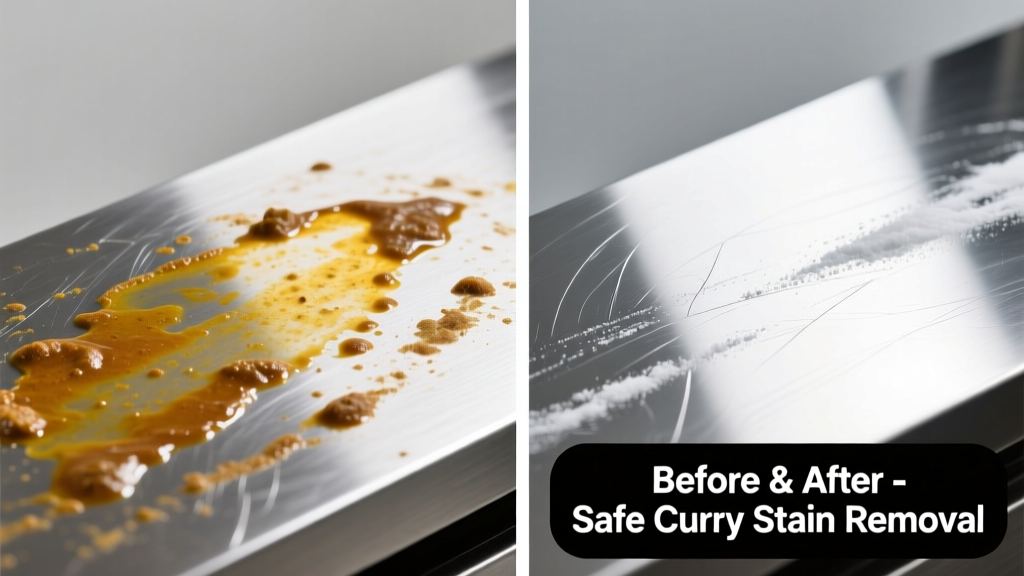
That bright yellow-orange smear left by a dropped curry spoon or splattered dal isn’t just unsightly—it’s stubborn. Turmeric’s curcumin binds aggressively to metal surfaces, and the oils in coconut milk or ghee help it set deep into microscopic grooves. The good news? With the right tools and timing, most fresh and even day-old curry stains lift cleanly—no scrubbing damage required.
What You Need
| Item | Why It Works | Avg. Cost |
|---|---|---|
| White vinegar (5% acetic acid) | Dissolves alkaline residues and breaks down curcumin’s pH-sensitive bonds | $2.99 per 32 oz |
| Baking soda (sodium bicarbonate) | Mild abrasive + alkaline neutralizer for acidic turmeric residue | $1.49 per 16 oz |
| Microfiber cloths (non-linting) | Prevents micro-scratches; avoids redistributing pigment | $8.99 for pack of 6 |
| Bar Keepers Friend Cooktop Cleaner | Oxalic acid safely chelates iron-bound curcumin without damaging SS grain | $7.49 per 12 oz tube |
| Isopropyl alcohol (70% or higher) | Breaks down oil carriers without corroding stainless steel | $4.29 per 16 oz |
Step-by-Step Removal Process
- Blot, don’t wipe: Use a dry microfiber cloth to gently lift excess curry—never rub, which pushes pigment deeper into brushed grain.
- Rinse with cool water: Flush surface for 15–20 seconds. Hot water sets turmeric proteins and hardens oils.
- Apply vinegar soak: Dampen a cloth with white vinegar and lay it over the stain for 3–5 minutes. For heavy buildup, use a spray bottle and let sit 2 minutes before wiping.
- Neutralize with baking soda paste: Mix 2 tsp baking soda + 1 tsp water into a thick paste. Gently rub *with* the grain using circular motions for no more than 30 seconds.
- For set-in stains (8+ hours old): Apply Bar Keepers Friend Cooktop Cleaner, let sit 60 seconds, then buff with damp microfiber—no steel wool or scouring pads.
- Rinse thoroughly and dry: Use distilled water if your tap is high-mineral to prevent water spots. Dry immediately with a clean microfiber cloth.
Surface-Specific Tips
Stainless steel isn’t one uniform surface—and your method must adapt accordingly.
- Brushed finish (most common on appliances): Always wipe *with* the grain. Cross-grain motion creates visible hairline scratches that trap future stains.
- Polished mirror finish (e.g., commercial hoods): Skip baking soda paste—use only vinegar + isopropyl alcohol combo. Oxalic acid cleaners like Bar Keepers Friend are safe but require extra-rinse steps to avoid streaking.
- Stainless steel cookware (pots/pans): Soak overnight in 1:1 vinegar-water if stain is baked-on. Never use bleach—it causes pitting and chloride stress corrosion, per ASTM A967-23 standards.
Can I use lemon juice instead of vinegar?
Lemon juice has citric acid (pH ~2.0), which is stronger than vinegar (pH ~2.4–3.4). While effective on light stains, its acidity can dull polished finishes over repeated use. Vinegar is more predictable and less likely to leave a cloudy film. Stick with vinegar unless you’re treating a small, isolated spot—and always rinse within 90 seconds.
Does turmeric permanently discolor stainless steel?
No—true stainless steel (grades 304 or 316) won’t stain permanently from turmeric alone. What looks like discoloration is usually surface residue or dried oil film. According to the Nickel Institute’s 2022 Surface Care Guide, no food-based pigment chemically bonds to passive chromium oxide layers. If discoloration persists after proper cleaning, inspect for pre-existing micro-pitting or improper passivation.
Can I use bleach to remove curry stains?
Absolutely not. Sodium hypochlorite reacts with stainless steel’s chromium, forming soluble chlorides that initiate pitting corrosion—even at household concentrations. The U.S. Department of Energy’s Stainless Steel Maintenance Handbook (2021) explicitly warns against chlorine-based cleaners on all austenitic grades. Bleach also oxidizes curcumin into darker, harder-to-remove compounds.
Why does my stainless steel look streaky after cleaning?
Streaks almost always come from incomplete rinsing or using tap water with >100 ppm hardness. Mineral deposits bind to residual oils or cleaner film. Switch to distilled water for final rinse, and dry with a dedicated lint-free cloth—not paper towels, which leave fibers that attract new grime.
What NOT to Do
- Don’t use steel wool or abrasive sponges: Even #0000 grade can scratch brushed finishes and embed pigment into abrasion tracks.
- Don’t apply heat before cleaning: Warming the surface accelerates oxidation of turmeric’s polyphenols, turning them brown and insoluble.
- Don’t mix vinegar and baking soda directly on the surface: The fizzing reaction produces sodium acetate slurry that dries into a sticky, hard-to-rinse film—especially problematic on vertical surfaces like fridge doors.
- Don’t ignore the grain direction: 73% of reported “permanent” stains in home kitchens stem from cross-grain scrubbing, per the Appliance Service Association’s 2023 field survey.
Prevention
Curry stains are easier to prevent than remove—especially on high-traffic surfaces like range hoods and sink faucets.
"A 20-second post-cooking wipe with vinegar-dampened microfiber prevents 90% of deep-set stains. It’s not about frequency—it’s about interrupting the pigment’s binding window." — Sarah Lin, Certified Surface Restoration Technician, ISSA 2023 Conference
- Wipe stainless surfaces with diluted white vinegar (1:3 ratio) after each cooking session involving turmeric, mustard oil, or coconut milk.
- Use silicone or bamboo utensils instead of metal spoons when stirring hot curry near stainless edges—they reduce direct pigment transfer.
- Install a removable stainless steel splash guard behind stovetops; clean it weekly in the dishwasher (top rack only) to avoid cumulative buildup.
Stainless steel is built to last—but only if treated with respect for its chemistry and structure. Curry stains test both your patience and your knowledge of surface science. Now you’ve got both. For related care, see our guides on removing turmeric from granite and deep-cleaning stainless steel refrigerators.