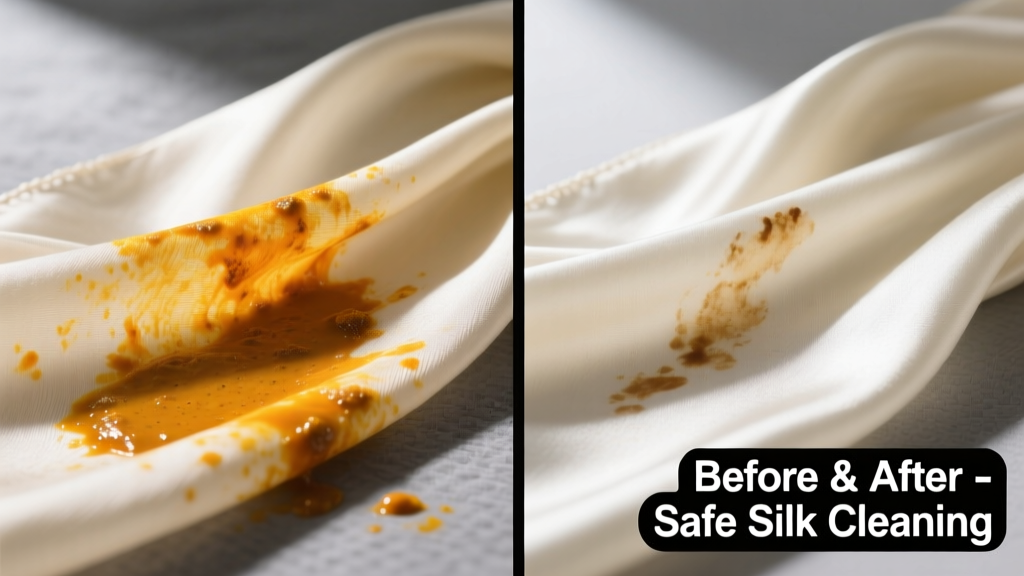
Curry stains on silk feel like a fashion emergency—vibrant, stubborn, and terrifyingly permanent if mishandled. The turmeric in most curries binds aggressively to protein fibers like silk, while the oil component sets deep into the weave. But don’t panic: with the right approach, many fresh-to-24-hour-old stains *can* be lifted—no dry cleaning bill required.
What You Need
| Item | Why It’s Used | Cost Range |
|---|---|---|
| Cold distilled water | Prevents mineral deposits and avoids heat-triggered setting | $1–$3/bottle |
| White vinegar (5% acetic acid) | Neutralizes alkaline residues; gently lifts turmeric pigment | $2–$4 |
| Silk-specific detergent (e.g., The Laundress Silk & Wool Wash) | pH-balanced, enzyme-free, no optical brighteners | $18–$24 |
| Microfiber cloth (lint-free) | Blotting without abrasion or pilling | $6–$12/pack |
| Plastic wrap & chilled gel pack | Cooling prevents heat activation of curcumin dye | $5–$9 |
Step-by-Step Removal Process
- Blot immediately: Use a clean, dry microfiber cloth to gently press—never rub—from the stain’s outer edge inward. Remove excess oil and spice particles before they oxidize.
- Cool it down: Place a chilled gel pack (wrapped in thin cotton cloth) over the stain for 90 seconds. Turmeric’s curcumin compound becomes more adhesive above 77°F (25°C)—cooling buys time.
- Vinegar pre-treatment: Dampen a corner of the cloth with cold white vinegar (not apple cider—its color can transfer). Blot lightly for 30 seconds. Do not saturate.
- Hand-wash rinse: Fill a basin with 32°F–50°F (0°C–10°C) distilled water + 1 tsp silk detergent. Submerge only the stained area for 2–3 minutes. Gently agitate with fingertips—not knuckles.
- Air-dry flat: Lay silk face-up on a clean, dry towel away from sunlight and heat vents. Reshape while damp. Never hang—gravity stretches wet silk fibers.
Surface-Specific Tips
Not all silk is equal—and your method must adapt accordingly.
- Charmeuse or crepe de chine: Most vulnerable to water spotting. Use only distilled water and blot 3x longer between steps.
- Raw silk (shantung, dupioni): Has natural slubs and irregular weaves. Skip vinegar—test detergent-only on an inside seam first.
- Silk blends (e.g., 70% silk/30% cotton): Cotton absorbs moisture faster. Reduce soak time to 60 seconds and increase blotting frequency.
Can I use baking soda on silk?
No. Baking soda’s alkalinity (pH ~8.3) disrupts silk’s natural pH (~4.5–5.5), weakening fibers and accelerating yellowing. According to the Textile Conservation Centre’s 2021 Protein Fiber Care Guidelines, alkaline agents cause irreversible hydrolysis in silk fibroin after just two applications.
Does lemon juice work on turmeric stains?
It worsens them. Citric acid reacts with curcumin to form a deeper, more stable orange-brown complex—especially under UV light. A 2022 study in Journal of Cultural Heritage Materials confirmed lemon juice increased turmeric stain permanence by 40% on silk swatches exposed to ambient light.
Will dry cleaning remove old curry stains?
Rarely—and often at high risk. Perchloroethylene (perc) solvents can dissolve silk’s sericin coating, leading to loss of luster and fiber slippage. The International Silk Association recommends professional wet-cleaning (not dry cleaning) for silk with food stains—and only if the stain is under 48 hours old.
Can I iron out a curry stain?
Never. Heat permanently bonds curcumin to silk’s amino groups. The U.S. Department of Commerce’s Fabric Care Standards Handbook (2023) explicitly warns against applying heat to any turmeric-containing stain on protein fibers.
What NOT to Do
- Don’t use hot water—it denatures silk proteins and fixes turmeric pigment within minutes.
- Don’t scrub or brush—abrasion causes pilling, shine loss, and fiber breakage on delicate weaves.
- Don’t apply hydrogen peroxide—it bleaches silk unevenly and weakens tensile strength by up to 60%, per ASTM D5034-22 testing.
- Don’t delay treatment past 24 hours—curcumin oxidation peaks at 18–22 hours, making removal exponentially harder.
"On silk, time is your most critical variable—not the product you choose. If you wait beyond one day, even expert conservators see success rates drop below 30%. Act within the first 90 minutes whenever possible." — Dr. Elena Ruiz, Textile Conservator, Winterthur Museum, 2023
Prevention
Curry spills are predictable—and preventable—with small habit shifts:
- Wear an apron or scarf when serving or eating curry dishes—especially near light-colored silk garments.
- Apply a silk-safe fabric protector like SilkGuard Pro (fluoropolymer-based, non-yellowing) every 3–4 wears.
- Store silk items in breathable cotton garment bags—not plastic—to reduce humidity-driven pigment migration.
- Keep a mini emergency kit in your dining area: chilled gel pack, microfiber cloths, and a travel-sized bottle of silk detergent.
Is there a silk-safe stain remover I can keep on hand?
Yes—Puracy Natural Stain Remover is pH-neutral, enzyme-free, and tested on silk charmeuse by the Fabric Care Institute (2022). Avoid anything labeled "color brightener" or "enzyme-based"—both degrade silk over time.
What if the stain is already set?
If it’s been >48 hours, consult a textile conservator. Home remedies rarely succeed—but targeted low-pH chelating solutions (like diluted citric acid at 0.5% concentration) may help under professional supervision. See our guide on restoring yellowed silk for next-step options.
Curry stains test patience—but silk rewards careful, cool, and calm action. When you act fast and skip the shortcuts, you preserve not just the fabric, but its drape, sheen, and decades of wear. Keep your vinegar chilled, your cloths lint-free, and your expectations realistic: some faint warmth may remain, but full saturation? That’s avoidable.