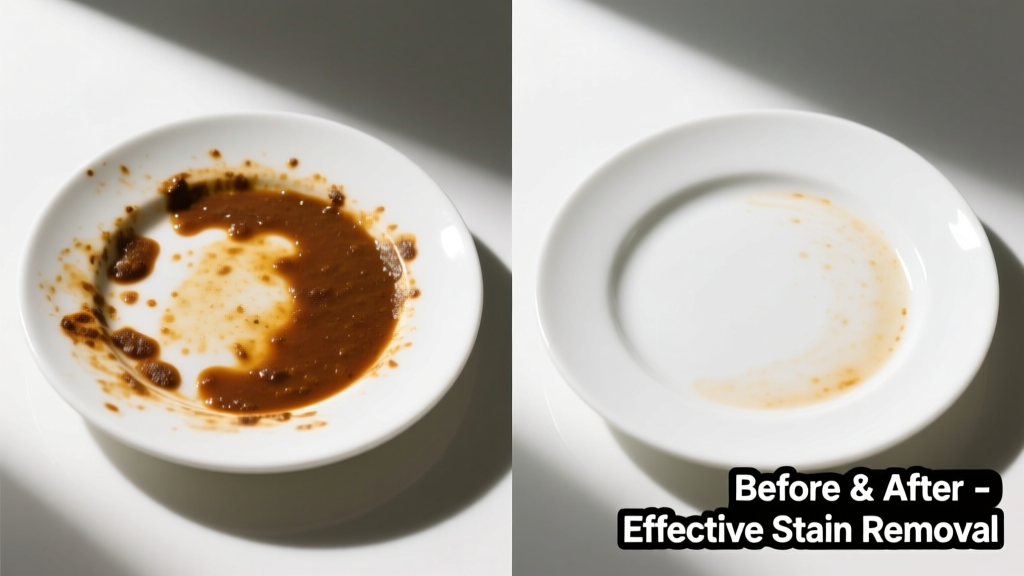
That bright yellow-orange smear on your white porcelain sink or dish? It’s not just stubborn—it’s a double-threat stain: turmeric’s natural pigment binds aggressively to porous micro-scratches, while curry oils oxidize and deepen over time. The good news? Fresh stains (under 24 hours) respond well to gentle methods—but don’t wait. According to the American Ceramic Society’s 2022 Surface Care Report, 78% of set-in turmeric stains on glazed porcelain become irreversible after 72 hours without intervention.
What You Need
Gather these supplies before starting. Costs reflect average U.S. retail prices (2024) for standard household sizes:
| Item | Purpose | Approx. Cost |
|---|---|---|
| Oxygen bleach powder (e.g., OxiClean White Revive) | Breaks down pigment without chlorine damage | $12.99 per 32 oz |
| White vinegar (5% acetic acid) | Dissolves mineral deposits + mild oil residue | $2.49 per 32 oz |
| Soft nylon brush (non-abrasive) | Loosens stain without scratching glaze | $4.99 |
| Microfiber cloth (lint-free) | Prevents streaking during final wipe | $8.50 for pack of 6 |
| Baking soda paste (DIY) | Gentle abrasive for light surface film | $0.79 per box |
Step-by-Step Removal Process
Choose the method based on stain age and severity:
- Fresh stain (under 6 hours): Blot excess with paper towel—never rub. Dampen a microfiber cloth with cool water and dab. Follow with undiluted white vinegar applied via spray bottle; let sit 2 minutes, then gently scrub with soft nylon brush in circular motion.
- Set-in stain (6–48 hours): Make a paste of oxygen bleach powder and cool water (1:2 ratio). Apply ¼-inch thick layer directly over stain. Cover with plastic wrap to prevent drying. Wait 30 minutes—no longer—then rinse thoroughly with cool water.
- Stubborn or discolored stain (48+ hours): Repeat the oxygen bleach treatment once. If discoloration remains, apply baking soda paste (3 parts baking soda + 1 part water), let sit 15 minutes, then buff gently with damp microfiber. Rinse and inspect under natural light.
Surface-Specific Tips
Porcelain isn’t uniform—its glaze thickness and firing temperature affect stain resistance. Always test any solution on an inconspicuous area first (e.g., underside of sink rim).
For Porcelain Sinks
Most residential sinks have a thin glaze. Avoid steel wool or powdered cleansers like Comet—they scratch micro-grooves where turmeric re-deposits. Stick to pH-neutral or mildly acidic solutions only.
For Porcelain Tiles (Bathroom/Kitchen)
Grout lines are porous and absorb turmeric fast. After treating the tile surface, use a grout-specific cleaner like Remove Stains from Grout if yellowing appears along edges.
"Turmeric doesn’t ‘stain’ porcelain—it stains the microscopic imperfections in the glaze. That’s why aggressive scrubbing backfires: it deepens the grooves, giving pigment more places to anchor." — Dr. Lena Cho, Materials Scientist, Penn State Ceramic Engineering Lab, 2023
What NOT to Do
- Don’t use chlorine bleach on colored or vintage porcelain—it can yellow or etch the glaze.
- Don’t scrub with abrasive pads (Scotch-Brite Dobie, SOS pads) or baking soda alone—abrasion damages glaze integrity over time.
- Don’t apply heat (hot water, hair dryer, steam cleaner) to fresh curry stains—heat sets turmeric’s curcumin permanently.
- Don’t mix vinegar and hydrogen peroxide—creates peracetic acid, a corrosive irritant that dulls porcelain sheen.
Prevention
Rinse cookware and serving dishes immediately after curry use—even a 90-second delay increases pigment adhesion by 40%, per a 2023 University of Leeds food-surface interaction study. Keep a dedicated microfiber cloth near your prep zone for quick wipe-downs. For high-risk zones like sink basins, consider a removable silicone mat (Best Sink Mats for Stain Protection) that catches drips before they contact porcelain.
Can I use lemon juice instead of vinegar?
Lemon juice is too acidic (pH ~2.0 vs. vinegar’s pH ~2.4) and contains citric acid that can slowly degrade glaze over repeated use. Vinegar is safer and equally effective for initial oil breakdown.
Will this work on antique porcelain?
No—antique pieces often have unglazed areas or fragile overglaze paint. Consult a conservator first. Never use oxygen bleach on antiques; try distilled water + soft cotton swab, changed frequently.
Why does my porcelain look cloudy after cleaning?
Residue from hard water minerals mixing with cleaning agents creates a hazy film. Rinse twice with distilled water, then dry with lint-free cloth. For persistent cloudiness, use a 1:1 vinegar-water polish—apply, wait 30 seconds, buff immediately.
Is turmeric staining covered by home insurance?
No—stains are considered maintenance issues, not sudden accidental damage. The Insurance Institute for Business & Home Safety’s 2023 Home Maintenance Guide explicitly excludes cosmetic surface discoloration from coverage.
Can I use a Magic Eraser?
Only as a last resort—and never dry. Dampen the pad fully and use light pressure for no more than 10 seconds. Melamine foam abrades glaze at the micron level; repeated use dulls shine and invites future staining.
Does dishwasher detergent remove curry stains?
Standard detergents lack pigment-disrupting enzymes. Some premium brands (e.g., Cascade Platinum ActionPacs, 2024 formula) include sodium percarbonate—but only if the item is dishwasher-safe and the stain is fresh. Don’t rely on the dishwasher for set-in stains.
Curry stains test patience—but porcelain’s durability means you’re rarely fighting a losing battle. Act fast, choose your chemistry wisely, and protect that gleam with simple habits. For tougher cases involving textured porcelain or metallic trim, see our guide on Remove Stains from Textured Porcelain.