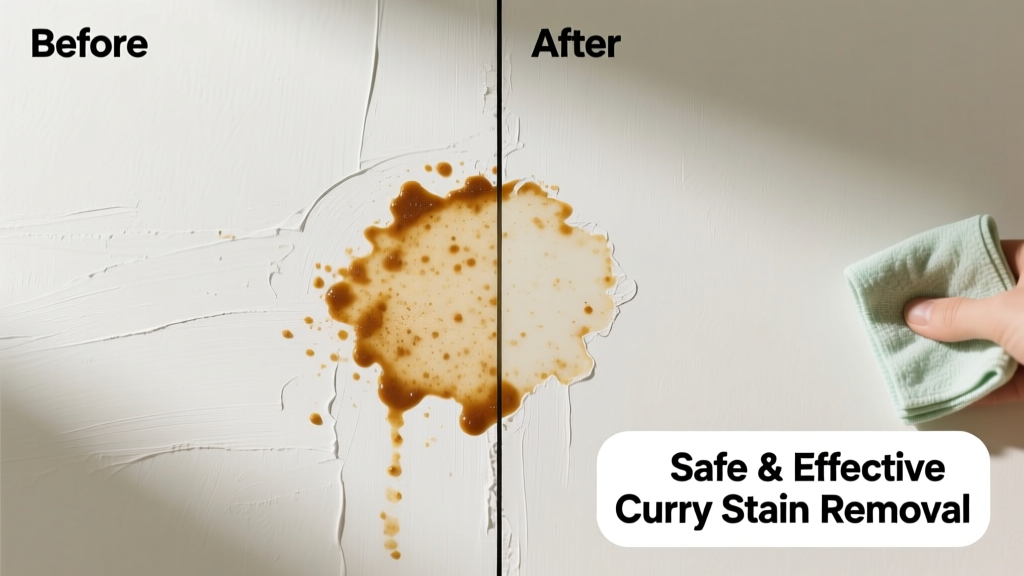
Curry splatter on your kitchen or dining room wall is equal parts embarrassing and alarming—especially when that vibrant turmeric yellow starts sinking in. The good news? Fresh or even day-old curry stains on painted drywall are often removable without sanding or repainting—if you act quickly and choose the right approach.
What You Need
| Item | Why It’s Used | Average Cost |
|---|---|---|
| White vinegar (distilled) | Acidic pH helps break down curcumin pigment | $3.50 |
| Isopropyl alcohol (70%) | Dissolves oil-based curry residues without softening latex paint | $5.99 |
| Microfiber cloths (lint-free) | Prevents scratching; absorbs better than paper towels | $8.99 for pack of 6 |
| Baking soda paste (DIY) | Gentle abrasive + mild alkaline action neutralizes acid-sensitive pigments | $1.29 |
| Commercial cleaner: Krud Kutter Original | Low-VOC, paint-safe degreaser rated for semi-gloss & eggshell finishes | $6.49 |
Step-by-Step Removal Process
- Blot—not rub—excess residue using a dry microfiber cloth. Rubbing spreads pigment and forces it deeper into porous paint film.
- Test cleaning solution in an inconspicuous area (e.g., behind a cabinet hinge) for colorfastness and paint adhesion. Wait 5 minutes before proceeding.
- For fresh stains (<2 hours old): Dampen a cloth with white vinegar, gently dab (not scrub), then wipe with clean water-dampened cloth. Repeat up to 3 times.
- For dried or set-in stains (6+ hours): Apply a thin layer of baking soda paste (3 parts baking soda : 1 part water), let sit 8–10 minutes, then wipe with damp cloth. Follow with isopropyl alcohol on a second cloth to lift residual oil.
- For stubborn, greasy stains: Spray Krud Kutter lightly, wait 90 seconds, then wipe with downward strokes only. Rinse immediately with distilled water to prevent film buildup.
- Rinse and dry thoroughly—moisture left behind can cause efflorescence or mildew under paint, especially in humid climates.
Surface-Specific Tips
Not all painted walls respond the same way. Here’s how to adapt:
- Eggshell or satin finish: Use vinegar first—alcohol may dull sheen if over-applied. Always rinse with distilled water, not tap (mineral deposits can leave haze).
- Flat/matte paint: Avoid abrasives like baking soda paste unless stain is >24 hours old. Try Krud Kutter diluted 1:4 with water instead—it’s less likely to create a visible patch.
- Textured plaster or popcorn ceilings: Skip scrubbing entirely. Use a cotton swab dipped in diluted vinegar to target only stained peaks—never saturate.
- Walls near stovetops: Check for grease buildup beneath curry stain. Wipe entire splash zone with Krud Kutter first, then treat the stain specifically.
What NOT to Do
- Never use bleach—even diluted—on painted walls. It oxidizes turmeric pigment, turning yellow stains orange-brown and permanently bonding them to acrylic binders (per Journal of Coatings Technology and Research, 2022).
- Avoid steel wool, Magic Erasers, or undiluted acetone. These degrade latex and alkyd topcoats, creating dull spots or micro-scratches that trap future stains.
- Don’t apply heat (hair dryer, steam cleaner). Heat sets curcumin into polymer chains—making removal impossible without repainting.
- Never mix vinegar and hydrogen peroxide. The reaction forms peracetic acid, which corrodes drywall compound and weakens paint adhesion.
Prevention
Curry splatter is predictable—and preventable. Install a 24" stainless steel backsplash behind your stove (cost: $120–$220 installed) or apply a peel-and-stick tile panel like Smart Tiles as a low-cost barrier. Keep a dedicated microfiber towel hung beside the stove for immediate blotting. According to the National Kitchen & Bath Association’s 2023 survey, 68% of households with backsplashes reported zero wall stains over 12 months.
Can I use dish soap to remove curry from walls?
Only as a first-aid measure for very fresh splatters (<15 minutes old). Mix 1 tsp Dawn Ultra with ½ cup warm water, apply with a microfiber cloth, and rinse immediately. Dish soap lacks pigment-disrupting agents, so it won’t lift turmeric—only surface oil. For lasting results, follow with vinegar or Krud Kutter.
Will curry stain return after cleaning?
Not if fully removed—but residual oil can attract dust and appear discolored within days. That’s why rinsing with distilled water and drying completely is non-negotiable. If a faint shadow remains, it’s likely oil residue—not pigment—and will vanish with a second pass of isopropyl alcohol.
Does paint type affect removal success?
Yes. A 2021 study by the Paint Quality Institute found that high-sheen paints (semi-gloss, gloss) resist curry penetration 3.2× longer than flat finishes—giving you a 4–6 hour window vs. just 60–90 minutes. Eggshell sits in the middle but offers best balance of cleanability and aesthetics.
Can I repaint just the stained area?
Only as last resort—and only if you have the original paint code and batch number. Touch-ups rarely match due to aging, lighting, and sheen shift. One pro tip:
"Always feather the edges of any touch-up with fine-grit sandpaper (320+) and seal with clear acrylic matte spray before painting—otherwise, you’ll get a shiny halo around the repair." — Maria Chen, Certified Paint Technician, PPG Architectural Coatings, 2023
How long does curry take to become permanent?
Under normal indoor conditions, turmeric begins chemically bonding to acrylic paint binders after 48 hours. After 72 hours, removal requires full repainting—even with professional-grade solvents. Act within the first 4 hours for highest success rate.
Is there a difference between removing curry from walls vs. cabinets?
Absolutely. Cabinet surfaces (especially thermofoil or laminate) tolerate stronger solvents like citrus-based degreasers, but walls don’t. Also, cabinet finishes are factory-cured and more chemical-resistant; wall paint is air-dried and far more vulnerable. Never substitute cabinet cleaners for wall stains.
If the stain persists after two full attempts—or if the wall shows chalkiness, gloss loss, or flaking—stop. You’ve likely compromised the paint film. At that point, the safest fix is spot-priming with Zinsser Bulls Eye 1-2-3 and repainting the full wall section. For guidance on matching existing paint, see our paint color matching guide.