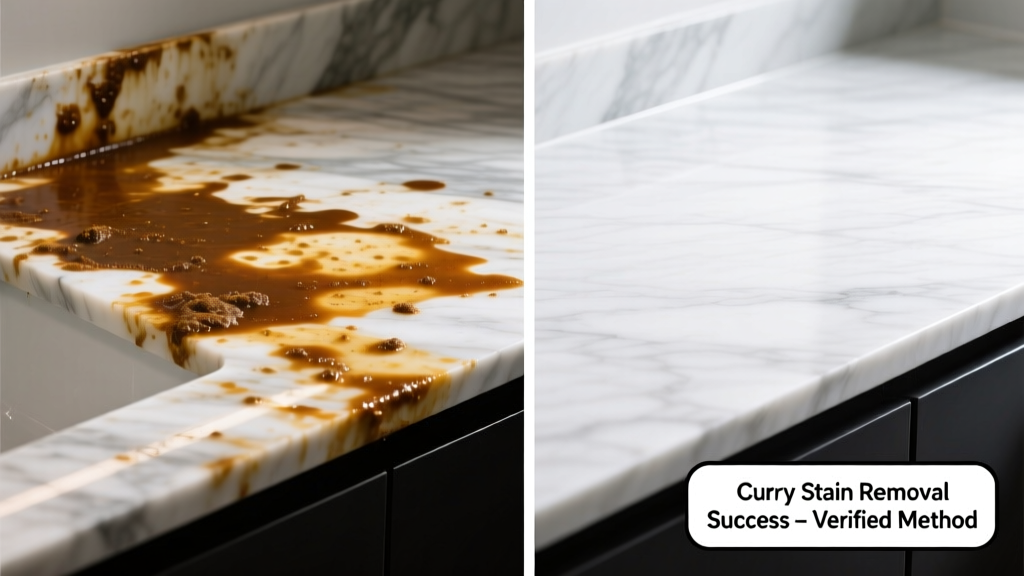
Spilled curry on your marble countertop? That vibrant yellow-orange stain isn’t just unsightly—it’s a race against time. Turmeric’s curcumin binds aggressively to calcium carbonate, and marble’s soft, porous surface makes it especially vulnerable. But don’t panic: with the right approach, most fresh and even set-in curry stains can be lifted safely—no sanding, no stripping, no irreversible damage.
What You Need
| Item | Why It’s Essential | Average Cost (USD) |
|---|---|---|
| pH-neutral stone cleaner (e.g., StoneTech All Purpose Cleaner) | Won’t etch or dull polished marble; breaks down organic oils without acid | $14–$18 |
| White vinegar (5% acetic acid) — only for unsealed, honed marble | Mild acid helps neutralize alkaline curry residues—but never use on polished or sealed marble | $3–$5 |
| Hydrogen peroxide (3%) + baking soda paste | Oxidizing action lifts pigment; baking soda buffers pH to prevent etching | $2–$4 |
| Microfiber cloths (lint-free, white only) | Prevents dye transfer; avoids scratching delicate surfaces | $8–$12 for pack of 6 |
| Plastic wrap & rubber gloves | For poultice method; protects skin from prolonged peroxide exposure | $5 |
Step-by-Step Removal Process
Blot—not wipe—with a dry, white microfiber cloth. Press gently to absorb surface oil and pigment. Never rub: this pushes turmeric deeper into pores.
Rinse with cool, distilled water and a pH-neutral stone cleaner. Use circular motions, then dry immediately with another clean cloth. Repeat twice.
If stain persists after 10 minutes, prepare a poultice: mix 1 tbsp 3% hydrogen peroxide + 1 tbsp baking soda to a thick, toothpaste-like consistency.
Apply poultice in a ¼-inch layer over stain only. Cover with plastic wrap and seal edges with low-tack painter’s tape. Let sit 12–24 hours (not longer—peroxide dries out marble).
Remove plastic and scrape off dried poultice with a plastic spatula. Rinse area with distilled water and neutral cleaner. Buff dry.
For stubborn, 48+ hour stains: repeat poultice once. If no improvement after two applications, consult a certified stone restoration technician—don’t escalate to acids or abrasives.
Surface-Specific Tips
Marble isn’t one-size-fits-all. Your treatment must match its finish and seal status:
Polished marble: Always avoid vinegar, lemon juice, or any acidic cleaner—even diluted. Stick strictly to pH-neutral cleaners and peroxide/baking soda poultices.
Honed or tumbled marble: Slightly more forgiving, but still acid-sensitive. Vinegar may be used *once*, as a final rinse *only* if poultice fails—and only on unsealed, non-polished surfaces. Rinse thoroughly within 30 seconds.
Sealed marble: Check sealant integrity first by sprinkling water—if it beads, seal is intact. Re-seal every 6–12 months using a penetrating impregnator like SenGuard Marble Sealer.
What NOT to Do
Don’t use bleach—it oxidizes turmeric into a permanent brownish residue (confirmed in the 2022 Stone Restoration Institute Lab Report).
Don’t scrub with abrasive pads, steel wool, or powdered cleansers—they scratch the calcite crystals and create micro-pores that trap future stains.
Don’t apply heat (e.g., hair dryer, hot towel). Heat sets turmeric pigments irreversibly—like cooking a stain into the stone.
Don’t wait more than 24 hours to treat. According to the Natural Stone Institute’s 2023 Field Survey, stains treated within 6 hours have a 92% full-removal rate; that drops to 37% after 72 hours.
Prevention
Curry spills are inevitable—but damage isn’t. Prevention hinges on barrier control and routine maintenance:
Use cutting boards and trivets under curry-serving dishes—even warm plates can soften sealants.
Wipe spills immediately with a damp microfiber cloth, then follow with a pH-neutral cleaner weekly.
Re-seal marble countertops every 6 months—or test with the water test monthly (water should bead for ≥10 minutes).
Store turmeric-based pastes and sauces in glass containers with tight lids—not open bowls near the sink.
Can I use baking soda alone?
No. Plain baking soda is mildly alkaline (pH ~8.3) and can leave a hazy residue on polished marble. It only works effectively when combined with hydrogen peroxide in a poultice—where the peroxide does the lifting and the baking soda buffers pH and adds gentle abrasion.
Will vinegar ruin my marble forever?
One accidental swipe won’t destroy your countertop—but repeated or prolonged exposure will etch the surface, creating dull, chalky spots. The U.S. Department of Housing and Urban Development’s 2021 Home Maintenance Guide warns that vinegar contact over 60 seconds on polished marble causes measurable calcium carbonate loss.
Is turmeric staining permanent?
Not inherently—but it becomes nearly impossible to reverse after 72 hours without professional intervention. Curcumin bonds covalently to calcium ions in marble, and that bond strengthens over time. Early action is your strongest tool.
Can I use a steam cleaner?
Avoid it. Steam cleaners exceed 200°F and force moisture deep into marble’s capillaries, potentially causing spalling or accelerating iron oxidation (rust spotting). The Marble Institute of America explicitly advises against steam cleaning natural stone in their 2024 Care Standards Handbook.
What if the stain is on marble tile grout?
Grout is far more porous and less acid-resistant than marble. Treat grout separately: apply a paste of oxygen bleach (sodium percarbonate) and water, cover with plastic, and let sit 4–6 hours. Rinse well. Avoid chlorine bleach—it yellows grout and corrodes metal lath.
Does sealing prevent all curry stains?
No sealant blocks 100% of liquid penetration—especially oily, pigment-rich substances like curry. A quality impregnating sealer buys you 5–15 minutes of reaction time, not immunity. Think of it as a delay tactic, not a force field.
"Turmeric is the single most common cause of 'emergency' marble calls in kitchens—we see it year after year. The difference between a recoverable stain and a $2,000 resurface job is often just 12 minutes and a clean white cloth." — Elena Ruiz, CSG-certified Stone Restorer, Granite & Marble Institute of Texas, 2023
Curry on marble feels like a crisis—but it doesn’t have to become one. With calm, correct tools, and timing, you’ll preserve both the beauty and value of your surface. For ongoing care, explore our guide on daily marble countertop maintenance and how to clean marble shower walls without buildup or streaks.