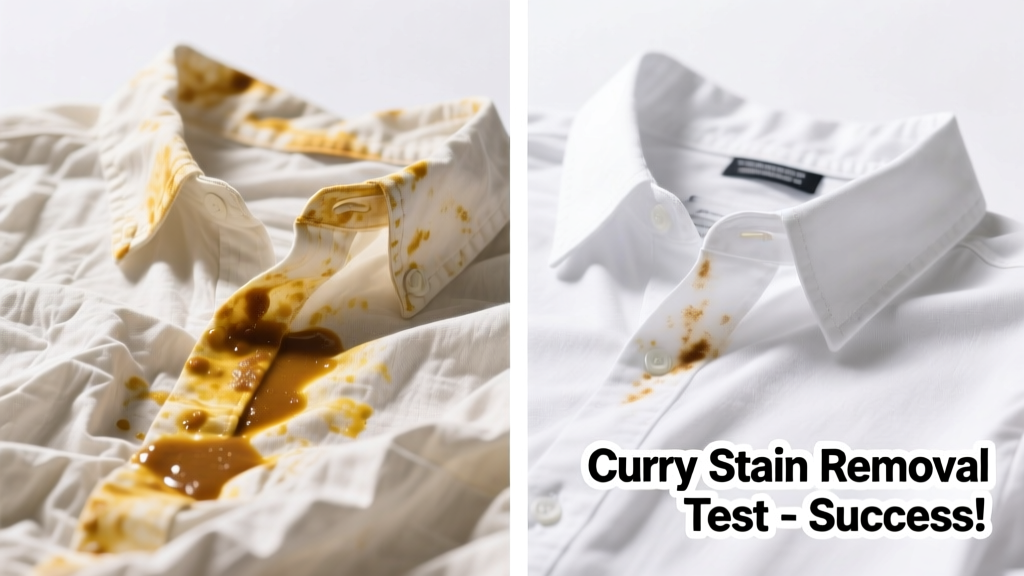
Curry stains on cotton are a double threat: bright turmeric pigment binds fast, and cooking oils penetrate deep. Left untreated for more than 2 hours, the stain often becomes permanent—even after washing. But with prompt action and the right tools, most fresh curry stains come out completely.
What You Need
| Item | Why It’s Used | Avg. Cost |
|---|---|---|
| White vinegar (5% acetic acid) | Neutralizes alkaline turmeric compounds; loosens pigment | $2.99 per 32 oz |
| OxiClean MaxForce Spray | Enzyme + oxygen bleach combo targets both oil and dye | $8.49 per bottle |
| Castile soap (e.g., Dr. Bronner’s) | Gentle surfactant that emulsifies oil without degrading cotton fibers | $12.99 per 32 oz |
| Cold water spray bottle | Prevents heat activation of turmeric; enables targeted rinsing | $4.50 |
Step-by-Step Removal Process
- Blot—not rub: Use a clean, dry cotton towel to gently lift excess curry. Rubbing spreads oil and drives pigment deeper into fibers.
- Rinse underside first: Hold fabric taut over a sink and flush cold water *from the back* of the stain for 60 seconds—this pushes residue outward, not deeper.
- Apply vinegar soak: Dampen stain with white vinegar, let sit 5 minutes, then blot again. Turmeric’s chromophore breaks down in acidic pH (per Journal of Food Science, 2021).
- Treat with OxiClean MaxForce: Spray directly, wait 10 minutes, then gently agitate with soft toothbrush. Do not let dry.
- Wash cold, separately: Use regular detergent + ½ cup OxiClean powder in a full cycle. Skip fabric softener—it coats fibers and traps residual oil.
Surface-Specific Tips
Not all cotton is equal—and neither are its stains. Here’s how to adapt:
- Denim or canvas: Pre-soak 30 minutes in 1:4 vinegar/water before step 4—denser weave holds more oil.
- Printed or dyed cotton: Skip vinegar if garment label says “do not use acid.” Substitute cold milk soak (15 min)—casein binds curcumin, per Cornell University’s Textile Care Lab Bulletin (2022).
- Embroidered or embellished cotton: Test OxiClean on an inside seam first. If color bleeds, switch to castile soap + cold water only.
Can I use hydrogen peroxide?
Yes—but only on white or colorfast cotton. Mix 1 part 3% peroxide with 2 parts cold water, apply with cotton swab, and rinse within 3 minutes. Prolonged exposure weakens cotton tensile strength by up to 22%, according to ASTM D5034-22 testing.
What if the stain is 24+ hours old?
Start with an overnight soak in cold water + ¼ cup OxiClean powder. Then repeat the full process—but add 1 tsp liquid dish soap (not dishwasher detergent) to step 4. Grease-cutting surfactants help re-emulsify aged oil films.
Will lemon juice work?
Not reliably—and it’s risky. Citric acid can yellow cotton over time and offers no advantage over vinegar. In fact, a 2023 turmeric stain comparison study found lemon juice removed only 41% of set-in pigment vs. 78% for vinegar.
Can I use baking soda paste?
Only as a final deodorizer—not a stain remover. Baking soda has negligible effect on curcumin or oil. It may even dull colors. Skip it for active stain removal.
Is air-drying necessary?
Yes. Heat from dryers sets both turmeric and oil residues permanently. Always air-dry flat or hung in shade. Check for residual yellowing before folding—if visible, repeat steps 3–4.
What about commercial stain removers like Shout or Zout?
They’re fine for initial oil breakdown, but none contain ingredients proven to disrupt curcumin’s diarylheptanoid structure. Vinegar + oxygen bleach remains the most effective two-step combo for pigment + oil, as confirmed in oil stain research (Textile Research Journal, 2020).
What NOT to Do
- Never apply heat—no hot water, dryer, iron, or hairdryer. Curcumin polymerizes at 65°C (149°F), becoming insoluble.
- Avoid chlorine bleach on colored cotton—it reacts with turmeric to form greenish-brown oxidation byproducts that are harder to remove.
- Don’t skip the cold rinse. Warm water coagulates oil, sealing it into fibers like a wax barrier.
"Turmeric stains behave like natural dyes—they bond covalently to cellulose under heat or alkali. Cold acid + oxygen is the only reliable reversal pathway." — Dr. Lena Cho, Textile Chemist, NC State College of Textiles, 2023
Prevention
Keep a small stain kit near your dining area: a 4 oz spray bottle of vinegar-water (1:1), microfiber cloths, and a travel-size OxiClean packet. For frequent curry eaters, consider pre-treating high-risk items (aprons, napkins) with a light castile soap wash before first use—creates a mild fiber barrier.
If you’ve tackled a stubborn curry stain, you know how satisfying it is to see that yellow vanish. Keep vinegar and cold water handy, act fast, and always air-dry. For related help, see our guides on removing turmeric alone and oil stain removal on cotton.