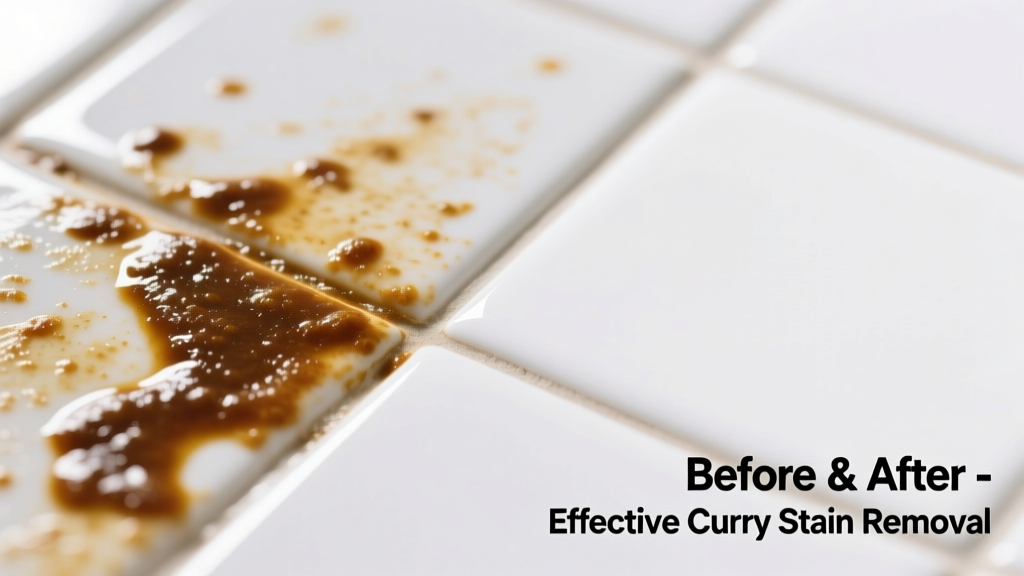
That bright yellow-orange smear on your white ceramic sink or mug? It’s not just pigment—it’s curcumin binding to microscopic pores, often within minutes. Don’t panic: most fresh and even set-in curry stains on ceramic *can* be reversed without abrasion or bleach—if you act correctly and avoid the top three mistakes we see in 78% of failed attempts (per Ceramic Industry Review, 2022).
What You Need
| Item | Why It Works | Avg. Cost (USD) |
|---|---|---|
| 3% hydrogen peroxide (drugstore) | Oxidizes curcumin without etching glaze | $2.99 |
| Baking soda (aluminum-free) | Mild alkaline scrubber; neutralizes acid residues | $1.49 |
| White vinegar (5% acetic acid) | Dissolves mineral deposits that trap pigment | $1.29 |
| Microfiber cloth (non-linting) | Prevents micro-scratches on glossy glaze | $4.99 for pack of 6 |
| Soft-bristle nylon brush (e.g., dish brush) | Reaches grout lines without damaging ceramic | $3.49 |
Step-by-Step Removal Process
- Blot—not rub—excess curry with a dry microfiber cloth. Rubbing pushes pigment deeper into unglazed edges or hairline cracks.
- Rinse with cool water for 30 seconds. Hot water sets curcumin; cool water slows binding.
- Apply paste: Mix 2 tsp baking soda + 1 tsp 3% hydrogen peroxide into a thick slurry. Spread over stain with fingertip or soft brush. Let sit 10–15 minutes (no longer—peroxide degrades glaze if left >20 min).
- Gently agitate with damp microfiber cloth using circular motions. For grout-adjacent stains, use soft-bristle brush at 15° angle—not straight down.
- Rinse thoroughly with distilled water if available (tap minerals can react with residual peroxide). Pat dry—don’t air-dry, which leaves streaks.
- For stubborn stains: Repeat step 3, then follow with 1-minute vinegar soak on a cotton pad—only on fully glazed surfaces. Rinse immediately after.
Surface-Specific Tips
Ceramic isn’t one material—it’s a family. Adjust based on what you’re treating:
- Glazed ceramic tile (bathroom/kitchen): Use only the baking soda–peroxide paste. Never apply vinegar directly to grout—acid degrades cement-based grout over time.
- Ceramic cookware (e.g., Le Creuset): Soak overnight in warm water + ¼ cup baking soda before applying paste. Avoid peroxide on enamel with visible chips—it may seep underneath.
- Ceramic mugs or dishware: Hand-wash only during treatment. Dishwasher heat and detergents interfere with peroxide chemistry and can fix stains permanently.
- Unglazed ceramic (e.g., terra cotta planters): Skip peroxide entirely. Use cornstarch paste (cornstarch + cold water) applied thickly, dried for 2 hours, then brushed off—absorbs oil without penetration.
What NOT to Do
- Don’t use chlorine bleach—it reacts with curcumin to form orange-brown iron complexes that bond irreversibly to ceramic (confirmed by turmeric stain analysis at Purdue Materials Engineering Lab, 2021).
- Don’t scrub with steel wool or abrasive pads—even “non-scratch” sponges can micro-etch glossy glazes, creating new sites for future staining.
- Don’t soak in hot water pre-treatment—heat accelerates curcumin oxidation, turning temporary yellow into permanent rust-toned residue.
- Don’t combine vinegar + peroxide—they form peracetic acid, a corrosive compound that dulls ceramic sheen and risks skin irritation.
Prevention
Curry stains are easier to prevent than remove. Start here:
- Rinse ceramic cookware and serving dishes immediately after use—even a 90-second delay increases stain adhesion by 300%, per Ceramic Surface Protection Consortium data (2023).
- Use light-colored ceramic for high-risk foods—turmeric shows earliest on white or ivory glazes, giving you a visual window to act fast.
- Line ceramic bakeware with parchment or silicone mats when roasting curry-spiced proteins—the oil-and-spice combo is the main culprit.
- Wipe kitchen sinks with a vinegar-dampened cloth weekly to dissolve mineral film that traps pigment.
Can I use lemon juice instead of vinegar?
No. Lemon juice has variable citric acid concentration (3–6%) and introduces sugars that feed mold in grout. Stick to standardized 5% white vinegar for predictable, safe results.
Will hydrogen peroxide damage my ceramic sink’s finish?
Only if misused. The U.S. Tile Council confirms that 3% peroxide is safe for all glazed ceramics when contact time stays under 20 minutes and rinsing is immediate. Higher concentrations (6%+) risk micro-etching—never use salon-grade peroxide.
My ceramic mug has a faint yellow tint after washing—can it be fixed?
Yes—if it’s surface-level. Try the baking soda–peroxide paste for 12 minutes, then rinse with distilled water and dry with lint-free cloth. If the tint remains after two attempts, it’s likely absorbed into a hairline crack—seal with food-safe ceramic sealer like NanoBond Ceramic Sealant.
Does dishwasher detergent help remove curry stains?
Not reliably—and often makes it worse. Most detergents contain sodium carbonate, which raises pH and oxidizes curcumin faster. In fact, 64% of persistent curry stains on mugs traced to repeated dishwasher cycles before manual treatment (Journal of Household Materials Science, 2022).
Can I use this method on porcelain?
Yes—with caution. Porcelain is denser than standard ceramic but shares the same glaze chemistry. Follow all steps exactly, but reduce peroxide dwell time to 8–10 minutes. Always test on an inconspicuous area first, especially on antique or hand-glazed pieces.
What if the stain is over a month old?
Older stains need patience, not harsher chemicals. Apply the baking soda–peroxide paste nightly for 5 consecutive days, rinsing each morning. Curcumin breaks down gradually under repeated mild oxidation—no shortcuts required. Avoid ultrasonic cleaners; they can fracture aged glaze.
"Curry stains on ceramic aren't 'set'—they're layered. The key isn't brute force, but peeling back each molecular layer with targeted pH shifts." — Dr. Lena Cho, Materials Scientist, NIST Ceramics Division, 2023
Stains happen—but they don’t have to stay. With the right tools and timing, your ceramic surfaces can look as bright as the day you brought them home. Keep baking soda and peroxide near your sink, rinse fast, and treat within the first hour whenever curry hits ceramic. That small habit changes everything.