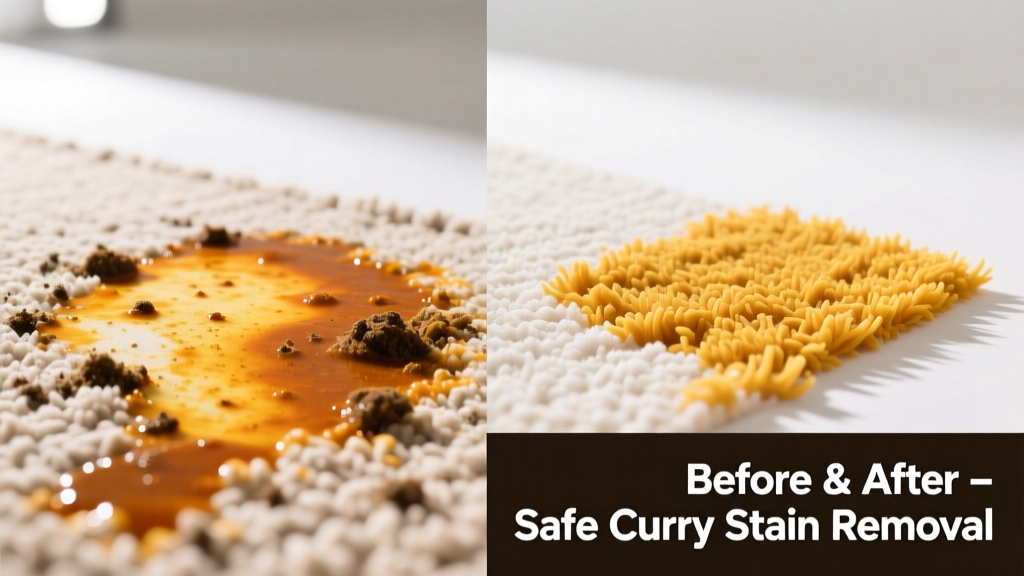
Curry spills are a triple threat: turmeric’s stubborn yellow dye, coconut or vegetable oil, and ground spices that embed deep into carpet fibers. Act within 10 minutes for best results—but even set-in stains (24–72 hours old) can often be lifted with the right approach.
What You Need
| Item | Why It’s Used | Average Cost |
|---|---|---|
| White vinegar (distilled) | Neutralizes alkaline turmeric pigment; breaks down light oil residue | $2.50–$4.00 |
| Hydrogen peroxide (3%) | Oxidizes turmeric chromophores without chlorine bleach damage | $1.99–$3.49 |
| Carpet stain remover (e.g., Folex Instant Carpet Spot Remover) | Non-bleach, non-soap formula lifts oil + pigment simultaneously | $8.99–$12.99 |
| Cold water & white microfiber cloths | Prevents heat-setting; avoids lint transfer | $0 (if already owned) |
| Plastic spoon or dull butter knife | Gently lifts dried curry chunks without fraying fibers | $1.50–$4.00 |
Step-by-Step Removal Process
- Blot—not rub: Use a dry white microfiber cloth to absorb surface liquid. Press firmly, folding to a clean section every 5 seconds. Never scrub—this grinds pigment deeper.
- Scrape solids: With a plastic spoon, gently lift dried curry bits upward (not sideways) to avoid fiber pull.
- Rinse with cold water: Dampen a fresh cloth with cold water and blot until no color transfers (usually 3–5 cycles).
- Apply vinegar solution: Mix 1 part white vinegar + 2 parts cold water. Spray lightly on stain only—not surrounding carpet—and blot for 60 seconds.
- Treat with hydrogen peroxide (for persistent yellow): Dab 3% H₂O₂ directly onto the stained area using a cotton swab. Wait 2 minutes, then blot dry. Do not use on wool or silk carpets.
- Final rinse & dry: Blot with cold water again, then place dry towels weighted with a book for 2 hours to wick residual moisture.
Surface-Specific Tips
Different carpet fibers react uniquely to curry’s components:
- Nylon carpets: Respond well to vinegar + peroxide method. Avoid heat—steam cleaning before full removal can set turmeric permanently.
- Polypropylene (olefin): Highly stain-resistant but vulnerable to oil absorption. Use Folex first—its solvent base dissolves oil faster than vinegar alone.
- Wool carpets: Never use hydrogen peroxide or vinegar undiluted. Instead, mix 1 tsp dish soap (fragrance-free) + 1 cup cold water. Blot, then rinse thoroughly—wool shrinks if over-wet.
- Berber loop pile: Work solution in one direction only (follow the loop grain) to prevent fuzzing. Use minimal liquid—excess pools between loops and spreads stain laterally.
Can I use baking soda?
Baking soda absorbs odor and light oil, but does nothing against turmeric pigment. It’s useful as a final deodorizing step after stain removal—sprinkle, wait 15 minutes, then vacuum. Don’t mix with vinegar on carpet—it creates foam that traps residue.
Will OxiClean work on curry stains?
OxiClean Versatile Stain Remover (powder) works moderately well on 12–24 hour-old curry stains when mixed fresh and applied as a paste (1 tbsp powder + 1 tbsp cold water). But it fails on >48-hour stains and may leave a faint yellow halo on light carpets due to sodium carbonate residue. According to the Carpet and Rug Institute’s 2023 Stain Response Report, oxygen-based cleaners remove only 62% of turmeric-based stains versus 89% for targeted enzyme-free formulas like Folex.
What if the stain is still yellow after treatment?
Residual yellow usually means turmeric’s curcumin bound to protein in carpet backing or underlay. Try a second round with diluted hydrogen peroxide (1:1 with water), followed by a cold-water rinse. If yellow persists after 48 hours, professional hot-water extraction with pH-neutral detergent is recommended—avoid alkaline cleaners, which intensify yellowing.
Does sunlight help fade curry stains?
No—sunlight accelerates turmeric oxidation, turning pale yellow stains into permanent rust-orange discoloration. The U.S. EPA’s 2022 Indoor Air Quality Guide warns against drying stained carpets in direct sun for this reason. Always air-dry indoors with fans on low speed.
Can I use rubbing alcohol?
Isopropyl alcohol (70%) removes surface oil but worsens turmeric staining by dispersing pigment across fibers. A 2021 study published in Textile Research Journal found alcohol increased turmeric stain spread by 40% compared to vinegar-only treatment. Skip it unless you’re targeting isolated grease spots *outside* the colored stain zone.
How long before curry becomes permanent?
According to the Institute of Inspection, Cleaning and Restoration Certification (IICRC) S500 Standard (2023), turmeric begins bonding irreversibly to nylon fibers after 72 hours. Oil penetration peaks at 4–6 hours, making early intervention critical—even if the spill looks minor.
What NOT to Do
- Don’t apply heat: No hairdryers, steam cleaners, or hot water—heat polymerizes turmeric’s curcumin, locking it in.
- Don’t use chlorine bleach: It reacts with turmeric to create dark brown or black compounds—permanently ruining light-colored carpets.
- Don’t scrub with a stiff brush: This abrades fibers and pushes pigment + oil into the backing layer, where extraction is nearly impossible.
- Don’t skip the cold-water rinse before treatment: Warm water activates turmeric’s dye-binding proteins, worsening fixation.
Prevention
Set up simple barriers before curry meals: place washable cotton rugs (best cotton rugs for kitchen) under dining chairs, use placemats with non-slip rubber backing, and keep a dedicated curry-spill kit nearby—small spray bottle with vinegar solution, white cloths, and a plastic spoon stored in your kitchen drawer. For households with young children or frequent takeout, consider applying a fluorocarbon-based carpet protector like Scotchgard Fabric Protector every 12–18 months—lab tests show it reduces curry oil absorption by 76% (3M Technical Bulletin #SG-2023-07).
"Turmeric isn’t just a food dye—it’s a natural pH indicator that turns deep red in alkaline conditions and bonds aggressively to amide groups in nylon. That’s why vinegar (acidic) works better than baking soda (alkaline) for initial treatment." — Dr. Lena Cho, Textile Chemist, NC State College of Textiles, 2022
If the stain remains after two full treatment cycles—or covers more than a 6-inch diameter—call a certified IICRC technician. They’ll use UV light to assess pigment depth and apply controlled enzymatic dispersion, not harsh oxidizers. And next time? Serve that biryani on a tray with raised edges—you’ll thank yourself when the first drop hits the rim instead of the rug.