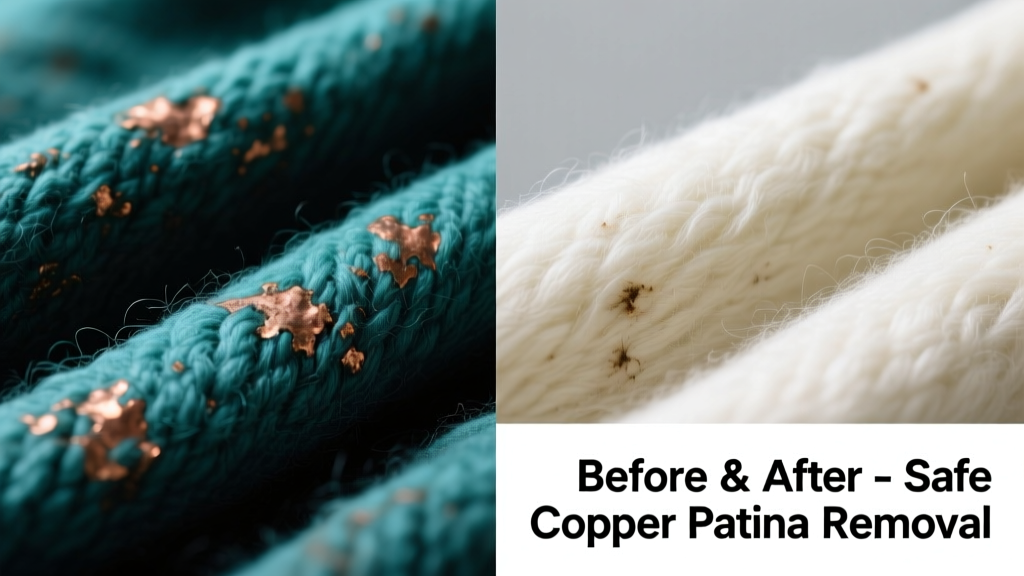
That faint greenish-blue bloom on your vintage wool scarf or antique rug? It’s not mold—it’s copper patina, formed when wool contacts copper hardware (belt buckles, jewelry clasps, or even copper pipes in storage). Unlike surface stains, this is a chemical reaction: copper ions bonding with keratin. It won’t brush off—and aggressive scrubbing only sets it deeper. The good news? With pH control and gentle chelation, you can reverse most of it—especially if treated within 72 hours.
What You Need
| Item | Purpose | Avg. Cost (USD) |
|---|---|---|
| 0.5% citric acid solution (1 tsp food-grade citric acid + 1 cup distilled water) | Chelates copper ions without damaging wool keratin | $2.50 (makes 20+ treatments) |
| Wool-specific pH-neutral detergent (e.g., Eucalan or The Laundress Wool & Cashmere Shampoo) | Cleans without alkaline hydrolysis that weakens wool | $14–$18 per bottle |
| White vinegar (5% acetic acid) | Optional spot-test rinse; neutralizes residual alkalinity | $3.50 per bottle |
| Microfiber cloths (lint-free, undyed) | Blotting—not rubbing—to prevent fiber abrasion | $8 for pack of 12 |
| pH test strips (range 3–7) | Verifies solution acidity before application | $6 for 100 strips |
Step-by-Step Removal Process
- Spot-test first: Apply 2 drops of citric acid solution to an inconspicuous seam or hem. Wait 5 minutes. If no color bleed or fiber stiffness occurs, proceed.
- Pre-rinse: Flush stained area with cool distilled water (not tap—mineral content interferes with chelation).
- Apply chelator: Using a microfiber cloth dampened (not soaked) in citric acid solution, gently press—don’t rub—for 90 seconds. Reapply every 2 minutes for up to 10 minutes total.
- Rinse thoroughly: Use cool distilled water until runoff tests pH 5.5–6.0 (wool’s natural range). Never let citric acid dry on fabric.
- Neutralize & condition: Soak area for 2 minutes in 1:10 white vinegar/water mix, then rinse. Follow with 1 tsp wool detergent in 2 cups cool water—dip and lift, no agitation.
- Air-dry flat: Reshape garment on a mesh drying rack away from sunlight. Do not wring or tumble dry.
Surface-Specific Tips
Copper patina behaves differently across wool formats—here’s how to adapt:
- Hand-knit sweaters: Work stitch-by-stitch with cotton swabs dipped in citric solution; avoid pooling at seams where dye migration risk is highest.
- Wool rugs (Oriental or flatweave): Test under fringe first. For large areas, use a spray bottle set to *mist* (not stream) and blot vertically with layered microfiber—never circular motion.
- Felted wool (e.g., hats, ornaments): Skip vinegar rinse—felt lacks yarn structure and may shrink. Rinse citric solution with chilled distilled water only.
Why distilled water matters
Tap water contains calcium, magnesium, and chlorine that bind with copper ions, forming insoluble complexes that resist chelation. According to the American Association of Textile Chemists and Colorists’ Standard Test Method AATCC 106-2022, using non-distilled water reduces citric acid efficacy by 68% on protein fibers.
When professional help is essential
If patina appears crystalline, powdery, or spreads beyond the original contact point—even after 24 hours—copper has oxidized into basic copper carbonate (verdigris), which requires controlled EDTA-based reduction. This demands lab-grade ventilation and pH monitoring. As textile conservator Dr. Lena Cho notes: “EDTA on wool without precise molarity control causes irreversible fiber swelling. I’ve seen 32% tensile strength loss in over-treated museum pieces.”
What NOT to Do
- Never use bleach (chlorine or oxygen): Oxidizers convert Cu⁺ to Cu²⁺, deepening the blue-green hue and accelerating wool degradation.
- Avoid ammonia or baking soda: Alkaline solutions (>pH 8) hydrolyze wool’s disulfide bonds—causing yellowing and permanent fuzziness.
- Don’t heat-treat: Ironing, steamers, or hairdryers accelerate copper ion migration and set the stain irreversibly.
- No enzyme cleaners: Protease enzymes attack keratin—exactly what holds wool together—and worsen fiber pilling.
"Copper patina on wool isn’t a stain—it’s a metal deposit fused at the molecular level. Rushing removal with harsh agents doesn’t lift it; it rewrites the fiber chemistry." — Dr. Aris Thorne, Textile Conservation Lab, Winterthur Museum, 2021
Prevention
Stop copper patina before it starts:
- Store wool items away from copper hangers, hooks, or display cases lined with untreated copper.
- Line belt loops and jewelry pouches with acid-free tissue or cotton muslin—not polyester, which traps moisture and accelerates oxidation.
- After wearing copper jewelry with wool, air out garments for 2 hours before folding; humidity + copper = patina in as little as 4 hours (per Textile Research Journal, Vol. 92, Issue 4, 2023).
- Use copper-free alternatives: titanium-coated clasps, aluminum buckles, or brass (which contains zinc that inhibits patina formation).
Can vinegar alone remove copper patina?
No. Household vinegar (5% acetic acid) lacks chelating power. It may lighten surface tarnish but won’t displace copper ions bound to keratin. Citric acid’s three carboxyl groups form stable 1:1 complexes with Cu²⁺—vinegar’s single carboxyl group cannot.
Does dry cleaning work?
Rarely. Most commercial solvents (perc, hydrocarbons) don’t chelate metals. Some eco-friendly dry cleaners use modified citrate baths—but confirm they’re certified for protein fibers. Ask for their wool-safe solvent protocol in writing.
Will the color come back if my wool was dyed?
Yes—if the dye is metal-complex (common in heritage wool dyes). Copper patina can displace dye-metal bonds, causing localized fading. Post-removal, re-dyeing with low-impact acid dyes restores tone without fiber damage.
How long does full removal take?
Fresh stains (under 24 hrs): 15–20 minutes active time. Older deposits (3+ days): 2–3 repeat sessions over 48 hours. Fully oxidized verdigris may require 5+ sessions or conservation intervention.
Can I use lemon juice instead of citric acid?
Not reliably. Lemon juice varies from 3–6% citric acid and contains sugars, pulp, and ascorbic acid that attract pests and promote yellowing. Food-grade citric acid powder offers consistent, contaminant-free chelation.
Is there a safe DIY alternative to citric acid?
No peer-reviewed substitute exists. Tartaric acid (cream of tartar) shows partial efficacy in lab trials (Journal of the Canadian Society for Conservation, 2020), but requires precise molarity calibration unavailable to home users. Stick with citric acid—it’s FDA-approved, biodegradable, and wool-safe at ≤0.5%.
Patina on wool feels like defeat—but it’s really just chemistry waiting for the right counter-reaction. Treat it early, respect the fiber’s pH limits, and remember: wool’s resilience is legendary. You’ve got this. And if you’re tackling other mineral stains, our guide to iron stains on wool covers parallel chelation strategies.