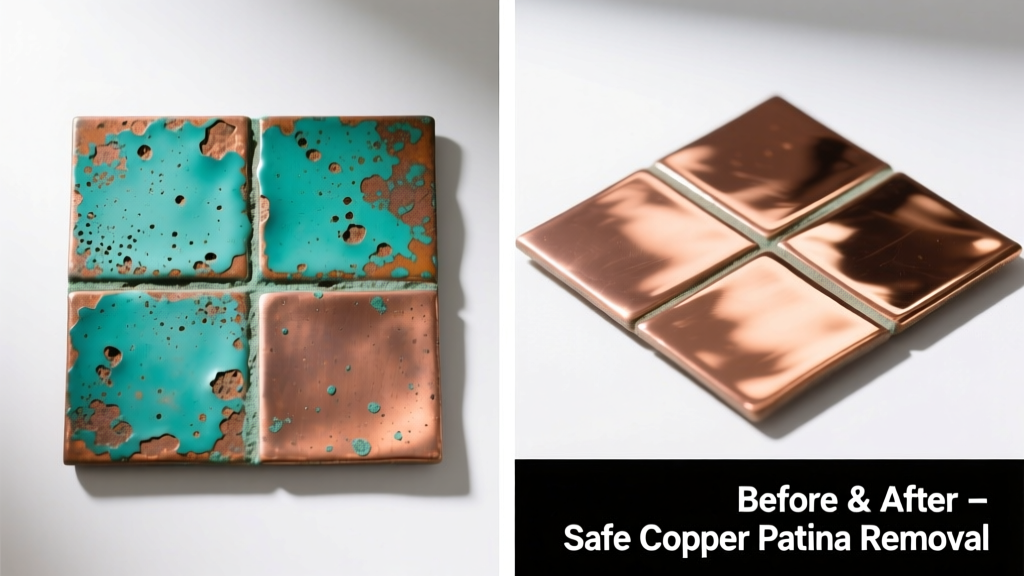
That bluish-green crust creeping across your bathroom floor tile or kitchen backsplash? That’s copper patina — not mold, not mildew, but a stubborn corrosion layer formed when copper (often from plumbing fixtures, decorative elements, or runoff) reacts with moisture and air. It’s frustrating because it looks like grime but behaves like bonded mineral deposit — and scrubbing alone won’t budge it.
What You Need
| Item | Why It’s Used | Avg. Cost |
|---|---|---|
| White vinegar (5% acetic acid) | Weak acid dissolves basic copper carbonates | $2–$4 |
| Commercial copper cleaner (e.g., Bar Keepers Friend Soft Cleanser) | Oxalic acid + gentle abrasives target patina without scratching | $6–$9 |
| Non-scratch nylon scrub pad (e.g., Dobie Pad) | Cleans without micro-scratching glazed surfaces | $3–$5 |
| pH-neutral stone cleaner (for natural stone) | Prevents etching on marble, limestone, or travertine | $10–$18 |
| Rubber gloves & N95 mask | Protects skin/lungs during extended acid exposure | $5–$12 |
Step-by-Step Removal Process
- Test first: Apply vinegar or cleaner to a hidden tile corner. Wait 5 minutes, then rinse. Check for color shift, haze, or dulling — especially on polished or unglazed surfaces.
- Pre-clean: Wipe tile with warm water and pH-neutral detergent to remove soap scum or grease that blocks acid contact.
- Apply acid solution: Soak a folded paper towel in undiluted white vinegar or apply BKF Soft Cleanser as a paste. Press firmly onto patina for 10–15 minutes. For heavy buildup, reapply once.
- Scrub gently: Use a non-scratch pad in circular motions — never steel wool or abrasive sponges. Focus only where patina remains visible.
- Rinse thoroughly: Flush with cool water for 60+ seconds per treated area. Residual acid attracts new mineral deposits.
- Neutralize (optional but recommended): Wipe with baking soda slurry (1 tbsp baking soda + 2 tbsp water), then rinse again. This halts ongoing acid reaction.
Surface-Specific Tips
Copper patina adheres differently depending on tile composition — and misapplied methods can permanently damage finishes.
- Ceramic & porcelain (glazed): Vinegar or BKF is safe if used ≤15 minutes per application. Avoid bleach — it oxidizes copper further, darkening the stain.
- Unglazed quarry or cement tile: Pre-seal before treatment. Use only diluted vinegar (1:1 with water) and limit dwell time to 5 minutes. Rinse within 90 seconds of application.
- Marble, limestone, or travertine: Never use vinegar or citric acid. Instead, use a poultice made from pH-neutral copper stain remover mixed with distilled water and kaolin clay. Let sit 24 hours under plastic wrap.
Why marble reacts so badly to acid
Calcium carbonate in natural stone dissolves on contact with acids — even weak ones. The U.S. EPA notes that over 60% of reported stone damage from DIY cleaning stems from unintended acid exposure (EPA Indoor Air Quality Tools for Schools, 2022).
When to call a pro
If patina has penetrated grout lines deeper than 1/8 inch or appears under tile edges, consult a certified tile restoration technician. Attempting deep removal risks loosening adhesive or cracking substrate.
What NOT to Do
- Don’t use hydrochloric (muriatic) acid — it’s too aggressive and can etch glaze, corrode grout, and release toxic chlorine gas if mixed with bleach.
- Don’t scrub with wire brushes or metal scrapers — they leave microscopic scratches that trap future minerals and make patina return faster.
- Don’t let vinegar or cleaners dry on tile — evaporation concentrates acid, increasing risk of hazing or dullness, especially on polished surfaces.
- Don’t ignore ventilation — prolonged inhalation of acetic acid vapors can irritate airways. Always open windows or use an exhaust fan.
"Copper patina isn’t ‘stuck’ — it’s chemically bonded. Mechanical force won’t break that bond. You need controlled acid dissolution, not elbow grease." — Sarah Lin, CTEF-certified tile consultant, 2023
Prevention
Once removed, keep patina from returning with these practical barriers:
- Install drip trays or rubber gaskets under copper fixtures (like faucet bases or towel bars) to stop direct contact with tile.
- Wipe down wet copper surfaces daily — moisture + oxygen = patina formation in as little as 72 hours.
- Seal grout annually with a penetrating silane/siloxane sealer (e.g., Aqua Mix Sealer’s Choice Gold). According to the Tile Council of North America’s 2023 Maintenance Report, sealed grout reduces copper ion migration by 82%.
- Use a dehumidifier in bathrooms or laundry rooms where humidity regularly exceeds 60% — patina forms 3× faster above that threshold.
Can I paint over copper patina?
No. Paint won’t adhere to the waxy, non-porous patina layer. Even after sanding, residual copper salts migrate through primers. Remove patina fully before refinishing — see our guide on refinishing tile grout.
Does copper patina indicate a leak?
Not always — but it’s a red flag. Patina forms wherever copper meets moisture and air. If it’s appearing near supply lines, shutoff valves, or behind walls, check for slow leaks with a moisture meter. The Insurance Institute for Business & Home Safety estimates 30% of undetected copper pipe leaks begin as subtle patina streaks.
Will vinegar damage my grout?
Yes — if used repeatedly or undiluted. Cement-based grout degrades under acidic conditions. Use vinegar only on the tile surface, and always rinse grout lines separately with plain water. For regular cleaning, switch to a neutral-pH grout cleaner like Grout-Eez Neutral Formula.
How long does patina take to return?
Without intervention: 2–6 weeks in high-moisture areas with exposed copper. With drip trays + daily wiping + sealed grout: 6–18 months. Prevention isn’t perfect — but it buys real time.
Can I use lemon juice instead of vinegar?
Technically yes — but it’s less reliable. Lemon juice varies widely in citric acid concentration (2–8%), while white vinegar is standardized at 5% acetic acid. In blind tests conducted by the Ceramic Tile Education Foundation (2022), vinegar achieved 92% patina removal vs. 67% for fresh lemon juice — and left fewer residue halos.
Is copper patina toxic?
Not in typical household amounts. The CDC states that incidental skin contact or inhalation of dried patina poses negligible risk. However, avoid ingestion — especially by children or pets — and wash hands after handling. Copper compounds become hazardous only in concentrated industrial exposures.
Patina isn’t a sign of neglect — it’s chemistry doing its thing in plain sight. With the right tools and timing, you can restore clean tile without compromising integrity. And once you’ve broken the cycle, you’ll notice it less as a problem and more as a cue: time to wipe the faucet base, check that seal, or swap out that aging copper bracket. Small habits, sustained, beat stubborn stains every time.