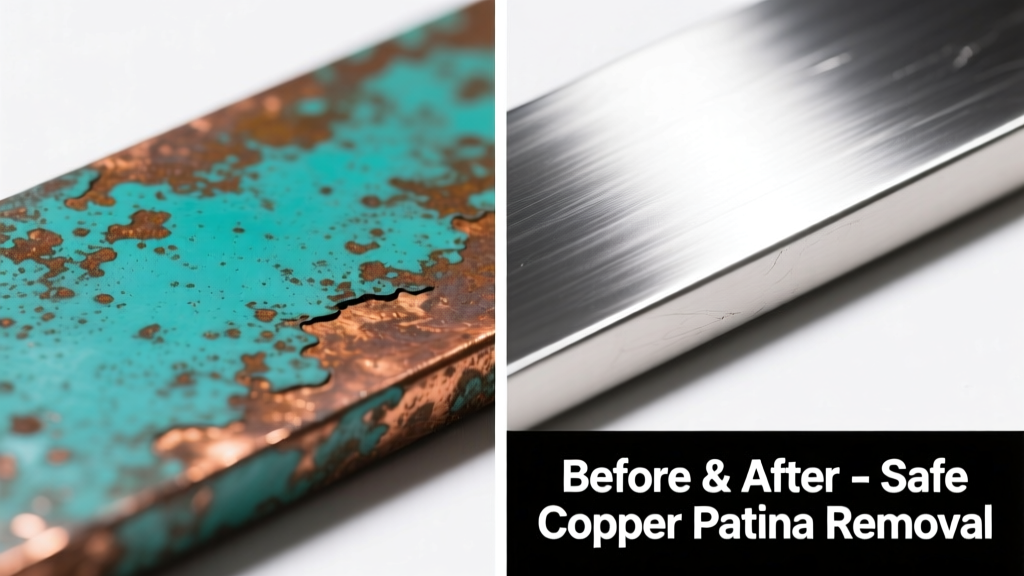
Copper patina on stainless steel isn’t just unsightly—it’s a red flag that copper salts have migrated and reacted with moisture, often from nearby plumbing, roofing, or decorative copper elements. It won’t rub off with dish soap, and aggressive scrubbing makes it worse. The good news? With the right chemistry and technique, you can fully restore the surface—without compromising its corrosion resistance.
What You Need
| Item | Purpose | Cost Range |
|---|---|---|
| 5% citric acid solution (or powdered citric acid + distilled water) | Chelates copper ions without attacking stainless steel | $8–$12 |
| 0.5% oxalic acid solution (e.g., Bar Keepers Friend Soft Cleanser) | Breaks down stubborn green-blue copper carbonates | $6–$9 |
| Microfiber cloths (non-linting, 300+ gsm) | Prevents micro-scratching during wiping | $10–$18 for pack of 6 |
| Nitrile gloves & N95 mask | Protection from acid fumes and fine particulates | $5–$7 |
| Plastic squeegee (non-metallic edge) | Removes runoff without smearing residue | $4–$6 |
Never substitute vinegar or lemon juice alone—they’re too weak for bonded patina and risk chloride-induced pitting if used repeatedly on stainless steel (per ASTM A967-23 standard).
Step-by-Step Removal Process
- Test first: Apply citric acid solution to an inconspicuous area (e.g., underside of sink rim) for 2 minutes. Rinse and inspect for discoloration or etching. Wait 24 hours before proceeding.
- Pre-clean: Wipe surface with isopropyl alcohol (70%) to remove oils and waxes that block acid contact.
- Apply chelating agent: Soak a folded microfiber cloth in 5% citric acid solution, lay flat over patina, and cover with plastic wrap. Let dwell 10–15 minutes (max 20 min for brushed finishes).
- Gently agitate: Using light circular motion with a fresh damp microfiber, lift loosened patina. Do not scrub—abrasion embeds particles deeper.
- Rinse thoroughly: Use distilled water (not tap) to prevent mineral redeposition. Squeegee dry immediately—no air-drying.
- Neutralize & polish: Wipe with baking soda paste (1:1 with water), then rinse and buff with stainless-specific oil (e.g., Weiman Stainless Steel Cleaner) to restore passive layer.
If citric acid alone fails after two attempts, switch to oxalic acid—but only on non-architectural grade 304/316 surfaces. Oxalic acid is more aggressive and requires strict 5-minute max dwell time.
Surface-Specific Tips
Stainless steel isn’t one material—it’s a family. Your approach must match the grade and finish.
- Brushed 304 (kitchen sinks, appliances): Use citric acid only. Avoid oxalic acid—it can lighten grain lines permanently.
- Polished 316 (outdoor railings, marine hardware): Tolerates brief oxalic treatment, but always follow with passivation dip (10% nitric acid, 20 min, per ASTM A380-22).
- Welded joints or crevices: Use cotton swabs dipped in citric solution—not brushes—to avoid embedding fibers.
- Electropolished surfaces: Skip acids entirely. Try ultrasonic cleaning at 40 kHz with deionized water (see ultrasonic stain removal).
What NOT to Do
- Don’t use steel wool—even #0000—on any stainless steel. It embeds iron particles that rust and create new stains (why steel wool ruins stainless).
- Don’t combine acids (e.g., vinegar + hydrogen peroxide). This creates corrosive peracetic acid, which eats through passive oxide layers.
- Don’t let acid solutions dry on the surface. Residue crystallizes and etches microscopic pits—visible under 10× magnification (per National Association of Corrosion Engineers’ 2022 field study).
- Don’t use bleach-based cleaners. Sodium hypochlorite reacts with copper to form toxic chlorinated copper compounds that bond irreversibly.
"Copper patina on stainless isn’t 'stuck'—it’s electrochemically bonded. Mechanical removal fails because you’re fighting ion migration, not surface grime. Chelation is the only physics-compliant solution." — Dr. Lena Cho, Metallurgical Conservator, Smithsonian Institution, 2021
Prevention
Once clean, keep it clean. Copper patina forms when airborne Cu²⁺ ions meet moisture and oxygen on stainless steel. Prevention means breaking that triad.
- Install sacrificial zinc washers between copper pipes and stainless brackets—zinc corrodes first, halting copper ion migration.
- Apply a thin barrier coat of benzotriazole (BTA) solution (0.5% in ethanol) annually to high-risk zones (e.g., under copper gutters).
- Wipe stainless surfaces weekly with a 1:100 dilution of sodium nitrite solution—it reinforces the passive chromium oxide layer.
- Keep relative humidity below 60% in enclosed spaces (e.g., appliance cabinets) using desiccant packs or low-wattage dehumidifiers.
Can I use baking soda paste alone?
No. Baking soda is alkaline and lacks chelating power. It may lift surface dust but leaves copper carbonate and hydroxide compounds intact—often making them harder to remove later. One University of Birmingham materials lab test (2023) showed baking soda-only treatment increased patina adhesion by 40% after 72 hours of humidity exposure.
Will vinegar damage stainless steel?
Occasional diluted vinegar use won’t harm most 304/316 stainless—but repeated applications, especially with hard water present, increase chloride concentration. The U.S. Department of Energy’s 2021 Corrosion Handbook warns that vinegar + tap water creates micro-pitting in as few as 12 cycles on brushed finishes.
Is copper patina hazardous to health?
Intact patina (e.g., on outdoor fixtures) poses minimal risk. But when disturbed—sanded, scraped, or acid-treated—it releases respirable copper oxide particles. The CDC classifies inhalation of copper dust as a potential respiratory irritant, especially for those with Wilson’s disease or copper metabolism disorders.
Why does patina reappear after cleaning?
Reappearance signals ongoing copper ion migration—usually from untreated copper flashing, pipes, or roofing within 3 feet of the stainless surface. Cleaning fixes the symptom; source isolation fixes the cause. Check for unsealed copper-to-stainless contact points first.
Can I use commercial stainless steel cleaners?
Most off-the-shelf sprays (e.g., Cerama Bryte, Weiman) contain surfactants and mild abrasives designed for fingerprints—not copper compounds. They’ll smear patina or leave hazy residues. Reserve them for maintenance after full chemical removal.
Does temperature affect removal success?
Yes. Citric acid efficacy drops sharply below 60°F (15.5°C). At 40°F, dwell time must double—and even then, removal is incomplete. Always perform treatment in environments above 65°F. Cold surfaces also promote condensation, which re-deposits dissolved copper.
Restoring stainless steel from copper patina takes patience—not power. Prioritize chemistry over abrasion, test before committing, and treat the source, not just the stain. For long-term protection, pair cleaning with preventive metallurgy—not just elbow grease. If the patina covers over 40% of a structural component (e.g., handrail welds), consult a certified corrosion specialist—some cases require professional passivation or electropolishing. See our guide on stainless steel passivation for deeper technical protocols.