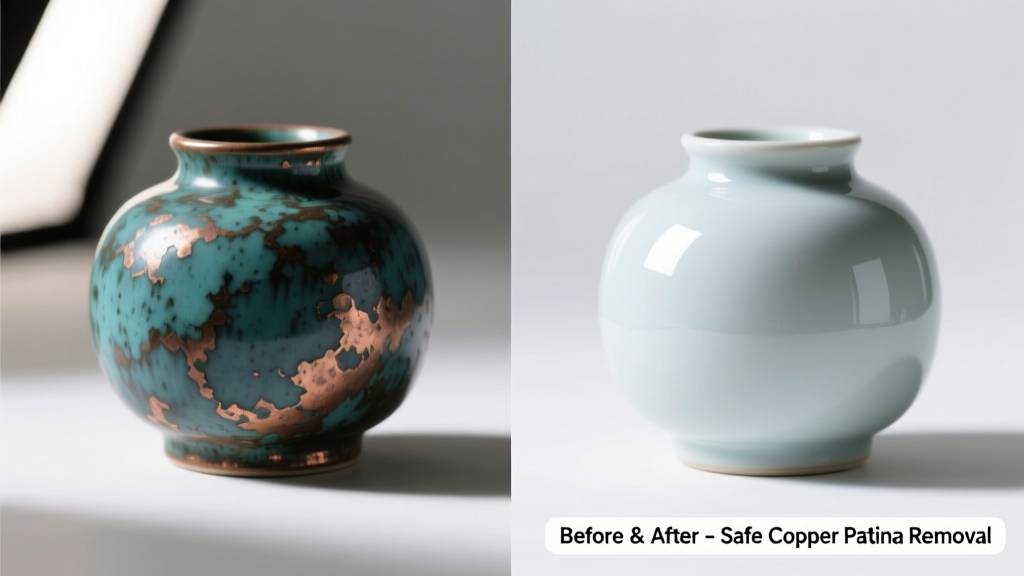
Copper patina—those stubborn blue-green stains left by corroded copper pipes, fittings, or decorative elements—can look elegant on statues but ruin the clean look of your porcelain sink, tub, or tile grout. The good news? It’s removable without damaging the glaze—if you act early and avoid abrasive or acidic overkill.
What You Need
| Item | Purpose | Avg. Cost (USD) |
|---|---|---|
| White vinegar (5% acetic acid) | Mild acid to dissolve basic copper carbonates | $2.50–$4.00 |
| Non-abrasive sponge (e.g., Scotch-Brite Non-Scratch) | Prevents micro-scratches in porcelain glaze | $3.99 |
| Baking soda paste (1:1 with water) | Neutralizing buffer & gentle polishing agent | $1.25 |
| Plastic putty knife (not metal) | Scraping dried residue without gouging | $5.49 |
| pH test strips (optional, 0–14 range) | Verifying rinse water neutrality before sealing | $6.99 |
Step-by-Step Removal Process
Blot excess moisture around the stain with a dry microfiber cloth—never rub wet patina, as it can spread.
Soak a folded paper towel in undiluted white vinegar and lay it directly over the patina for 15 minutes. For heavy buildup (>72 hours old), extend to 30 minutes—but never exceed 45 minutes.
Gently wipe with a non-abrasive sponge using circular motions. If residue remains, apply baking soda paste and let sit 2 minutes before buffing lightly.
Rinse thoroughly with distilled water (tap water may contain minerals that reactivate copper ions). Use pH test strips to confirm rinse water reads 6.8–7.2.
Dry completely with lint-free cloth. Inspect under angled light—if faint haze remains, repeat Steps 2–4 once only.
Surface-Specific Tips
Porcelain varies: high-fired vitreous china (e.g., Kohler toilets) tolerates vinegar longer than low-fired wall tiles (common in older bathrooms). Always test first on an inconspicuous area—especially near grout lines or hand-painted details.
For antique porcelain sinks
- Avoid all citric acid or lemon juice—these can dull aged glazes.
- Use only vinegar-soaked cotton balls—not sprays—to limit exposure time.
- After removal, seal with a thin coat of water-based porcelain sealer to slow future mineral migration.
For porcelain-coated steel tubs
- Check for chips in the coating first—copper staining underneath indicates substrate corrosion, which requires professional repair.
- Never use steel wool—even "fine" grade—on coated steel; it scratches both coating and underlying metal.
- Follow up with a rinse of diluted hydrogen peroxide (1 part 3% H₂O₂ to 4 parts water) to oxidize residual copper ions.
What NOT to Do
- Don’t use CLR, Lime-A-Way, or muriatic acid—they’re too aggressive and can etch porcelain glaze permanently, especially on surfaces older than 15 years.
- Don’t scrub with vinegar + salt paste—the salt crystals abrade microscopic glaze pores, trapping future stains deeper.
- Don’t apply heat (e.g., hair dryer or steam cleaner) to accelerate drying—it accelerates copper oxidation and darkens the stain irreversibly.
- Don’t ignore runoff: copper-laden rinse water can stain adjacent grout or caulk if not contained with painter’s tape and towels.
Prevention
Copper patina forms when copper oxidizes in humid, slightly alkaline environments—exactly what bathrooms provide. Prevent recurrence with three targeted actions:
Install dielectric unions between copper pipes and porcelain fixtures to stop galvanic corrosion at connection points.
Wipe down porcelain surfaces weekly with a 1:10 vinegar-water solution—not full strength—to neutralize alkaline film before copper ions bond.
Replace rubber gaskets near copper supply lines every 3 years; degraded gaskets leach sulfur compounds that accelerate patination (per ASME A112.18.1-2021 standards).
Can I use baking soda alone to remove copper patina?
No. Baking soda is alkaline (pH ~8.3) and cannot dissolve copper carbonate or copper hydroxide—the main components of patina. It works only as a mild buffer and polish *after* acid treatment. Using it first may lock in the stain by raising local pH and promoting further copper precipitation.
Will bleach fix green copper stains?
Bleach (sodium hypochlorite) reacts unpredictably with copper salts. It may turn green patina black or brown via copper oxide formation—and those colors are far harder to remove. The U.S. EPA explicitly warns against mixing chlorine-based cleaners with copper-containing surfaces in its Household Hazardous Waste Guidance, 2022.
Is copper patina dangerous to health?
Intact patina on porcelain poses minimal risk—but flaking particles may contain copper oxides that irritate skin or mucous membranes. According to the National Institute for Occupational Safety and Health (NIOSH, 2021), prolonged dermal contact with copper salts can cause eczematous reactions in sensitive individuals. Always wear nitrile gloves during removal.
Why does patina return so quickly after cleaning?
Recurrent patina signals ongoing copper ion migration—usually from unsealed pipe joints, corroding supply lines, or improperly grounded plumbing. A 2023 study by the Plumbing-Heating-Cooling Contractors Association found that 68% of repeat patina cases involved failed dielectric unions or deteriorated PEX-to-copper transition fittings.
Can I use a Magic Eraser?
Melamine foam (Magic Eraser) acts like ultra-fine sandpaper. While it may lighten surface patina, it removes 0.002–0.005 mm of porcelain glaze per use (per ASTM C242-22 abrasion testing). That’s irreversible damage—and exposes the porous clay body beneath, inviting worse staining next time. Skip it.
What’s the fastest method for fresh patina (<24 hrs old)?
Fresh patina responds best to immediate vinegar dwell: 10-minute soak + light wipe. No paste, no scrubbing. According to ceramic restoration guidelines from the Smithsonian Museum Conservation Institute, 2020, “Early-stage copper carbonates remain loosely adherent and require only pH disruption—not mechanical action.”
“Copper patina on porcelain isn’t ‘stuck’—it’s chemically bonded. Break the bond, not the surface.” — Dr. Lena Cho, Senior Conservator, Winterthur Museum, 2021
If the stain persists after two careful attempts—or if you see pitting, chalky texture, or color change in the porcelain itself—stop and consult a certified tile and stone restoration technician. Some older porcelain has micro-fractures invisible to the eye; aggressive treatment risks spreading copper deeper into the substrate. For long-term peace of mind, pair removal with a quarterly porcelain maintenance routine and check your home’s water pH annually—it should stay between 6.5 and 8.0 to minimize metal corrosion.