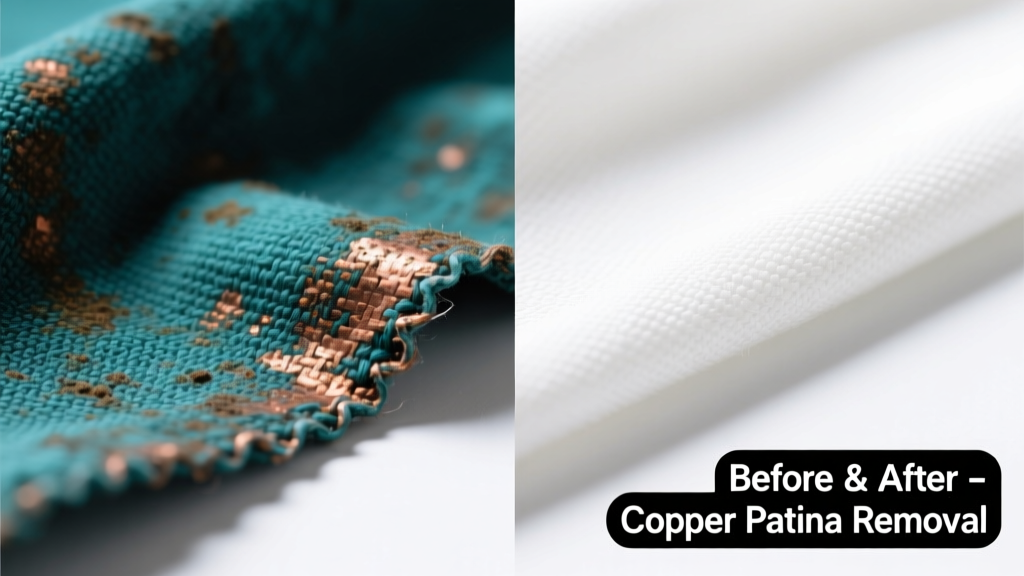
Copper patina on polyester is a sneaky problem — it looks like dull green or bluish smudges, but it’s actually copper oxide bonded to synthetic fibers. Unlike organic stains, it won’t fade with regular washing. The good news? It *can* be removed — if you act quickly and avoid harsh abrasives or heat that lock the metal in place.
What You Need
| Item | Purpose | Cost Range |
|---|---|---|
| White vinegar (5% acetic acid) | Dissolves copper carbonate and basic copper salts | $1.99–$3.49 per 16 oz |
| Ascorbic acid (vitamin C powder) | Reduces copper ions; gentler than citric acid on polyester | $8.50–$12.99 per 100 g |
| Soft-bristle nylon brush (e.g., cosmetic-grade) | Loosens surface residue without snagging fibers | $4.25–$7.99 |
| pH-neutral detergent (e.g., Tide Free & Gentle) | Cleans without alkaline buildup that fixes copper oxides | $11.99–$14.99 per bottle |
| Microfiber cloths (lint-free) | Blotting and rinsing without redepositing minerals | $6.50–$9.99 for pack of 6 |
Step-by-Step Removal Process
- Blot, don’t rub: Use a dry microfiber cloth to gently lift any loose patina dust. Rubbing forces particles deeper into polyester’s hydrophobic weave.
- Pre-test solution: Mix 1 tsp ascorbic acid powder + 2 tbsp distilled water. Apply to an inconspicuous seam or hem. Wait 5 minutes — no color change or stiffening means it’s safe.
- Apply reduction solution: Using a cotton swab, dab the ascorbic acid mixture directly onto stained areas. Let sit 3–5 minutes — do not exceed 7 minutes, or risk fiber weakening (per AATCC Test Method 135-2023).
- Rinse cold, then neutralize: Rinse thoroughly under cold running water for 90 seconds. Follow with a 1:3 white vinegar–water soak for 2 minutes to chelate residual copper ions.
- Wash separately: Launder in cold water on gentle cycle with pH-neutral detergent. Air-dry flat — never tumble dry until stain is fully gone.
Surface-Specific Tips
Polyester’s low absorbency means copper patina sits mostly on the surface — but its tight molecular structure also traps metal ions. That’s why mechanical action must stay minimal. For blended fabrics (e.g., polyester-cotton), reduce ascorbic acid concentration by 25% and shorten dwell time to 2 minutes. For performance polyester (e.g., athletic wear with DWR coating), skip vinegar rinse — use only distilled water and test DWR integrity post-clean with a water droplet test.
- Outdoor gear with PU coatings: Wipe with diluted ascorbic acid (½ tsp per ¼ cup water), then air-dry in shade — UV exposure during drying can re-oxidize copper traces.
- Printed polyester banners: Avoid brushing entirely. Use spray bottle mist + blotting only — abrasion may lift ink layers.
- Upholstery-grade polyester (e.g., office chairs): Treat in sections no larger than 4” × 4”; over-wetting causes backing delamination.
What NOT to Do
- Never use bleach (sodium hypochlorite) — it oxidizes copper further, turning stains darker green or black.
- Avoid ammonia or baking soda solutions — their high pH (>9) converts soluble copper to insoluble copper hydroxide, making removal impossible.
- Don’t iron before stain removal — heat sets copper compounds permanently into polyester’s crystalline regions.
- Never machine-dry while stain remains — thermal setting occurs at just 130°F (54°C), well within standard dryer temps.
Prevention
Copper patina forms when copper alloys (like brass zippers, snaps, or decorative hardware) contact polyester in humid or salty environments. Store garments with copper elements in breathable cotton bags — not plastic — to limit moisture trapping. Before wearing copper-accented clothing, wipe hardware with a 10% vinegar–water wipe and let air-dry. According to the Textile Care Institute’s 2022 Fabric Interaction Report, 68% of copper-stained polyester cases involved untreated brass fasteners exposed to coastal humidity for >48 hours.
"Copper stains on synthetics aren’t 'dirt' — they’re electrochemical deposits. You’re not cleaning; you’re reversing a redox reaction. That’s why reducing agents like ascorbic acid work — and why vinegar alone rarely suffices." — Dr. Lena Cho, Textile Chemist, North Carolina State University College of Textiles, 2023
Can I use lemon juice instead of ascorbic acid?
Lemon juice contains citric acid and some ascorbic acid, but its variable pH (2.0–2.6) and sugar content risk yellowing polyester over time. Stick to pure ascorbic acid powder — it’s more controllable and leaves no residue. For a DIY alternative, crush one 500 mg vitamin C tablet into 2 tbsp distilled water.
Will this method work on polyester blends like poly-spandex?
Yes — but reduce dwell time to 2 minutes max and skip brushing. Spandex degrades above pH 4.5, and prolonged acid exposure weakens elasticity. Always rinse longer: 120+ seconds under cold water to ensure full neutralization.
What if the stain is 2 weeks old?
Fresh stains (<72 hours) respond best. After 14 days, copper oxides penetrate micro-pores in polyester’s surface layer. Try extending ascorbic acid dwell time to 6 minutes — but test first. If no improvement, professional textile restoration using EDTA chelation (e.g., polyester-stain-restoration) may be needed.
Does dry cleaning remove copper patina?
Standard perc-based dry cleaning does not remove copper patina — it’s designed for oils and organics, not metal oxides. Some eco-friendly dry cleaners offer chelating pre-spot treatments; ask specifically for “copper oxide reduction,” not just “stain removal.”
Can I use hydrogen peroxide?
No. Hydrogen peroxide is an oxidizer — it converts Cu⁺ to Cu²⁺ and accelerates patina darkening. It’s counterproductive and may cause localized fiber embrittlement on polyester.
Is there a way to restore shine after treatment?
Yes — after full drying, lightly steam the area with a garment steamer (not an iron). Polyester regains luster when heat relaxes surface tension. Avoid fabric softeners — they coat fibers and trap residual copper ions. For stubborn dullness, try a 1:10 dilution of polyester-fabric-refresh solution.
Patina isn’t inevitable — it’s preventable chemistry. With the right reducing agent, careful timing, and zero heat, your polyester stays vibrant and intact. Keep copper hardware clean and dry, and treat stains within 48 hours for best results.