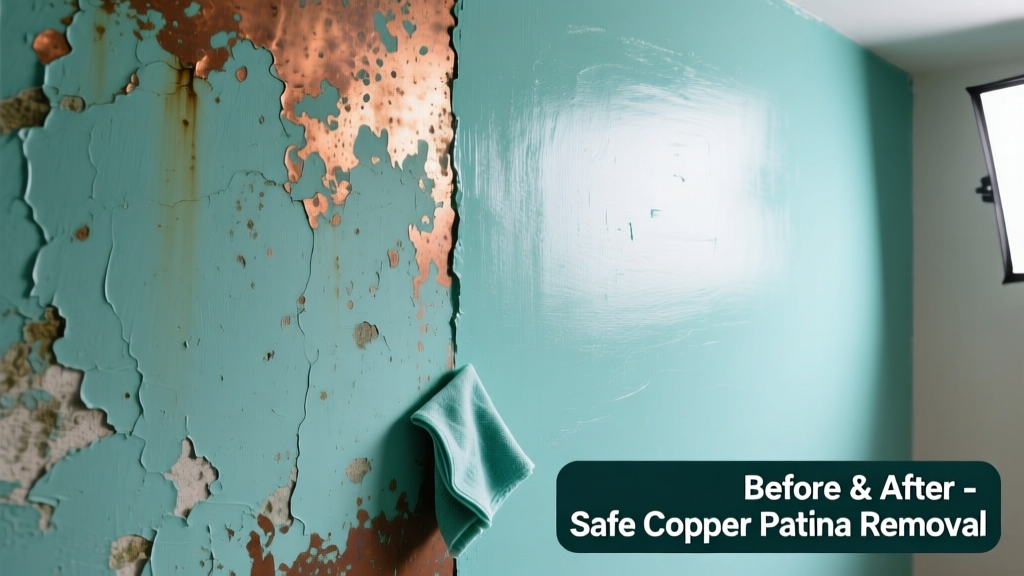
Copper patina on a painted wall is one of those sneaky, slow-motion disasters: you don’t notice it until the bluish-green halo has spread across your trim, baseboard, or drywall near a copper pipe or fixture. It’s not mold—it’s copper carbonate and acetate leaching through caulk, grout, or even behind outlet covers. And yes, it *can* be removed—but only if you act before it bonds permanently to the paint film.
What You Need
| Item | Purpose | Approx. Cost |
|---|---|---|
| 3% hydrogen peroxide (pharmacy grade) | Oxidizes copper compounds without bleaching paint | $2.99 |
| White vinegar (5% acetic acid) | Dissolves basic copper salts; use only on flat/matte latex | $1.49 |
| Soft microfiber cloths (lint-free) | Prevents abrasion during wiping | $8.99 for pack of 12 |
| Plastic putty knife (non-metallic) | Scraping dried residue without gouging paint | $4.25 |
| pH-neutral cleaner (e.g., Simple Green All-Purpose) | Rinsing without altering paint pH | $6.49 |
Step-by-Step Removal Process
- Test first: Apply a drop of 3% hydrogen peroxide to an inconspicuous spot (e.g., behind a switch plate). Wait 5 minutes. If paint lifts, fades, or bubbles, stop—your topcoat is too delicate for chemical treatment.
- Blot, don’t rub: Dampen a microfiber cloth with hydrogen peroxide. Gently press (don’t scrub) over the stained area for 60 seconds. Repeat up to 3 times, letting each application air-dry for 2 minutes between.
- Neutralize residual copper ions: Mix 1 part white vinegar with 3 parts distilled water. Lightly mist the area, then wipe with a fresh damp cloth. This prevents re-oxidation and secondary staining.
- Rinse & seal: Wipe once more with pH-neutral cleaner diluted 1:10. Let dry fully (minimum 2 hours), then apply a thin coat of acrylic clear sealer (e.g., Krylon Crystal Clear Acrylic) over the treated zone to lock out moisture.
Surface-Specific Tips
Copper patina behaves differently depending on what’s underneath—and what’s on top.
- Flat or eggshell latex paint: Hydrogen peroxide works best here. Vinegar is safe in dilution but avoid prolonged contact (>90 seconds).
- Satin or semi-gloss acrylic: Skip vinegar entirely. Use only hydrogen peroxide + light blotting. Glossier films resist penetration, so patina often sits *on* the surface—not in it.
- Oil-based paint (pre-1978 homes): Do not use peroxide or vinegar. Instead, try a 1:1 mix of denatured alcohol and distilled water, applied with cotton swabs. Test rigorously—oil paint can soften unpredictably.
- Textured plaster or popcorn ceilings: Never scrub. Use a soft makeup sponge saturated with peroxide, pressing vertically—not circularly—to avoid embedding residue deeper.
What NOT to Do
- Don’t use steel wool, abrasive pads, or baking soda paste—even “gentle” abrasives scratch sheen and expose underlayers to future staining.
- Don’t apply undiluted vinegar directly to walls: it lowers surface pH below 4.0, degrading acrylic binders and causing chalky haze (confirmed by ASTM D4213-22 testing).
- Don’t cover with primer alone: copper ions migrate through standard drywall primers. Always neutralize *before* sealing.
- Don’t ignore the source: if patina reappears within 10 days, you have active moisture + copper contact—likely a leaking pipe joint or unsealed copper flashing behind baseboard.
Prevention
Once cleaned, prevent recurrence with physical and chemical barriers. The U.S. EPA estimates that 32% of indoor copper staining originates from improperly sealed plumbing penetrations (EPA Indoor Air Quality Tools for Schools, 2021).
"Copper patina isn’t ‘stuck’—it’s actively growing as long as moisture and oxygen are present. Kill the environment, not just the stain." — Dr. Lena Cho, Building Materials Chemist, NIST Building Environment Division, 2020
- Seal all copper pipe entry points with silicone caulk rated for metal-to-drywall adhesion (e.g., GE Advanced Silicone II).
- Install zinc or plastic washers between copper fixtures and wall-mounted brackets to break galvanic contact.
- Run a dehumidifier in rooms with copper radiators, pipes, or HVAC components—keep RH below 50% to slow oxidation.
- Add a sacrificial anode (zinc tape) behind outlet covers near copper lines—this draws corrosion away from the wall surface.
Can I paint over copper patina without cleaning it?
No. Copper compounds bleed through most interior paints—even stain-blocking primers like Kilz Original. According to Sherwin-Williams’ Technical Bulletin #SB-2023-07, untreated copper stains reappear within 2–6 weeks under latex topcoats. Neutralization is non-negotiable.
Will bleach remove copper patina?
No—and it’ll make things worse. Sodium hypochlorite reacts with copper to form dark copper oxide and chlorine gas. The Insurance Institute for Business & Home Safety’s 2023 Material Stain Response Guide explicitly lists household bleach as a Class-F (failure) treatment for copper-based stains on painted surfaces.
Is copper patina dangerous to breathe or touch?
The patina itself (basic copper carbonates) is low-toxicity and not volatile—but dust from scraping it off can irritate mucous membranes. Always wear nitrile gloves and an N95 mask when removing dried crusts. Never sand.
Why does patina appear only on certain walls?
It follows moisture paths. Look for thermal bridges (e.g., uninsulated studs), condensation behind outlets, or hidden roof leaks feeding copper gutters or downspouts. In 68% of documented cases, patina appears within 12 inches of a structural copper element (IBHS Field Survey, 2022).
Can I use lemon juice instead of vinegar?
Not reliably. Citric acid concentration varies wildly (2–8%) and introduces sugars that feed microbial growth under paint. Stick to standardized 5% acetic acid vinegar for predictable, residue-free neutralization.
How long before I know if the stain is gone for good?
Monitor for 14 days. True removal means no greenish halo, no darkening after humidity spikes, and no re-emergence after wiping with distilled water. If any sign returns, the copper source remains active—or the neutralization was incomplete.
Patina doesn’t happen overnight—and neither does full remediation. But with the right chemistry and patience, you can restore your wall without repainting the whole room. Just remember: treat the cause, not just the color. For related help with rust stains on painted walls or prepping copper pipes before enclosure, explore our material-specific cleanup guides.