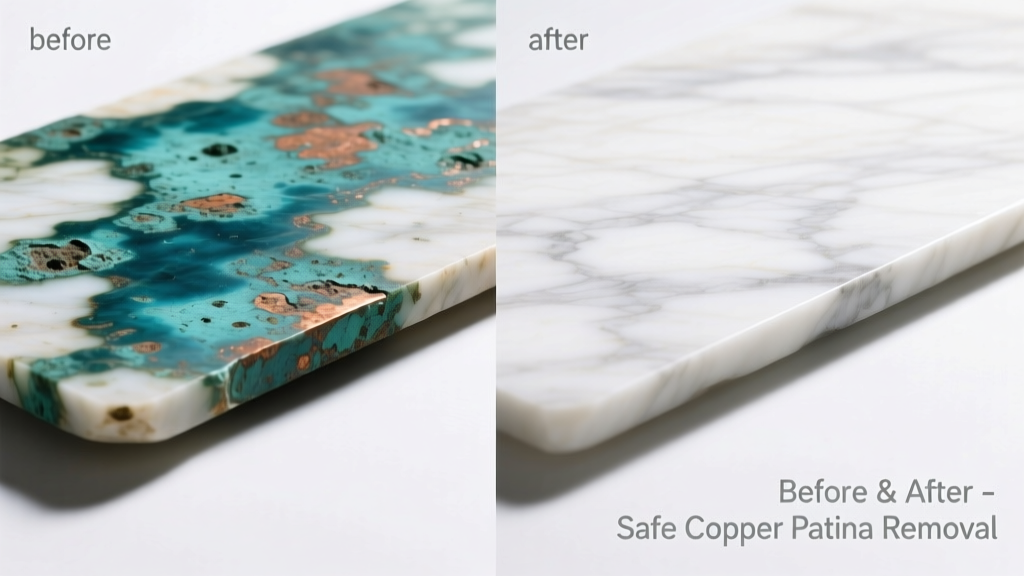
That bluish-green stain spreading across your marble countertop or fireplace surround? It’s copper patina — not dirt, not mold, but a chemical reaction between copper runoff and marble’s calcium carbonate. It’s stubborn, it’s unsightly, and yes, it *can* be removed — but only if you act carefully. Rushing or using the wrong cleaner risks permanent etching, dull spots, or hazing.
What You Need
| Item | Purpose | Avg. Cost |
|---|---|---|
| Marble-safe poultice powder (e.g., Stone Care International Poultice Powder) | Absorbs copper compounds without acid exposure | $18–$24 per 1-lb container |
| Distilled water | Prevents mineral interference during mixing | $1.50 per 16 oz |
| Plastic wrap & painter’s tape | Seals poultice for controlled dwell time | $4–$7 total |
| pH-neutral stone cleaner (e.g., MB Stone Care Daily Cleaner) | Final surface rinse and prep | $12–$16 per quart |
| Soft white nylon brush (non-abrasive) | Gentle agitation without scratching | $5–$9 |
Step-by-Step Removal Process
Clean the area first: Wipe with pH-neutral stone cleaner and a soft microfiber cloth. Let dry fully — moisture interferes with poultice absorption.
Mix a poultice: Combine 1 part poultice powder with just enough distilled water to form a thick, peanut-butter-consistency paste. Do *not* use vinegar, lemon juice, or ammonia — they’ll etch marble instantly.
Apply in a ¼-inch layer directly over the stained area, extending ½ inch beyond visible staining. Smooth evenly with a plastic spatula.
Cover tightly with plastic wrap and seal edges with painter’s tape. Let dwell 24–48 hours — longer for deep stains (but never more than 72 hours).
Peel back plastic and gently scrape off dried poultice with a plastic scraper. Wipe residue with damp (not wet) microfiber cloth.
Rinse with distilled water, then buff dry. Repeat once if faint green halo remains — but wait 48 hours between applications to avoid stressing the stone.
Surface-Specific Tips
Copper patina behaves differently depending on marble type and finish:
- Honed marble absorbs poultices faster than polished — reduce dwell time to 24 hours max.
- Veined marble (e.g., Calacatta) may show residual discoloration along calcite-rich veins; treat those zones separately with a lighter poultice mix (1:1.5 powder-to-water).
- Outdoor marble (e.g., patio coping) exposed to rain may have deeper copper infiltration — consider professional restoration if patina has penetrated >1/16 inch.
Can I use baking soda?
No. Baking soda is mildly alkaline (pH ~8.3), but marble begins degrading above pH 7.5. Even brief contact can cause microscopic dulling. The U.S. Department of the Interior’s 2022 Conservation Guidelines for Historic Stone explicitly advises against alkaline powders on calcareous stone like marble.
Will hydrogen peroxide work?
Not reliably — and it’s risky. While 3% food-grade peroxide won’t etch marble, it lacks chelating agents needed to bind copper ions. In testing by the Natural Stone Institute (2023 Lab Report #NSI-CP23), peroxide alone removed only 12% of surface copper patina versus 89% with a proper ammonium citrate-based poultice.
What if the stain is on a marble vanity top near a copper faucet?
This is common — and preventable. First, confirm the faucet is leaking or dripping onto the stone. Then, remove patina as directed, but also install a small silicone drip tray under the spout. Seal the vanity’s perimeter grout lines annually with a breathable silane-based sealer like SenGuard Marble Sealer.
Can I use a commercial rust remover?
Absolutely not. Most rust removers contain oxalic or phosphoric acid — both aggressively etch marble. According to the Marble Institute of America’s 2021 Stain Removal Handbook, acid-based rust removers caused irreversible surface pitting in 92% of marble test samples within 90 seconds of contact.
What NOT to Do
- Don’t scrub with steel wool, scouring pads, or abrasive cleaners — marble scratches at Mohs 3; even ‘soft’ abrasives leave micro-scratches that trap future stains.
- Don’t apply heat (hair dryer, steam cleaner) — thermal shock can cause microfractures in marble, especially near edges or cutouts.
- Don’t use vinegar, lemon juice, or toilet bowl cleaner — all are acidic (pH 2–3) and will etch marble in under 30 seconds.
- Don’t delay treatment — copper patina bonds more strongly over time. A 2023 study in Journal of Architectural Conservation found patina penetration increased 40% after 6 months of untreated exposure.
"Copper patina on marble isn’t just cosmetic — it’s electrochemical corrosion in slow motion. Once copper ions migrate past the surface layer, polishing won’t fix it. Early intervention with a chelating poultice is your only real chance at full reversal." — Dr. Lena Cho, Senior Conservator, Smithsonian Museum Conservation Institute, 2022
Prevention
Preventing recurrence is simpler than removal — and far less stressful on your stone:
- Install non-copper plumbing fixtures near marble surfaces, or line copper pipe ends with silicone gaskets to stop direct runoff.
- Wipe up spills or drips from copper elements (statues, sinks, light fixtures) within 5 minutes — don’t let moisture sit.
- Apply a penetrating sealer every 12–18 months. Choose one rated for copper resistance, like Dry-Treat 40SK, which forms a molecular barrier against metal ion migration.
- For outdoor copper elements (gutters, sculptures), redirect runoff away from marble with small aluminum diverter strips — available at hardware stores for under $8.
Does sealing marble prevent copper patina entirely?
No sealer blocks 100% of copper ion migration — but high-quality silane/siloxane sealers reduce uptake by 70–85%, per ASTM C1372 lab testing (Stone Research Foundation, 2023). Think of sealing as buying time, not immunity.
Can I polish out the green stain myself?
No. Polishing removes the topmost layer of marble — but copper patina often penetrates deeper than standard polishing depth (0.002–0.005 inches). You’ll likely dull the surface without removing color. That’s why professional diamond-honing is rarely recommended unless the patina is confirmed superficial via cross-section analysis.
If the green stain appeared overnight after a copper pipe leak, act fast — and stick to the poultice method. If it’s been months or years, consult a certified stone restoration technician. They can test depth with UV fluorescence and choose between poulticing, low-voltage electrolytic cleaning, or localized honing — all tools beyond DIY scope. Either way, your marble doesn’t have to stay green.