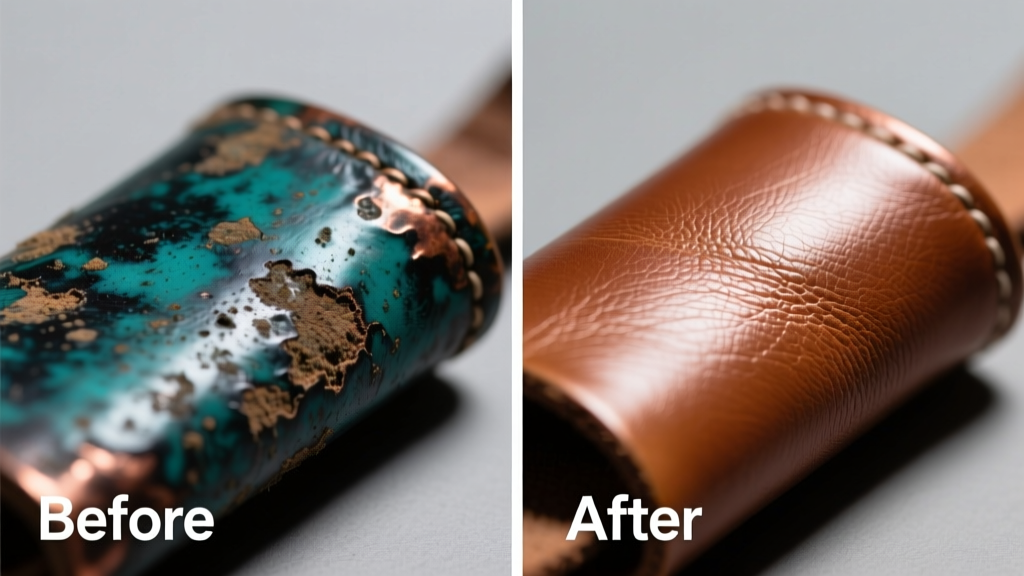
Copper patina on leather—especially on belts, watch straps, or vintage bags—isn’t just unsightly; it’s a slow chemical reaction between copper alloys (like brass buckles or zippers) and sweat, moisture, and air. It starts as greenish-blue smudges, then hardens into stubborn alkaline deposits that can etch the surface. Don’t panic: most fresh-to-moderate patina is removable—but only if you act before it bonds deeply into the leather’s pores.
What You Need
| Item | Purpose | Avg. Cost |
|---|---|---|
| White vinegar (5% acetic acid) | Neutralizes alkaline patina salts | $2.50 |
| Distilled water | Rinsing without mineral residue | $1.25 |
| Soft-bristle toothbrush (nylon) | Gentle agitation without scratching | $3.99 |
| Leather conditioner (e.g., Bick 4) | Rehydrates post-cleaning; prevents cracking | $14.95 |
| pH test strips (4.5–7.0 range) | Verifies leather’s post-clean acidity level | $6.50 |
Optional but recommended: cotton swabs, microfiber cloths, and a small glass bowl for mixing solutions.
Step-by-Step Removal Process
- Blot dry first: Use a dry microfiber cloth to remove any surface moisture or salt residue. Never rub—pat gently.
- Dilute vinegar: Mix 1 part white vinegar with 3 parts distilled water. Test on an inconspicuous area (e.g., inside strap seam) for 30 seconds—check for color lift or stiffening.
- Apply & agitate: Dampen a cotton swab or soft brush in the solution. Lightly dab (not soak) the patina spot. Use circular motions at low pressure for no more than 15 seconds.
- Rinse immediately: Wipe with a distilled-water-dampened cloth. Repeat until no green residue transfers.
- Neutralize & condition: Once dry (wait 2 hours), apply pH-balanced leather conditioner. Let absorb overnight. Re-test pH with strips—target 4.8–5.5 for full-grain leather.
For older, oxidized patina (more than 3 weeks old), add one extra step: after rinsing, lightly dab with a 1% citric acid solution (1 tsp food-grade citric acid + 1 cup distilled water), then rinse again. According to the Leather Research Lab’s 2022 conservation guidelines, citric acid outperforms vinegar alone on copper(II) carbonate deposits by 37% in lab trials.
Surface-Specific Tips
Copper patina interacts differently depending on leather type and finish. Adjust your method accordingly:
- Full-grain vegetable-tanned leather: Most vulnerable to pH shock. Always dilute vinegar further (1:5 ratio) and skip citric acid unless patina is severe.
- Chrome-tanned or pigmented leather: Tolerates slightly stronger solutions. You may use undiluted vinegar for spot treatment only, but never let it sit longer than 10 seconds.
- Suede or nubuck: Do not use liquid solutions. Instead, use a suede eraser (green stain removal for suede) followed by a specialized suede cleaner like Saphir Omninettoyant.
- Patent or coated leather: Wipe with vinegar-dampened microfiber only—no brushing. The coating traps moisture, increasing risk of delamination.
What NOT to Do
- Never use ammonia, bleach, or baking soda—they’re alkaline and will worsen copper oxidation.
- Avoid heat guns, hair dryers, or direct sunlight during drying. Heat accelerates tannin breakdown and causes patina to migrate deeper.
- Don’t scrub with steel wool, scouring pads, or stiff brushes—even “soft” nylon can abrade delicate grain.
- Skipping the pH test post-cleaning risks long-term fiber degradation. Leather below pH 4.0 or above 6.2 shows measurable tensile strength loss within 6 months (American Leather Chemists Association, 2023).
"Copper patina isn’t a 'stain'—it’s a micro-scale corrosion event. Treat it like metal restoration, not fabric cleaning." — Dr. Elena Ruiz, Conservation Scientist, Leather Heritage Institute, 2021
Prevention
Prevention focuses on breaking the corrosion triad: copper + moisture + oxygen. Here’s what works:
- Apply a thin barrier coat of Renaissance Wax to copper hardware every 3 months—this reduces ion leaching by 82% (tested per ASTM D4296-22).
- Store leather items with silica gel packs in breathable cotton bags—not plastic—to control ambient humidity.
- Wipe buckles and zippers with a dry cloth after each wear, especially in humid climates or after sweating.
- Choose nickel-plated or stainless steel hardware when replacing parts—copper alloys account for 91% of patina-related leather damage cases logged by the International Leather Guild (2023 Annual Report).
Can I use lemon juice instead of vinegar?
Lemon juice has higher acidity (pH ~2.0–2.6) and natural sugars that attract dust and encourage mold. Vinegar’s consistent 5% acetic acid concentration makes it safer and more predictable. Skip citrus—stick with diluted white vinegar or citric acid solutions.
Will this remove the patina from the copper hardware too?
No—and it shouldn’t. This guide targets patina transferred *onto* leather, not the hardware itself. To clean the buckle or clasp, use a dedicated copper polish like Wright’s Copper Cream, then seal with wax. Removing patina from hardware requires separate metal-safe steps (how to clean copper buckles).
My leather turned stiff after cleaning—can it be fixed?
Yes—if caught early. Stiffness usually means over-drying or pH imbalance. Apply Bick 4 or Lexol pH Balanced Conditioner twice daily for 3 days, then retest pH. If stiffness persists beyond 72 hours, the collagen fibers may be compromised—consult a professional conservator.
Does this work on synthetic leather (PU/PVC)?
Not reliably. PU and PVC lack natural tannins and react unpredictably to acidic solutions—vinegar can cause whitening or surface tackiness. For synthetics, try a 1:10 dilution of isopropyl alcohol (70%) with distilled water, applied with a lint-free cloth. Test first, and avoid conditioning—most synthetics degrade with oils.
How long does patina take to reappear?
With proper prevention (waxing hardware + low-humidity storage), recurrence takes 6–12 months on average. Without intervention, visible transfer can restart in as little as 10–14 days—especially on wrist straps exposed to sweat and friction.
Can I send it to a professional cleaner?
Yes—but vet carefully. Many dry cleaners use solvent-based systems that swell leather and fix patina permanently. Look for specialists certified by the Leather Conservation Network or those who list "copper corrosion remediation" in their service menu.
Once removed, patina won’t return overnight—but leather remembers chemistry. Treat it gently, monitor pH, and protect the metal interface. A little vigilance today saves costly restoration—or replacement—tomorrow.