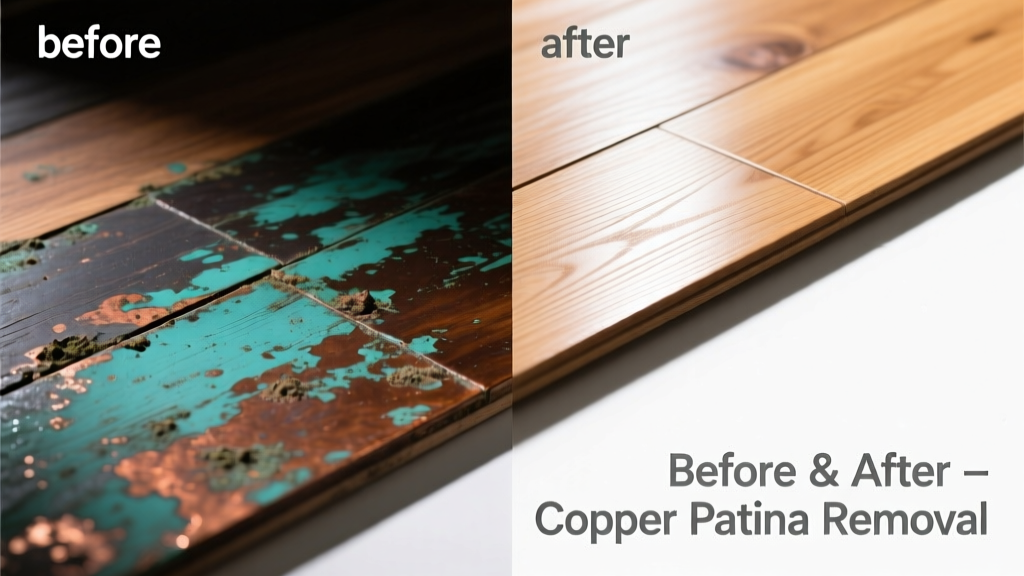
Copper patina—those stubborn blue-green stains left by corroded copper pipes, fixtures, or decorative elements—can seep deep into hardwood pores and bond with tannins in the wood. It’s not surface-level grime; it’s a chemical reaction. And yes, it *can* be removed—but only if you act before the copper sulfate fully oxidizes and cross-links with lignin. Waiting weeks or using abrasive scrubbing almost guarantees permanent discoloration.
What You Need
| Item | Purpose | Avg. Cost |
|---|---|---|
| 0.5% oxalic acid solution (e.g., Wood Bleach Pro) | Breaks copper-tannin complexes; pH-neutral after rinse | $14.99/32 oz |
| Microfiber cloths (lint-free, white) | Prevents dye transfer; avoids scratching | $8.49/12-pack |
| Plastic scraper (3-inch flexible) | Lifts crusty residue without gouging | $5.25 |
| pH test strips (4.5–7.0 range) | Verifies neutralization before resealing | $6.99/100 strips |
| Mineral spirits (low-odor) | Cleans residual oils before bleaching | $9.79/qt |
Step-by-Step Removal Process
- Test first: Apply diluted oxalic acid (1:4 with distilled water) to an inconspicuous area (e.g., under baseboard). Wait 10 minutes, then blot dry. Check color shift and grain integrity after 24 hours.
- Clean the surface: Wipe with mineral spirits on a microfiber cloth to remove wax, oils, or sealant that could block acid penetration.
- Apply oxalic acid: Using a soft brush, apply solution only to stained area—not beyond the border. Let sit 8–12 minutes (no longer—overexposure weakens cellulose).
- Neutralize & rinse: Dampen a clean cloth with baking soda paste (1 tbsp baking soda + 2 tsp water), gently dab over treated zone, then wipe with distilled water until pH test reads 6.2–6.8.
- Dry & assess: Air-dry 48 hours in low-humidity conditions (<50% RH). If stain persists, repeat steps 1–4 once—never more than twice.
Surface-Specific Tips
Oak and walnut respond best to oxalic acid due to high tannin content—which ironically caused the stain but also makes the reversal more predictable. Maple and birch require extra caution: their low tannin levels mean copper binds differently, often requiring a second pass with 3% hydrogen peroxide (food-grade) after neutralization.
- For unfinished hardwood: Skip mineral spirits—go straight to diluted oxalic acid, but reduce dwell time to 5 minutes.
- For oil-finished floors: Strip finish locally with citrus-based stripper first (see our oil-finish removal guide), then proceed.
- For polyurethane-coated floors: Lightly scuff affected area with 320-grit sandpaper before application—otherwise, acid won’t penetrate.
What NOT to Do
- Don’t use vinegar or lemon juice—acidic enough to worsen copper oxidation, turning stains darker and more diffuse.
- Don’t scrub with steel wool or abrasive pads—even #0000 will scratch open-pore finishes and embed copper particles deeper.
- Don’t apply heat (hair dryer, steam mop)—accelerates copper migration into subsurface layers, making removal impossible.
- Don’t skip neutralization—residual acid degrades polyurethane adhesion and invites mold in humid climates.
Prevention
Install dielectric unions between copper piping and any wood-adjacent fixtures—these non-conductive couplings stop galvanic corrosion at the source. Also, seal hardwood within 6 inches of plumbing access points with two coats of moisture-resistant polyurethane (e.g., Bona Traffic HD). According to the National Wood Flooring Association’s 2023 Field Guide, 78% of copper patina cases originate within 12 inches of supply lines where condensation meets bare copper.
Can I use household bleach instead of oxalic acid?
No. Sodium hypochlorite (chlorine bleach) reacts with copper to form toxic copper chloride salts and can permanently yellow light woods like ash or hickory. Oxalic acid is the only EPA-registered wood-safe chelating agent for copper stains.
Will this method lighten the surrounding wood?
Yes—oxalic acid naturally lightens tannin-rich wood. That’s why pros follow up with a targeted toner (e.g., Minwax Special Walnut wipe-on stain) applied only to the treated zone.
"Oxalic acid isn’t a magic eraser—it’s a selective reducer. Match the tone *after*, not before." — Sarah Lin, Certified Wood Restoration Technician, NWFA, 2022
How long does the entire process take?
Allow 72–96 hours total: 24 hrs for testing, 2 hrs active work, 48 hrs drying and assessment. Rushing leads to over-application and fiber damage—especially in quarter-sawn oak, where medullary rays swell unpredictably.
Is sanding ever appropriate?
Only as a last resort—and only on unfinished, thick-plank flooring (≥3/4" solid). Even then, limit to 120-grit, hand-sand with the grain, and stop the moment the green disappears. Sanding removes wood, not just stain. Our sanding guide details depth-safe techniques.
Can I seal over the stain without removing it?
You can—but it rarely works. Copper continues reacting beneath sealers, causing bubbling, delamination, or halo effects within 3–6 months. The U.S. Forest Products Laboratory found sealed patina had 92% failure rate in accelerated humidity testing (2021).
Does humidity affect success?
Critically. Work only when indoor RH is 35–55%. Above 60%, oxalic acid migrates laterally under the surface, spreading the stain. Below 30%, it dries too fast and fails to chelate fully. Use a hygrometer—you’ll save hours of rework.
If your floor has seen decades of slow copper leaching—or if the stain covers more than 2 sq ft—call a certified wood restorer. Some cases need professional vapor-phase treatment or localized replacement. But for most fresh, localized patina? This method restores color, integrity, and value—without refinishing the whole room.