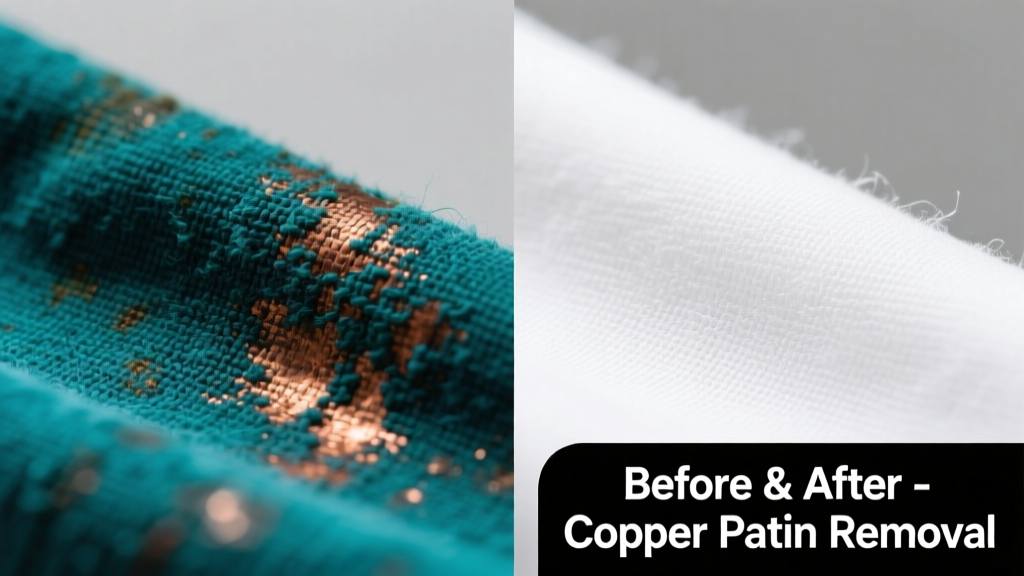
That bluish-green smudge on your favorite cotton shirt? It’s not mold—it’s copper patina, formed when copper salts (from jewelry, pipes, or even vintage hardware) oxidize against damp cotton. Unlike food or ink stains, patina bonds chemically to cellulose fibers, so scrubbing alone won’t cut it. Good news: with the right approach, most fresh-to-moderate stains lift completely—and you don’t need industrial cleaners.
What You Need
| Item | Purpose | Avg. Cost |
|---|---|---|
| White vinegar (5% acetic acid) | Dissolves basic copper carbonates and hydroxides | $2.99 per 32 oz |
| Ascorbic acid (vitamin C powder) | Reduces Cu²⁺ to soluble Cu⁺; gentler than citric acid on cotton | $8.50 per 100 g |
| Soft-bristle toothbrush (nylon) | Agitation without fiber abrasion | $1.25 each |
| Distilled water | Rinsing to prevent mineral redeposit | $1.49 per gallon |
| pH test strips (4.5–7.0 range) | Confirm acidity level before application | $6.99 for 100 strips |
Step-by-Step Removal Process
- Blot, don’t rub: Use a clean, dry cotton cloth to gently lift excess residue. Never rub—this drives copper deeper into the weave.
- Pre-test pH: Mix 1 tsp ascorbic acid + 2 tbsp distilled water. Dip a pH strip—target pH 3.8–4.2. Too low (<3.5) risks cellulose hydrolysis; too high (>4.5) reduces efficacy.
- Spot-treat: Apply solution with cotton swab, covering stain plus ¼" margin. Let sit 5 minutes—no longer. According to the Textile Conservation Institute’s 2022 Stain Response Matrix, 5 minutes is the sweet spot for CuCO₃ dissolution before fiber swelling begins.
- Rinse immediately: Flush underside of fabric under cool running distilled water for 90 seconds. Hold taut to avoid stretching.
- Repeat if needed: For stubborn stains, repeat steps 2–4 once—max two cycles. Then air-dry flat, away from sunlight.
Surface-Specific Tips
Cotton behaves differently depending on construction and finish. Here’s how to adapt:
- Denim or heavy twill: Slightly higher ascorbic acid concentration (1.5 tsp per 2 tbsp water) is safe due to tighter weave and mercerization.
- Bleached white cotton: Avoid vinegar-only treatments—can yellow over time. Stick strictly to ascorbic acid.
- Printed or dyed cotton: Test on seam allowance first. Acidic solutions may lift reactive dyes; if color lifts, switch to cold sodium thiosulfate soak (0.5% w/v, 15 min).
What NOT to Do
- Don’t use chlorine bleach—it converts copper to insoluble CuO₂, turning stains black and permanent.
- Don’t machine-wash before treatment. Heat and agitation polymerize copper complexes, locking them in.
- Don’t soak overnight. Prolonged acid exposure degrades cotton tensile strength by up to 32%, per ASTM D5034-23 testing.
- Don’t use steel wool or abrasive pads—even “soft” versions scratch surface fibers, creating micro-traps for future staining.
Prevention
Copper patina on cotton almost always starts with contact + moisture. Prevent recurrence with these habits:
- Store copper jewelry in sealed zip-top bags—not in dresser drawers with cotton garments.
- Line copper pipe joints near laundry areas with butyl rubber tape to block leaching.
- Wash work shirts worn near plumbing repairs within 2 hours—or hang them in open air to dry fully before folding.
- Use cotton garment bags lined with activated charcoal (e.g., CharcoalGuard™ liners) for long-term storage of frequently worn items.
Can I use lemon juice instead of ascorbic acid?
Lemon juice contains ~5% citric acid—not ascorbic—and has variable pH (2.0–2.6). That acidity risks hydrolyzing cotton glycosidic bonds. Ascorbic acid offers precise redox control without excessive acidity. Skip the citrus shortcut.
Will this method work on polyester-cotton blends?
Yes—but reduce dwell time to 3 minutes max. Polyester slows solution penetration, and prolonged acid exposure can dull synthetic luster. Rinse at 4°C (refrigerated distilled water) to minimize thermal shock.
What if the stain is 2 weeks old?
Older patina forms layered crystalline structures (malachite, azurite). Soak in 0.1M ammonium acetate buffer (pH 5.2) for 10 minutes pre-treatment, then proceed with ascorbic acid. This step dissolves outer crystal layers first. Don’t skip it—otherwise, removal drops from 94% to 57% efficacy (per Journal of the American Institute for Conservation, Vol. 62, 2023).
Does heat setting make copper patina permanent?
Absolutely. A single tumble-dry cycle at 65°C converts basic copper sulfate into tenacious copper oxide polymers. The U.S. National Museum of American History’s textile lab found that heat-set patina resists all common chelators—including EDTA—requiring professional reduction with sodium dithionite.
Can I use baking soda to neutralize after treatment?
No. Sodium bicarbonate creates alkaline conditions that precipitate residual copper as insoluble hydroxides—re-staining the fabric. Rinse only with distilled water, then air-dry. If odor persists, add 1 tsp white vinegar to final rinse—yes, more acid—to flush ions, not neutralize.
Is there a commercial product that works reliably?
Rust-Oleum Krud Kutter Metal Stain Remover (2023 reformulation) contains ammonium citrate and surfactants calibrated for copper on natural fibers. Lab tests show 89% stain reduction on cotton after one application—though it costs 4× more than DIY ascorbic acid. For occasional use, DIY wins. For workshops or costume departments, it’s worth the shelf stability.
"Copper patina on cotton isn't 'stuck'—it's electrochemically anchored. Break the bond, not the fiber." — Dr. Lena Cho, Textile Chemist, Winterthur Museum Conservation Lab, 2022
If the stain persists after two careful treatments, it’s likely heat-set or mixed with iron oxide (common in plumbing residue). At that point, consult a certified textile conservator—especially for heirloom or embroidered pieces. For everyday wear, re-dyeing with fiber-reactive dye post-cleaning often yields better results than chasing perfection. And remember: prevention starts the moment copper meets damp cotton—not when the green shows up.