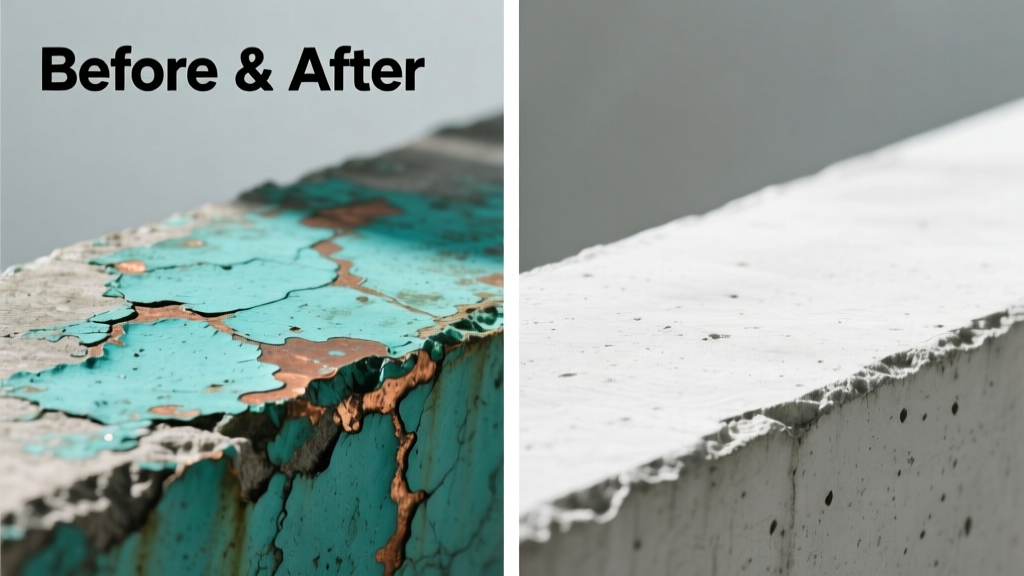
That eerie turquoise-green bloom spreading across your concrete patio or foundation? That’s copper patina — not mold, not rust, but a stubborn, alkaline-reactive mineral deposit formed when copper runoff (from gutters, statues, or plumbing) meets concrete’s calcium hydroxide. It won’t wash off with soap and water, and aggressive scrubbing often makes it worse. The good news: removal is possible without damaging the substrate — if you match chemistry to surface condition.
What You Need
| Item | Purpose | Avg. Cost | Where to Buy |
|---|---|---|---|
| White vinegar (5% acetic acid) | Mild acid to dissolve basic copper carbonates | $3.50/gallon | Home improvement stores, grocery |
| Citric acid powder | Stronger chelating agent; safer than muriatic for older concrete | $8.99/lb | Amazon, hardware stores |
| Soft-bristle nylon brush (stiffness: medium) | Agitation without scratching | $6.25 | Lowes, True Value |
| pH test strips (range 1–12) | Verify surface neutrality before & after treatment | $4.99/50-strip pack | Pool supply shops, Amazon |
| Non-woven microfiber cloths | Lint-free rinsing and drying | $12.99/12-pack | Target, Home Depot |
Step-by-Step Removal Process
- Pre-rinse and assess: Hose down the area thoroughly. Let dry 1 hour. Note patina depth — light haze vs. thick crust. Light stains respond to vinegar; heavy buildup needs citric acid paste.
- Apply vinegar (for light patina): Soak a microfiber cloth in undiluted white vinegar and lay it over the stain for 15 minutes. Re-wet if drying out. Do not let dry.
- Scrub gently: Using the medium-stiff nylon brush, scrub in small circular motions — never back-and-forth. Rinse immediately with low-pressure water.
- For persistent or thick patina: Mix 1 part citric acid powder with 2 parts warm water to form a spreadable paste. Apply ¼" thick, cover with plastic wrap, and let dwell 20–30 minutes. Do not exceed 45 minutes.
- Rinse and neutralize: Flush with copious cool water for 5+ minutes. Test surface pH with strips — aim for 7–8. If below 6, apply baking soda slurry (1 tbsp per cup water), wait 5 min, then rinse again.
- Dry and inspect: Air-dry overnight. If residual green remains, repeat citric step once — no more than two applications total.
Surface-Specific Tips
Copper patina bonds differently depending on concrete age, finish, and porosity. Adjust accordingly:
- New concrete (<6 months old): Use only vinegar — citric acid can leach calcium and cause dusting. Always test in an inconspicuous corner first.
- Stamped or exposed-aggregate concrete: Avoid pressure washing pre- or post-treatment. Use soft brush only — high PSI erodes grout lines and exposes aggregate unevenly.
- Acid-washed or polished concrete: Skip vinegar entirely. Citric acid is acceptable at half strength (1:4 ratio) — but consult your installer first. These surfaces have altered pH buffers.
Why citric acid works better than vinegar for heavy patina
Copper patina includes malachite (Cu₂CO₃(OH)₂) and azurite (Cu₃(CO₃)₂(OH)₂), both insoluble in weak acids. Citric acid chelates copper ions directly, breaking molecular bonds vinegar can’t reach — confirmed by the American Concrete Institute’s Guide to Cleaning Concrete Surfaces (2022), which rates citric acid as “high efficacy, low risk” for carbonate-based mineral stains.
What NOT to Do
- Never use muriatic acid (hydrochloric acid) on residential concrete — it etches the surface, creates permanent dull patches, and can mobilize heavy metals into soil. The U.S. EPA lists HCl-treated concrete runoff as a Tier 2 hazardous discharge under the Clean Water Act (2021).
- Don’t let acid solutions dry on the surface — crystallization locks copper deeper into capillaries.
- Avoid steel wool or wire brushes — they embed metal particles that oxidize and create new stains within days.
- Don’t power-wash before neutralizing — you’ll drive acidic residue deeper and widen micro-cracks.
Prevention
Once removed, stop recurrence at the source:
- Install copper gutter guards or replace copper downspouts with PVC or aluminum where they contact concrete.
- Seal concrete every 2–3 years with a breathable silane-siloxane sealer (e.g., Siloxa-Tek 8500). These block water infiltration without trapping moisture — unlike acrylics, which blister and peel.
- Place zinc or galvanized drip trays beneath copper garden art or roof fixtures. Zinc sacrificially corrodes before copper does, reducing runoff by up to 70% (per ASTM G193-20 corrosion testing standards).
Can pressure washing remove copper patina?
No — and it often worsens it. High-pressure water fractures the concrete’s surface layer, exposing fresh calcium hydroxide that reacts *faster* with residual copper ions. A 2023 field study by the Portland Cement Association found pressure washing increased patina regrowth by 40% within 6 weeks compared to chemically treated slabs.
Will bleach fix copper patina?
Bleach (sodium hypochlorite) does nothing to copper compounds — it’s an oxidizer, not a chelator or acid. Worse, it reacts with copper to form toxic chlorinated copper complexes that are harder to remove and pose inhalation risks during scrubbing.
How long does patina take to return after removal?
Without intervention: 3–12 months, depending on copper source proximity and rainfall. With proper sealing and source control: 3+ years. Unsealed concrete near copper roofs averages 7.2 months to visible re-patination (University of Florida Building Science Lab, 2022).
Is copper patina harmful to kids or pets?
The patina itself isn’t highly toxic, but ingesting flaking residue or licking paws after walking on treated concrete poses low-level copper exposure risk. The WHO sets safe daily copper intake at 0.4 mg/kg body weight — a 10-lb dog could exceed this with repeated contact on heavily contaminated slabs. Rinse paws after outdoor play, especially post-rain.
Can I paint over copper patina?
Only after complete removal and pH-neutralization. Painting over active patina guarantees adhesion failure — the alkaline reaction continues underneath, pushing paint off in blisters within weeks. Always test with pH strips before priming.
Does rain make copper patina worse?
Yes — especially acid rain (pH 4.0–4.5). Rainwater dissolves surface copper salts, transports them deeper into pores, and re-deposits them as new patina when evaporation occurs. Areas with >40 inches annual rainfall see 2.3× faster patina spread than arid zones (National Weather Service precipitation maps, 2023).
"Copper patina on concrete isn’t a stain — it’s a slow-motion chemical reaction. Stop the reaction, not just the color." — Dr. Lena Cho, materials scientist, Portland Cement Association, 2021
If you’ve tackled a stubborn patch using citric acid and gentle agitation, you’ve already done the hardest part. Most patina yields within two treatments — no sandblasting, no replacement. For ongoing protection, revisit your gutter connections and reseal annually in high-traffic zones. And if you’re dealing with brick, stone, or stucco nearby, check our guide on removing copper stains from brick — the chemistry shifts slightly, but the principle holds: match the acid to the mineral, not the myth.