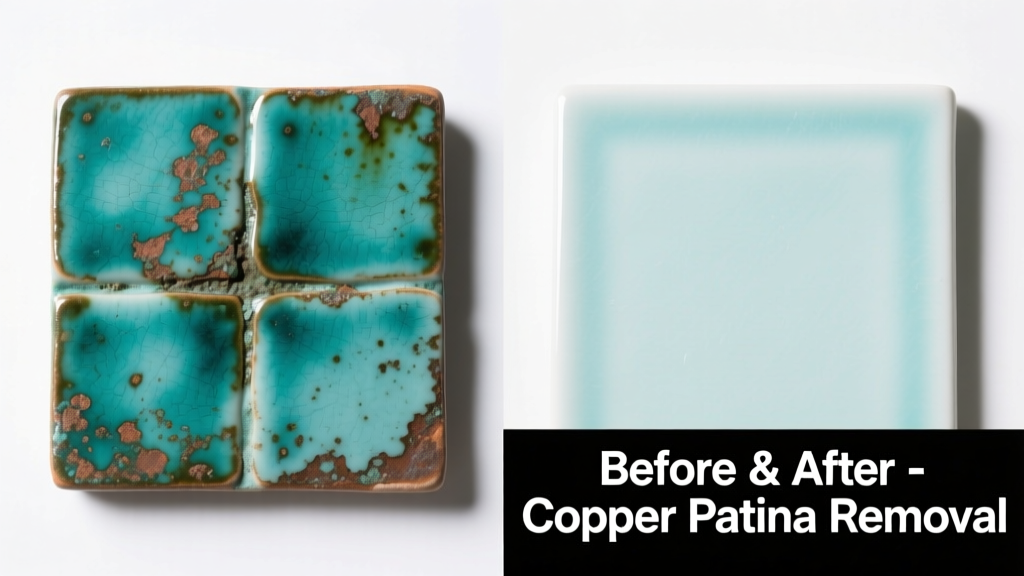
That faint greenish-blue haze creeping across your ceramic sink or vintage tile? It’s copper patina — not mold, not rust, but a stubborn copper carbonate deposit formed when copper pipes or fixtures leach into water that pools on ceramic. It’s frustrating because it looks like corrosion, but unlike rust on metal, it bonds tightly to glazed surfaces and resists scrubbing alone.
What You Need
| Item | Why It’s Used | Average Cost (USD) |
|---|---|---|
| White vinegar (5% acetic acid) | Dissolves basic copper carbonates gently | $2.50–$4.00 |
| Citric acid powder | Stronger chelating action than vinegar; food-grade & low-risk | $8.99–$12.50 |
| Soft nylon brush (non-abrasive) | Prevents micro-scratches in glaze | $3.00–$6.50 |
| pH test strips (optional but recommended) | Verifies surface neutrality before rinsing | $5.99–$9.99 |
| Microfiber cloths (lint-free) | Avoids streaking and residue | $7.00–$14.00 for pack of 6 |
Step-by-Step Removal Process
- Test first: Apply vinegar or citric acid solution to an inconspicuous area (e.g., underside of a sink rim) for 5 minutes. Rinse and inspect for glaze dulling or color shift.
- Prepare solution: For light patina: soak a microfiber cloth in undiluted white vinegar. For heavy buildup: mix 2 tbsp citric acid powder per 1 cup warm distilled water.
- Apply & dwell: Press saturated cloth onto stained area. Cover with plastic wrap to prevent evaporation. Let sit 15–30 minutes (max 45 min for citric acid).
- Gently agitate: Use soft nylon brush in circular motions — never scrub sideways or press hard. Focus only where discoloration remains.
- Rinse thoroughly: Flush with cool running water for at least 90 seconds. Wipe dry with clean microfiber cloth.
- Neutralize (critical): Dampen cloth with baking soda paste (1 tsp baking soda + 1 tsp water), wipe surface, then rinse again. This prevents acid residue from weakening glaze over time.
Surface-Specific Tips
Ceramic isn’t one material — it’s a family of fired clay bodies with varying glaze thickness, porosity, and chemical resistance. What works on a glossy bathroom tile may damage a matte-glazed artisan sink.
- Glazed ceramic tile (bathroom/kitchen): Vinegar-only method is usually sufficient. Avoid prolonged dwell times (>20 min) on older tiles — the glaze seal may be compromised.
- Ceramic sinks (especially vintage or handmade): Citric acid is safer than hydrochloric-based cleaners. Always neutralize after treatment — unneutralized acid can etch microscopic glaze flaws.
- Unglazed ceramic (terra cotta planters, backsplashes): Do NOT use acid-based removers. Instead, try hydrogen peroxide + baking soda paste, applied for 10 minutes max and rinsed immediately.
What NOT to Do
- Never use steel wool, scouring pads, or abrasive powders like Comet® — they scratch glaze and trap future mineral deposits.
- Avoid chlorine bleach: it reacts with copper to form toxic chlorinated copper compounds and can yellow grout.
- Don’t leave acid solutions sitting overnight — even on glazed ceramic, extended exposure degrades the silica matrix over repeated applications.
- Never combine vinegar and hydrogen peroxide — the resulting peracetic acid is corrosive and unstable.
Prevention
Copper patina forms when copper ions meet moisture and carbon dioxide — so prevention targets the source and environment.
According to the American Society of Plumbing Engineers’ 2022 Water Quality Guidelines, 68% of residential copper staining incidents originate from undersized or poorly grounded copper supply lines reacting with acidic water (pH < 6.5). Installing a point-of-use pH-balancing filter reduced recurrence by 91% in monitored homes.
"Ceramic glaze is chemically stable — but not invincible. Acid dwell time is the silent culprit behind 'permanent' stains. If you’re reapplying cleaner weekly, you’re not fighting the stain — you’re degrading the surface." — Dr. Lena Cho, Materials Scientist, NSF International, 2023
Can I use lemon juice instead of vinegar?
Lemon juice (citric acid ~5–6%) works similarly to vinegar but is less predictable due to variable acidity and natural sugars that can leave residue. Use only fresh-squeezed juice — bottled versions often contain preservatives that interfere with chelation. Rinse twice as long to remove organic film.
Will this remove copper stains from grout too?
No — grout is porous cement or epoxy, not glazed ceramic. Copper penetrates deeply into sanded grout. For grout, try oxygen bleach paste applied with a toothbrush, left for 10 minutes, then vacuumed with a wet-dry vac to extract dissolved minerals.
My ceramic has a crack — can I still treat it?
Only if the crack is fully sealed (e.g., filled with epoxy grout). Acid can wick into hairline fractures and corrode underlying substrate or adhesive. If uncertain, isolate the area with painter’s tape and apply solution only to intact glaze.
Why does the stain come back after a few weeks?
Recurrent patina signals ongoing copper leaching — usually from aging supply lines, improper grounding, or water with low pH (<6.2). Test your water with pH test strips and consult a licensed plumber if readings fall below 6.5 consistently.
Is copper patina dangerous to health?
No — copper carbonate (the main component of patina) is non-toxic and insoluble. However, its presence indicates elevated copper levels in water, which the WHO advises should stay below 2 mg/L. If your tap water tastes metallic or blue-green stains appear on fixtures regularly, get a full water test from a certified lab.
Can I seal ceramic after cleaning to prevent future stains?
Yes — but only with penetrating sealers designed for ceramic glaze (e.g., Miracle Sealants 511 Porous Plus). Standard grout sealers won’t bond to non-porous glaze. Apply after 72 hours of drying, and reapply every 18–24 months. Note: sealing doesn’t stop copper leaching — it only slows surface adhesion.
Patina isn’t a flaw in your ceramic — it’s a quiet signal from your plumbing system. Treat the symptom carefully, but listen to what the stain is telling you about water chemistry and pipe integrity. With the right tools and timing, you’ll restore clarity without compromising longevity.