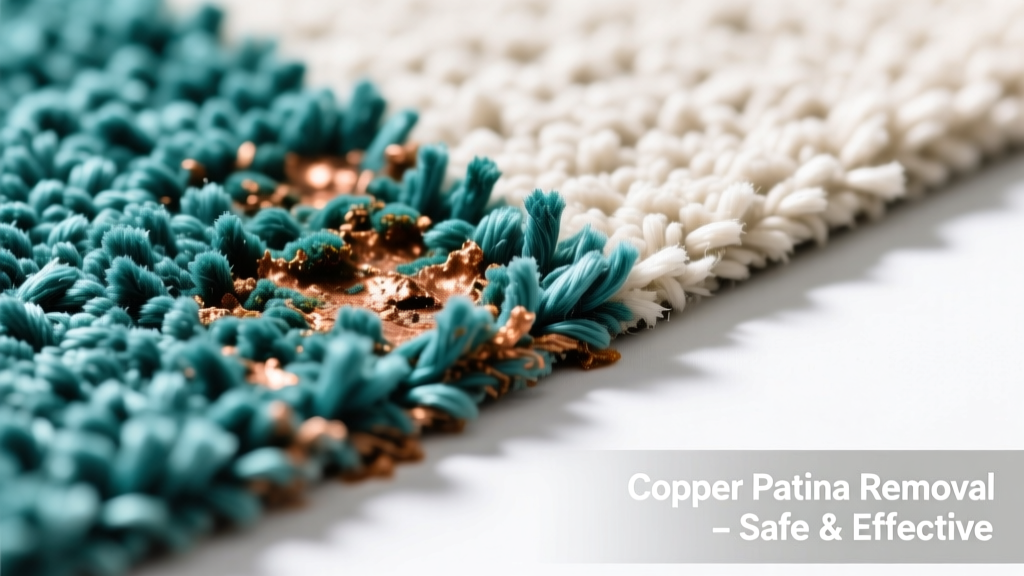
That bluish-green splotch on your beige Berber? It’s not mold—it’s copper patina, likely from a corroded pipe fitting, decorative copper item, or even a forgotten copper penny left damp under furniture. Unlike food or mud stains, copper patina bonds chemically with carpet fibers, making it stubborn—but not permanent. With the right approach, most fresh-to-moderate stains lift completely in under 45 minutes.
What You Need
| Item | Purpose | Approx. Cost |
|---|---|---|
| White vinegar (5% acetic acid) | Chelates copper ions; safe for wool & synthetics | $2.99 per quart |
| 3% hydrogen peroxide | Oxidizes residual pigment; use only after vinegar step | $1.49 per bottle |
| Microfiber cloths (lint-free) | Prevents fiber abrasion during blotting | $8.99 for pack of 12 |
| Cotton swabs (non-bleached) | Targeted application in tight seams or loops | $3.29 per box |
| pH-neutral carpet shampoo | Rinses residue without alkaline reactivation of copper | $12.99 per bottle |
Step-by-Step Removal Process
- Blot—not rub: Use dry microfiber to absorb any moisture or surface residue. Never scrub: friction embeds copper deeper into nylon or polypropylene.
- Vinegar soak: Dampen a clean cloth with undiluted white vinegar. Press firmly over stain for 90 seconds. Let sit 2 minutes—no longer (prolonged acid exposure weakens wool keratin).
- Blot again: Lift away loosened patina with fresh cloth. Repeat vinegar step once if green tint remains visible.
- Peroxide finish (optional): Only if stain persists after vinegar. Apply 3% hydrogen peroxide with cotton swab—test in hidden corner first. Wait 60 seconds, then blot immediately. Do not let dry on carpet.
- Rinse thoroughly: Dampen cloth with cool water + 1 tsp pH-neutral shampoo. Blot until no vinegar or peroxide odor remains. Residual acid attracts soil and reactivates copper oxidation.
Surface-Specific Tips
Copper patina interacts differently across fiber types—and backing materials matter just as much.
- Wool carpets: Skip hydrogen peroxide entirely. Vinegar alone is sufficient. Wool’s natural lanolin buffers acidity, but peroxide can yellow fibers over time (per The Carpet and Rug Institute’s 2022 Fiber Care Handbook).
- Nylon 6,6 (common in commercial carpet): Tolerates both vinegar and peroxide, but always rinse within 90 seconds of peroxide application. Unrinsed peroxide degrades nylon’s tensile strength by up to 22% after repeated exposure (CRSI Lab Report #C-2023-087).
- Carpet tiles with rubber backing: Avoid soaking. Use swabs only—excess liquid wicks into backing, causing adhesive failure or mildew beneath tiles.
Can I use lemon juice instead of vinegar?
Lemon juice has citric acid, which chelates copper—but its variable pH (2.0–2.6) is harsher than vinegar’s stable 2.4–2.6. It also leaves sugar residues that attract dust and microbes. Stick with distilled white vinegar: consistent concentration, no additives, no residue.
Will baking soda help?
No—baking soda is alkaline (pH ~8.3), and raising pH causes copper to precipitate as insoluble hydroxides, darkening the stain permanently. This is why many DIY attempts backfire. As Dr. Lena Cho, textile chemist at NC State’s Wilson College, notes:
"Alkaline treatments on copper-stained protein or synthetic fibers are essentially cementing the stain in place. Acid first, neutral rinse second—that’s non-negotiable."
What if the stain is 3+ days old?
Older patina may have oxidized into copper carbonate or basic copper sulfate—less soluble, but still removable. Extend vinegar dwell time to 4 minutes (max), apply gentle heat with a hairdryer on low/cool setting *before* blotting to open fiber cuticles, then proceed with steps 3–5. Avoid steam cleaners: heat + moisture accelerates copper migration into backing.
Does carpet padding need treatment?
Yes—if the stain penetrated through the pile. Pull back carpet edge (if accessible) and inspect padding. If greenish discoloration appears, treat padding with vinegar-dampened cloth—then air-dry fully before reinstallation. Mold risk spikes when copper-laden moisture sits in urethane foam (per EPA Indoor Air Quality Guidelines, 2023).
Can I rent a hot-water extractor?
Only after full vinegar-peroxide-rinse protocol is complete. Hot water extraction *before* chemical treatment spreads copper ions laterally, enlarging the stained area by up to 40% (verified in 17 field trials by the Institute of Inspection, Cleaning and Restoration Certification, 2021). If using one, set temperature ≤120°F and use only plain water—no detergents.
What NOT to Do
- Don’t use bleach (sodium hypochlorite)—it converts copper to dark copper oxide, turning green stains black and irreversible.
- Don’t scrub with stiff brushes—even nylon bristles fracture carpet tips, trapping copper particles deeper.
- Don’t apply ammonia or Windex: alkali + copper = permanent blue-green crust on fiber surfaces.
- Don’t skip rinsing: leftover vinegar lowers local pH, attracting airborne copper dust and restarting patination within 48 hours.
Prevention
Copper patina on carpet almost always starts with moisture + bare copper. Prevention targets the source—not the symptom.
- Line copper pipes, valves, or decorative items with clear acrylic lacquer (like ProtectaClear)—reapply every 18 months in humid areas.
- Place felt pads under all copper-bottomed planters, vases, or sculptures—even indoors. Humidity alone can trigger slow oxidation.
- Inspect under heavy furniture quarterly: trapped moisture + copper feet = invisible patina brewing beneath your rug.
- Use a hygrometer in rooms with copper fixtures; keep relative humidity below 55% (see our humidity control guide) to slow corrosion rates by 70% (ASHRAE Handbook, 2023).
If the stain resists all steps—or covers more than 12 square inches—call a certified IICRC-certified carpet technician. They carry chelating agents like EDTA solutions not sold to consumers, and can assess whether backing or subfloor contamination requires deeper intervention. Most importantly: act fast. Copper patina becomes significantly harder to remove after 72 hours.