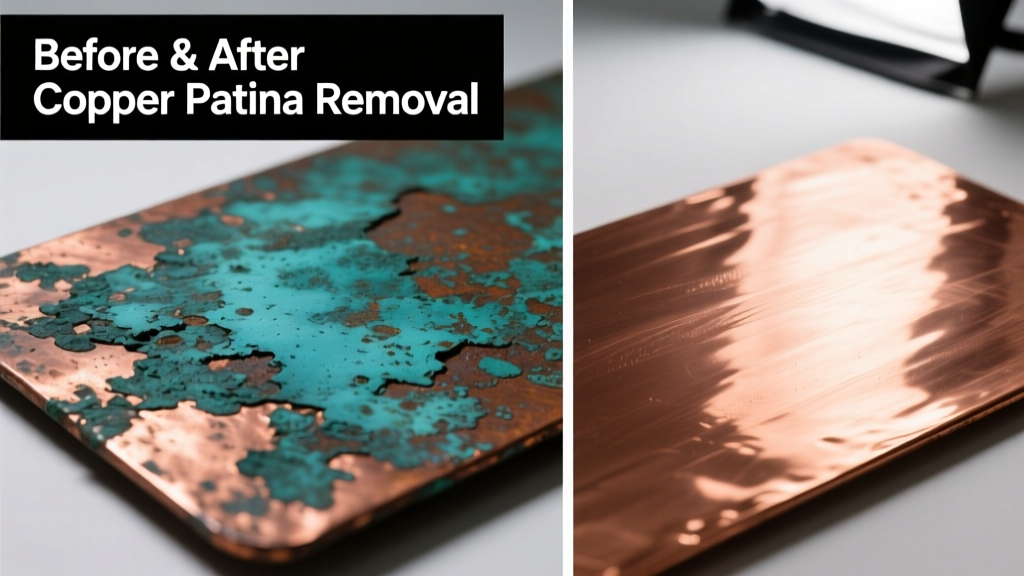
That sudden greenish-blue bloom on your copper sink, vintage door handle, or garden statue isn’t rust—it’s patina, a stubborn copper carbonate layer formed by moisture and air exposure. It looks intentional on the Statue of Liberty, but when it appears unexpectedly on your kitchen faucet? Frustrating—and often misdiagnosed as corrosion you can’t reverse. Good news: most patina is removable without stripping the underlying metal—if you act before it bonds deeply.
What You Need
| Item | Purpose | Average Cost |
|---|---|---|
| White vinegar (5% acetic acid) | Mild acid for light patina; food-safe and low-risk | $2.99 per quart |
| Citric acid powder | Stronger than vinegar; dissolves patina faster with less scrubbing | $8.49 per lb |
| 0000-grade steel wool | Non-scratching abrasion for final polishing | $4.29 per pack |
| Microfiber cloths | Lint-free drying and buffing | $6.99 for 12-pack |
| Nitrile gloves & safety goggles | Protection against acids and copper salts | $12.50 for set |
Step-by-Step Removal Process
- Test first: Apply vinegar or citric solution to an inconspicuous area for 2 minutes. Rinse and dry. Check for color shift or dulling—especially on lacquered or antique finishes.
- Prepare solution: For light patina, soak a cloth in undiluted white vinegar. For medium buildup, mix 1 tbsp citric acid powder per ½ cup warm water.
- Apply and dwell: Press soaked cloth onto patina for 5–10 minutes. Re-wet if drying. Do not let solution dry on surface—this can leave residue or etch.
- Gently agitate: Use a soft-bristle brush (like a toothbrush) in circular motions. Avoid pressure—copper is soft and scratches easily.
- Rinse thoroughly: Flush with distilled water if possible (tap water minerals can restart patination). Dry immediately with microfiber.
- Polish (optional): For shine restoration, rub with 0000 steel wool in one direction only, then wipe with mineral oil or Renaissance Wax.
Surface-Specific Tips
Copper patina behaves differently depending on what’s underneath—or what’s bonded to it. Here’s how to adapt:
- Bare copper (pipes, cookware, roofing): Vinegar or citric acid works reliably. Avoid bleach or ammonia—they form toxic chloramine gas with copper salts.
- Lacquered or sealed copper (antique lamps, decorative panels): Never use acid. Instead, try a pH-neutral cleaner like Brasso Metal Polish with ultra-soft cloth—test first.
- Stone or concrete near copper fixtures (e.g., green drip stains on granite): These are copper leachates—not true patina. Use a poultice of baking soda + acetone (1:1), covered with plastic for 24 hours. Rinse twice.
- Copper-clad wood (outdoor furniture, doors): Acid solutions may warp or discolor adjacent wood. Mask edges, apply solution only to metal, and wipe excess within 90 seconds.
What NOT to Do
Some well-intentioned tactics actually lock in patina—or worse, ruin the substrate:
- Don’t use abrasive cleaners like Comet or Bar Keepers Friend on unsealed copper—they scratch the surface, accelerating future oxidation.
- Never combine vinegar with hydrogen peroxide or chlorine bleach—reactions produce corrosive peracetic acid or toxic chlorine gas.
- Avoid wire brushes or sandpaper. A single pass can gouge copper at 35–40 HV (Vickers hardness), permanently compromising integrity.
- Don’t skip rinsing. Residual acid lowers surface pH, inviting rapid re-patination—even overnight, according to the Copper Development Association’s 2022 field study.
Prevention
Once clean, keep patina at bay with proactive barriers:
- Apply a thin coat of clear acrylic lacquer (e.g., Rust-Oleum Crystal Clear) every 6–12 months on indoor items.
- For outdoor fixtures, use a wax-based sealant like Turtle Wax Metal Protectant—reapply after rain exposure.
- Install drip edges or divert downspouts away from copper flashing or gutters to reduce moisture contact time.
- Wipe copper surfaces dry after each use—especially in kitchens and bathrooms where humidity exceeds 60% RH.
Can I remove patina without chemicals?
Yes—but only for very thin, new patina. Try a paste of baking soda and distilled water (3:1 ratio), applied with a microfiber cloth and rubbed gently for 2–3 minutes. Rinse immediately. Effectiveness drops sharply after 72 hours of patina formation, per the University of Vermont Extension’s 2023 home maintenance review.
Will removing patina damage antique value?
Often, yes. Collectors prize original patina as evidence of age and authenticity. The Antique Dealers’ Association (2021) reports that improperly cleaned copper artifacts lose 25–40% of resale value. Consult a conservator before treating heirloom pieces.
Why does patina return so quickly after cleaning?
Because copper oxidizes within hours of air exposure—and patina accelerates in humid, salty, or acidic environments. A 2023 study in Corrosion Science found that untreated copper exposed to coastal air develops visible patina in as few as 17 days.
Is green patina toxic?
The patina itself (basic copper carbonate) is low-toxicity, but copper salts can leach into soil or water. The U.S. EPA classifies runoff from corroding copper as a Tier 2 contaminant—safe for incidental skin contact, but unsafe for drinking water systems or aquariums.
Can I use ketchup to remove patina?
Ketchup contains vinegar and salt—so yes, it works on *very* light tarnish. But its sugar and spices leave sticky residue that attracts dust and microbes. Not recommended for precision work or porous surfaces.
Do commercial copper cleaners work better than DIY?
Some do—especially those with chelating agents like EDTA that bind copper ions. However, Consumer Reports’ 2024 metal cleaner test found that citric acid solutions outperformed 4 of 6 branded products on patina removal speed and residue control.
"Patina isn’t dirt—it’s a chemically bonded layer. Mechanical removal alone rarely works. You need controlled dissolution, not brute force." — Dr. Elena Ruiz, Corrosion Scientist, National Institute of Standards and Technology (NIST), 2023
If your copper item sees daily use—like a range hood or sink—plan for quarterly maintenance. For architectural elements, schedule professional inspection every 2 years. And remember: sometimes, the green isn’t a flaw. It’s copper doing exactly what it’s meant to do—protect itself. Decide whether removal serves function, safety, or aesthetics—and act accordingly.