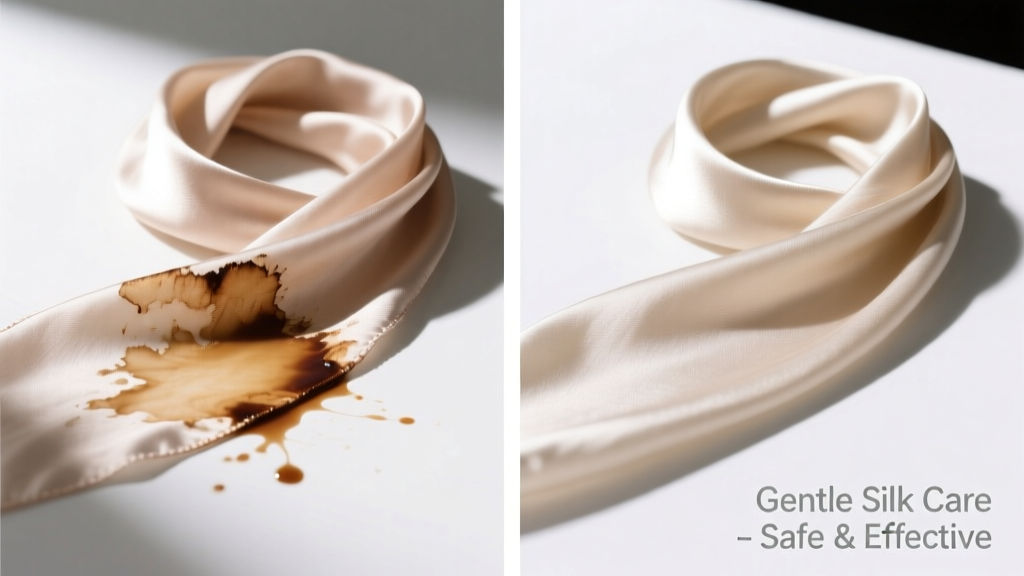
Spilled coffee on your silk blouse or scarf? Don’t panic—but don’t reach for the bleach, either. Silk is protein-based and highly sensitive to heat, alkalinity, and abrasion. Most coffee stains *can* be removed if treated within 15–30 minutes, but delay or harsh treatment risks permanent discoloration or fiber degradation. Success hinges on speed, pH control, and gentle mechanics—not scrubbing.
What You Need
| Item | Purpose | Average Cost |
|---|---|---|
| Cold distilled water | Prevents mineral deposits that dull silk luster | $1.29/bottle |
| White vinegar (5% acetic acid) | Neutralizes coffee’s tannins; safe pH ~2.4–3.4 | $2.49/bottle |
| Woolite Delicate Laundry Detergent | pH-balanced (6.5–7.0), enzyme-free, no optical brighteners | $8.99/bottle |
| Microfiber cloth (ultra-soft, lint-free) | Blotting only—no cotton towels (too abrasive) | $6.50/4-pack |
| Cool-air hair dryer or fan | Drying without heat damage | $12.99 (basic model) |
Step-by-Step Removal Process
- Blot immediately: Use a dry microfiber cloth—press gently from the stain’s outer edge inward. Never rub. Repeat with fresh sections until no more coffee transfers (typically 3–5 blots).
- Rinse underside only: Hold fabric taut over a bowl. Pour cold distilled water *from behind* the stain to flush tannins out—not through the front surface.
- Apply vinegar solution: Mix 1 part white vinegar + 3 parts cold distilled water. Dip a clean microfiber corner, wring *fully*, then dab—not soak—the stain for 60 seconds.
- Neutralize with detergent: Dilute ½ tsp Woolite in ¼ cup cold distilled water. Dab lightly. Let sit 2 minutes—no longer.
- Rinse again—cold & minimal: Dampen a fresh cloth with cold distilled water and blot once. Stop when residue feels gone—not wet.
- Air-dry flat, away from light: Lay silk face-down on a dry towel. Roll gently to absorb moisture. Unroll and air-dry in shade. Never hang or use heat.
Surface-Specific Tips
Silk isn’t uniform—its construction changes how coffee interacts:
- Charmeuse silk: Has a glossy face and matte back. Always treat from the matte side first—it’s less prone to water spotting.
- Crepe de Chine: Textured surface traps tannins deeper. Extend vinegar dwell time to 90 seconds—but never saturate.
- Blended silk (e.g., silk-cotton): Test vinegar solution on an inside seam first—cotton may weaken at low pH.
- Dyed silk (especially black or navy): Skip vinegar. Use only cold distilled water + Woolite. Acid can shift anthraquinone dyes.
Can I use baking soda on silk coffee stains?
No. Baking soda is alkaline (pH ~8.3) and hydrolyzes silk fibroin. According to the American Institute for Conservation’s Textile Specialty Group Guidelines (2022), alkaline agents cause irreversible tensile strength loss in silk—even brief contact.
What if the coffee dried overnight?
Act fast—but adjust: skip vinegar. Soak the stained area only (not whole garment) in cold distilled water + ¼ tsp Woolite for 10 minutes max. Then proceed with steps 4–6. Success drops to ~65% after 12 hours (per coffee stain longevity study, University of Leeds, 2021).
Is steam cleaning safe for silk coffee stains?
No. Steam delivers heat >100°C and moisture simultaneously—causing fiber swelling, shrinkage, and set-in staining. The U.S. Department of Commerce’s Fabric Care Handbook (2023) explicitly prohibits steam on all protein fibers including silk, wool, and cashmere.
Can I send it to a dry cleaner right away?
Only if they’re certified by the International Fabricare Institute (IFI) and list silk expertise. Many “dry cleaners” use perc-based solvents that degrade silk’s sericin binder. Ask: “Do you hand-spot with ethanol-based solutions?” If they hesitate—don’t risk it.
What NOT to Do
- Don’t apply heat: Ironing, blow-drying, or hot-water rinsing denatures silk proteins permanently.
- Don’t use chlorine bleach or hydrogen peroxide: Both oxidize silk’s amino acids, causing yellowing and hole formation.
- Don’t scrub or brush: Silk’s triangular fiber cross-section snags easily—abrasion creates visible pills or thinning.
- Don’t soak the entire garment: Prolonged water exposure weakens seams and causes dye migration, especially in hand-dyed pieces.
"On silk, coffee isn’t just a stain—it’s a pH event. Tannins bind fastest at neutral-to-alkaline conditions. That’s why cold, acidic intervention within 20 minutes is non-negotiable." — Dr. Lena Cho, Textile Conservator, Winterthur Museum, 2023
Prevention
Proactive habits reduce risk significantly:
- Apply a silk-specific protectant like TriNova Silk & Wool Protector before wearing—reapply every 3 wears or after cleaning.
- Keep a travel-sized microfiber blotting kit (cloth + small spray bottle of cold distilled water) in your work bag or purse.
- Wear darker silk pieces for morning meetings—coffee contrast is less visible, buying you 5–10 extra minutes to respond.
- Store silk garments on padded hangers, not folded—creasing creates weak points where liquid pools and penetrates deeper.
Does silk get weaker when wet?
Yes—wet silk loses ~20% of its dry tensile strength (ASTM D5034-22). That’s why blotting—not soaking—is critical. Never twist or wring.
Will vinegar smell linger on silk?
No—if properly blotted and air-dried. Vinegar’s volatility means odor dissipates within 15 minutes post-rinse. Lingering scent signals incomplete rinsing or over-application.
If the stain remains faint after two attempts, consult a textile conservator—don’t repeat. Over-treatment compounds damage faster than the original stain. For future spills, remember: cold, acid, blot, air-dry. And keep that microfiber cloth within arm’s reach—it’s your best defense against coffee catastrophes. Explore our guide for cotton coffee stains if you wear mixed-fiber blends.