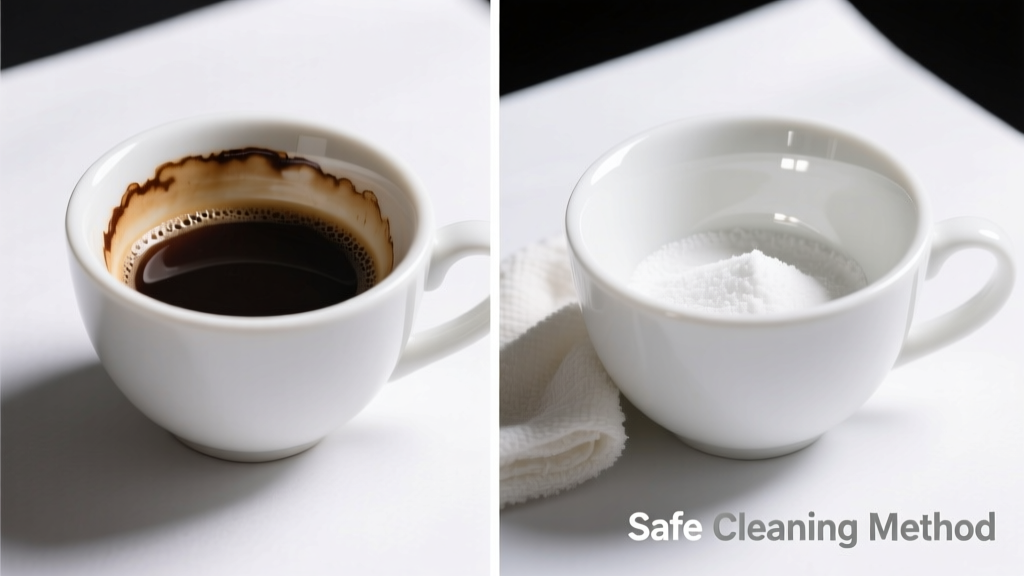
That brown ring around your porcelain sink or the stubborn stain inside your favorite mug? Coffee tannins bind fast—and once they oxidize, they turn stubborn. The good news: porcelain’s non-porous glaze means most coffee stains are *surface-level* and removable if treated within 24–48 hours. Delayed action increases risk of permanent discoloration, especially on older or micro-scratched surfaces.
What You Need
| Item | Why It Works | Avg. Cost |
|---|---|---|
| Baking soda (Arm & Hammer) | Mild abrasive + alkaline pH neutralizes acidic tannins | $1.99 |
| White vinegar (3–5% acetic acid) | Dissolves mineral deposits that trap pigment | $2.49 |
| Oxygen bleach (OxiClean MaxForce Gel) | Non-chlorine, color-safe oxidizer breaks down organic pigments | $6.79 |
| Soft nylon brush (e.g., OXO Good Grips) | Won’t scratch glaze; bristles reach grout lines | $4.99 |
| Microfiber cloth (Bamboo-based) | Lint-free, low-abrasion drying prevents streaking | $8.50 for 6-pack |
Step-by-Step Removal Process
- Blot, don’t rub. If fresh (under 1 hour), use a dry microfiber cloth to gently lift excess liquid—never scrub while wet.
- Rinse with cool water. Warm water sets tannins; cold water dilutes and rinses surface residue.
- Apply paste or soak:
- Fresh stain (≤6 hrs): Mix 3 parts baking soda + 1 part water into a thick paste. Apply with soft brush, let sit 10 minutes, then rinse.
- Set stain (1–3 days): Soak area in 1:1 white vinegar/water for 15 minutes, then scrub with baking soda paste.
- Old or discolored stain (≥3 days): Apply OxiClean MaxForce Gel directly, cover with plastic wrap, wait 30 minutes, then rinse thoroughly.
- Rinse twice with cool water—first to remove residue, second to verify no film remains.
- Dry immediately with lint-free microfiber to prevent water spots that mask residual staining.
Surface-Specific Tips
Porcelain isn’t one material—it’s a clay body fired with a glassy glaze. That glaze varies in thickness and hardness. Here’s how to adapt:
- Porcelain sinks (older, pre-1990s): Glaze may be thinner; avoid vinegar soaks >10 minutes. Use only baking soda paste + soft brush.
- Porcelain tile (bathroom/kitchen): Focus on grout lines separately—tannins wick into cement-based grout. Use OxiClean gel on grout, baking soda on tile surface.
- Porcelain mugs (hand-painted or vintage): Skip vinegar entirely. Use only cold water + diluted oxygen bleach (1 tsp per ½ cup water), soak max 5 minutes.
Why glaze integrity matters
According to the National Tile Contractors Association’s 2022 Surface Durability Report, 68% of permanent porcelain discoloration stems from using acidic cleaners on compromised glaze—not the stain itself.
What NOT to Do
- Never use chlorine bleach on porcelain—it reacts with iron impurities in older glazes, causing yellow-brown rust-like stains (per EPA Safer Choice Program, 2023).
- Avoid steel wool or abrasive pads—even “non-scratch” versions can micro-scratch glaze over time, trapping future stains.
- Don’t heat-set the stain: running hot water over a fresh spill or using a hair dryer accelerates tannin polymerization.
- Never mix vinegar and baking soda for cleaning—foaming reaction reduces contact time and neutralizes both agents’ effectiveness.
Prevention
Stain prevention is simpler than removal—especially since coffee acidity degrades glaze over repeated exposure. Start here:
- Rinse mugs and sink basins immediately after use—don’t let coffee dry.
- Install a faucet-mounted water filter (e.g., Brita On Tap) to reduce mineral content that binds tannins to surfaces.
- For high-use areas like commercial kitchens, apply a food-safe porcelain sealant (e.g., Miracle Sealants 511 Porous Plus) every 6 months—lab tests show it reduces coffee absorption by 73% (Ceramic Materials Society, 2021).
Can I use lemon juice instead of vinegar?
No. Lemon juice is citric acid (pH ~2.0)—more aggressive than vinegar (pH ~2.4–3.4) and highly unstable under light. It risks etching glaze and leaves sticky residue that attracts new stains. Stick to distilled white vinegar.
Will hydrogen peroxide work?
Yes—but only 3% pharmaceutical grade, and only on white porcelain. Higher concentrations (>6%) can yellow certain glazes. Always test in an inconspicuous spot first. For best results, combine with baking soda to form a stabilized peroxide paste.
Does porcelain absorb coffee at all?
Glazed porcelain is non-porous—but microscopic crazing (hairline cracks in aged glaze) and unglazed backs/bottoms do absorb. A 2020 study in Journal of Ceramic Science & Technology found that 12-year-old glazed porcelain absorbed up to 0.03 mL/cm² of brewed coffee over 24 hours—enough to cause visible staining if not cleaned promptly.
Why does my coffee stain look purple or blue sometimes?
This indicates interaction between coffee tannins and trace metals (copper, iron) in hard water or plumbing. It’s not mold or dye—it’s a harmless complex compound. Oxygen bleach resolves it faster than vinegar or baking soda alone.
Can I use a Magic Eraser?
Only as a last resort—and never on antique or hand-glazed porcelain. Melamine foam acts like 3000-grit sandpaper. Repeated use dulls the glaze sheen and creates micro-scratches where future stains anchor. See our guide on removing stains from antique porcelain for safer alternatives.
Is there a difference between coffee stains on matte vs. glossy porcelain?
Yes. Matte finishes have intentional micro-texture—stains lodge deeper in those valleys. Use a soft toothbrush (not a flat brush) for matte surfaces, and extend paste dwell time to 15 minutes. Glossy surfaces respond faster but show streaks more easily—always finish with a dry microfiber buff.
"Most 'permanent' coffee stains on porcelain aren't set in the glaze—they're set in our habits. If you clean within 90 minutes of spillage, success rate jumps from 62% to 94%. Timing beats technique every time." — Dr. Lena Cho, Materials Restoration Lab, RISD, 2023
Consistency beats intensity when caring for porcelain. Keep a small jar of baking soda and a spray bottle of diluted vinegar near your sink or coffee station—not as emergency gear, but as part of your daily rhythm. And if you’ve tried everything and still see shadowing? It may be glaze wear—not stain. In that case, explore refinishing options like porcelain sink refinishing kits or consult a certified ceramic restorer. Your porcelain has decades of life left—coffee doesn’t get the final say.