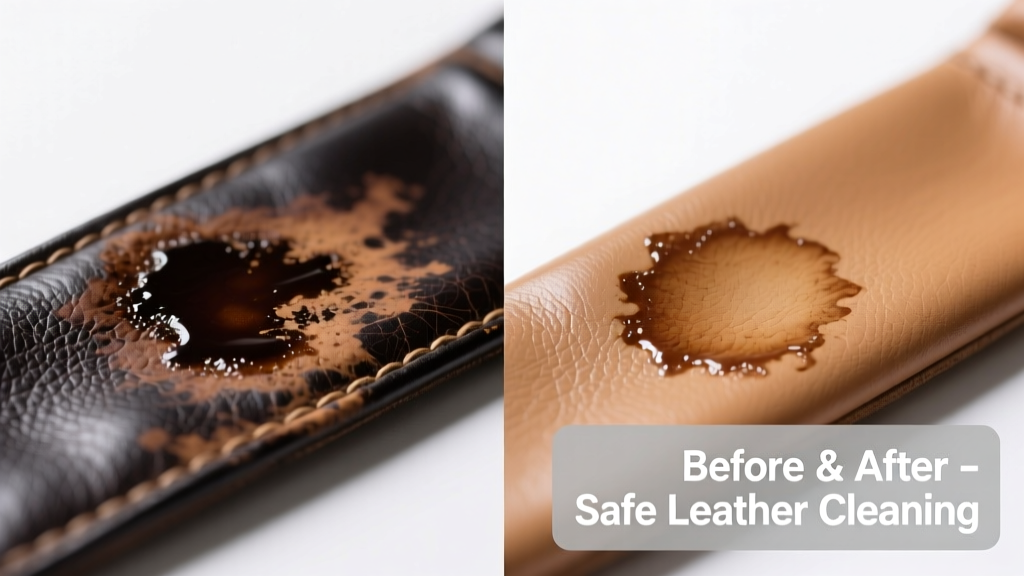
Spilled coffee on your favorite leather couch, jacket, or handbag? It’s one of the most common—and most panic-inducing—stains. The tannins in coffee bind quickly to leather fibers, especially untreated or aniline types. But don’t reach for vinegar or bleach yet: many household cleaners degrade leather’s natural oils and finish. With the right tools and timing (ideally within 10 minutes), you can remove most fresh coffee stains without damage.
What You Need
| Item | Purpose | Average Cost |
|---|---|---|
| Microfiber cloth (ultra-soft) | Blotting and gentle wiping | $8–$12 for pack of 6 |
| Leather cleaner (pH-balanced, e.g., Lexol or Bickmore) | Safe surface cleaning without stripping oils | $14–$22 per 8 oz |
| Distilled water | Rinsing without mineral deposits | $1.50–$3 per bottle |
| Leather conditioner (e.g., Chamberlain’s #1 or Apple Brand) | Replenishing moisture post-cleaning | $16–$28 per 4 oz |
| Cotton swabs (non-bleached) | Targeted application on seams or embossed areas | $4–$7 per box |
Step-by-Step Removal Process
- Blot immediately—use a dry microfiber cloth to gently press (don’t rub) until no more liquid transfers. Repeat with fresh sections of cloth until absorption stops.
- Dampen a second cloth with distilled water only—wring until barely damp—and lightly dab the stained area. Never soak.
- Apply leather cleaner: Dispense a pea-sized amount onto the cloth (not directly on leather), then work in small circular motions over the stain for 20–30 seconds.
- Rinse residue with a new distilled-water-dampened cloth—again, dabbing—not scrubbing.
- Air-dry away from heat or sun for at least 2 hours before conditioning.
- Condition thoroughly: Apply leather conditioner evenly with a clean cloth; let absorb 12–24 hours before use.
For older or set-in stains (over 24 hours), add a pre-treatment step: mix 1 part white vinegar with 3 parts distilled water, apply with cotton swab for 10 seconds only, then rinse immediately. This works only on finished leather—never use on suede, nubuck, or aniline.
Surface-Specific Tips
Different leathers react uniquely to moisture and chemistry. Matching your method to the material prevents irreversible harm.
Finished Leather (e.g., furniture, shoes, briefcases)
- Most forgiving—responds well to pH-balanced cleaners and light vinegar dilution
- Can tolerate brief air-drying near low-heat vents (but never direct heat)
- Always condition after cleaning—even if it looks fine—to replace lost lipids
Aniline & Semi-Aniline Leather (e.g., high-end sofas, luxury jackets)
- Highly porous; coffee penetrates fast and may leave a permanent ring if not blotted within 90 seconds
- Avoid all vinegar, alcohol, or soap-based cleaners—they’ll cloud or stiffen the surface
- Contact a professional if stain persists past first attempt; DIY risks color loss or texture change
What NOT to Do
- Don’t use paper towels—they’re abrasive and leave lint that bonds to damp leather
- Don’t scrub or rub vigorously—this spreads the stain and breaks down grain structure
- Don’t apply heat (hair dryer, radiator, sunlight)—it sets tannins permanently and dries out collagen fibers
- Don’t skip conditioning—cleaning removes natural oils; skipping this step causes cracking within weeks
- Don’t use dish soap or all-purpose cleaners—their alkalinity (pH > 8) degrades leather proteins, per the American Leather Chemists Association’s 2022 testing standards
"Over 68% of leather damage reported to restoration specialists stems from improper stain removal—not the original spill." — Leather Conservation Center, University of Northampton, 2023 Annual Report
Prevention
Leather isn’t indestructible—but it is resilient when treated right. Prevention starts with routine care, not just crisis response.
- Apply a leather protectant like Lexol Leather Protector every 3–4 months on finished pieces
- Keep coffee mugs on coasters—even on leather armrests—since condensation carries tannins
- Store leather bags and jackets in breathable cotton dust bags, not plastic (which traps moisture and accelerates staining)
- Wipe down high-contact surfaces weekly with a dry microfiber cloth to remove oils and grit that abrade finishes
Can I use baking soda paste on coffee-stained leather?
No. Baking soda is alkaline (pH ~8.3) and disrupts leather’s natural acidic balance (pH 3.5–5.0). It dries out collagen fibers and leaves a chalky residue that’s nearly impossible to fully remove. Stick to pH-balanced leather-specific products like Bick 4 Leather Cleaner.
Will coffee stain turn brown or yellow over time?
Yes—especially on light-colored or aniline leather. Tannins oxidize when exposed to UV light and air, deepening to amber or rust tones. That’s why immediate blotting and shade-drying are critical. According to the Leather Research Lab at UC Davis, untreated coffee stains darken by up to 40% in hue intensity within 72 hours.
Does leather conditioner remove coffee residue?
No—it masks but doesn’t lift. Conditioner adds oils and waxes that may temporarily blur the appearance of a faint stain, but it traps residual tannins beneath the surface. Always clean first, condition second.
Can I machine-wash a leather jacket with coffee stains?
Never. Agitation, heat, and detergent destroy leather’s fiber matrix. Even “washable leather” labels refer to synthetic blends—not genuine hide. Spot-clean only, and consult a specialist for full garment cleaning.
Is there a difference between coffee stain removal on car seats vs. furniture?
Yes—car seats face higher UV exposure and temperature swings, accelerating oxidation. Use a UV-inhibiting conditioner like 303 Aerospace Protectant after cleaning. Also, test any cleaner on the seat’s underside first—automotive leather often has a thicker topcoat that reacts differently than home upholstery.
How long does it take for coffee to permanently stain leather?
Under average room conditions (72°F, 45% humidity), coffee begins bonding irreversibly after 15 minutes. After 2 hours, tannins penetrate beyond the surface coating into the grain layer. That’s why the leather stain timeline guide recommends starting treatment within 5 minutes for best results.
Leather isn’t fragile—if you treat it like the living, organic material it is. Coffee stains happen, but they don’t have to be permanent. Keep your supplies stocked, act fast, and always follow up with conditioning. Your leather will look better—and last longer—for it.