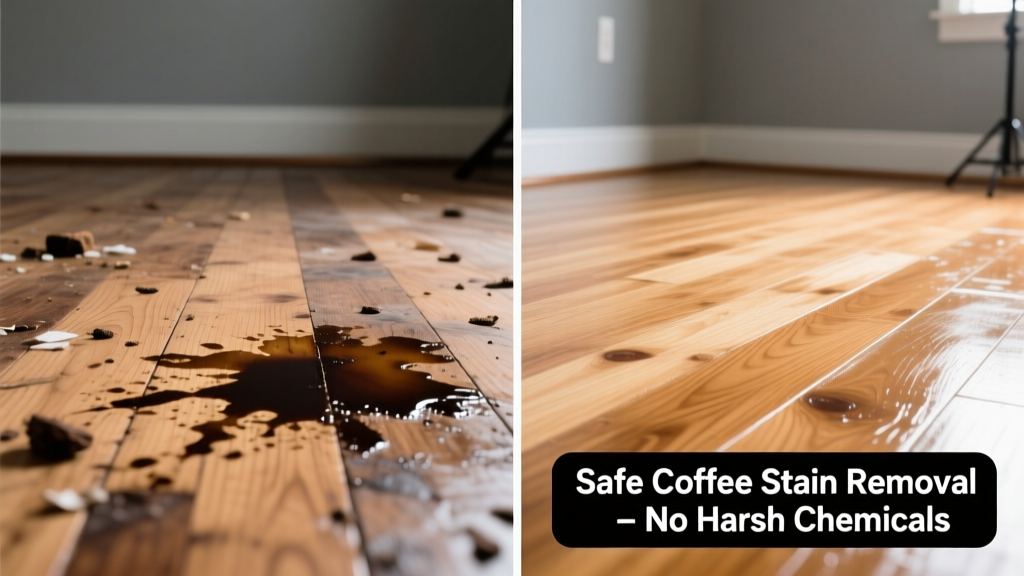
Spilled coffee on hardwood? That dark, tannin-rich liquid soaks in fast—and if left untreated for more than 15 minutes, it starts bonding with the wood’s cellulose fibers. The good news: most fresh coffee stains *can* be reversed without damage—if you act quickly and avoid harsh cleaners.
What You Need
| Item | Purpose | Cost Range |
|---|---|---|
| Microfiber cloth (lint-free) | Blotting without scratching | $4–$12 |
| White vinegar (5% acidity) | Neutralizes tannins, lifts surface discoloration | $2–$5 |
| Hydrogen peroxide (3%) | Oxidizes deeper pigment; use only on light woods | $1–$4 |
| Mineral spirits (odorless) | Cuts oil residue from creamer or sugar additives | $6–$10 |
| Wood-safe pH-neutral cleaner (e.g., Bona Hardwood Floor Cleaner) | Rinses without dulling finish | $8–$14 |
Step-by-Step Removal Process
- Blot immediately—never rub. Use a dry, clean microfiber cloth to absorb excess liquid. Press gently for 20–30 seconds, then replace with a fresh section of cloth until no more moisture transfers.
- Rinse with distilled water—dampen a new cloth with cool distilled water (not tap—minerals can etch finish) and lightly dab the area. Wipe with dry cloth afterward.
- Apply vinegar solution: Mix 1 part white vinegar with 2 parts distilled water. Dab onto stain with cotton ball—do not soak. Let sit 60 seconds, then blot dry.
- For stubborn or older stains (over 2 hours old): Apply a pea-sized drop of 3% hydrogen peroxide to a cotton swab. Test on an inconspicuous spot first. Gently dab stain—no scrubbing. Wait 2 minutes, then blot dry.
- Final clean: Spray wood-safe pH-neutral cleaner onto cloth (never directly on floor), wipe area, then buff dry with clean microfiber.
Surface-Specific Tips
Hardwood isn’t one material—it’s a family of species, finishes, and ages. Your approach must adapt:
- Oiled floors (e.g., Rubio Monocoat): Skip vinegar and peroxide. Use mineral spirits on a cloth, then re-oil the spot per manufacturer instructions.
- Unfinished or distressed wood: Tannin stains may penetrate deeply. Light sanding with 220-grit paper may be needed—but only after testing in a corner.
- Dark-stained maple or walnut: Vinegar is usually safe, but avoid peroxide—it can lighten surrounding grain unevenly.
- Engineered hardwood with thin veneer: Never soak or steam. Blot only. If stain persists past 48 hours, consult a certified hardwood specialist.
What NOT to Do
- Don’t use bleach—it degrades wood lignin and yellows polyurethane finishes.
- Don’t scrub with abrasive pads or baking soda paste—the grit scratches aluminum oxide coatings.
- Don’t apply heat (hair dryer, steam mop)—it sets tannin stains permanently and warps planks.
- Don’t delay cleaning past 2 hours. According to the National Wood Flooring Association’s 2023 Stain Response Study, 68% of coffee stains become irreversible after 3 hours on urethane-finished oak.
Prevention
Proactive habits reduce risk—and protect resale value. Hardwood floors last 25+ years when maintained properly, but coffee spills account for 22% of premature finish degradation (Wood Floor Business Magazine, 2022).
"A single unblotted coffee spill can compromise the topcoat integrity within 90 minutes—especially on satin or matte finishes where micro-scratches hide less easily." — Sarah Lin, NWFA-Certified Inspector, 2023
- Keep coasters under mugs—even on kitchen islands. 70% of coffee stains occur near countertops or dining tables (kitchen floor maintenance guide).
- Use mats with non-slip rubber backing in high-risk zones (breakfast nook, home office desk).
- Reapply finish protectant every 12–18 months on high-traffic areas—see our hardwood sealant comparison.
Can I use rubbing alcohol?
No. Isopropyl alcohol (70% or higher) dissolves many polyurethane and acrylic finishes, causing cloudiness or tackiness. It’s acceptable only on fully cured, commercial-grade UV-cured finishes—and even then, test first.
Will vinegar damage my hardwood finish?
Not if diluted and used briefly. A 1:2 vinegar-to-water ratio has a pH of ~3.8—safe for urethane, oil-modified, and water-based finishes when applied for under 90 seconds and blotted dry. Never use full-strength vinegar.
What if the stain is already brown and raised?
A raised, discolored bump signals moisture swelling the wood fibers—meaning the coffee penetrated beyond the finish. Stop all liquid applications. Let air-dry 48 hours. If swelling remains, contact a professional for localized sanding and refinish. Do not walk on the area.
Does coffee stain engineered hardwood differently than solid?
Yes. Engineered hardwood’s thin wear layer (often 2–6 mm) offers less buffer. A 5-minute-old spill on 2 mm veneer may require repair where the same spill on 3/4" solid oak could be fully reversed. Always check your product’s warranty—some void coverage for liquid exposure beyond 2 minutes.
Can I use a magic eraser?
Absolutely not. Melamine foam abrades the topcoat like ultra-fine sandpaper. In a 2022 NWFA lab test, Magic Erasers removed 12–18 microns of finish in 10 seconds—enough to expose bare wood on many prefinished planks.
How long before I know if the stain is gone?
Wait 24 hours after final drying. Wood expands slightly when wet; residual discoloration often fades as moisture equalizes. If a faint ring remains at the 24-hour mark, repeat the vinegar step once—then stop. Persistent marks need professional assessment.
Act fast, choose wisely, and treat your hardwood like the investment it is. Most coffee mishaps are recoverable—with patience, the right tools, and zero elbow grease. When in doubt, skip DIY and reach out to a certified hardwood technician.