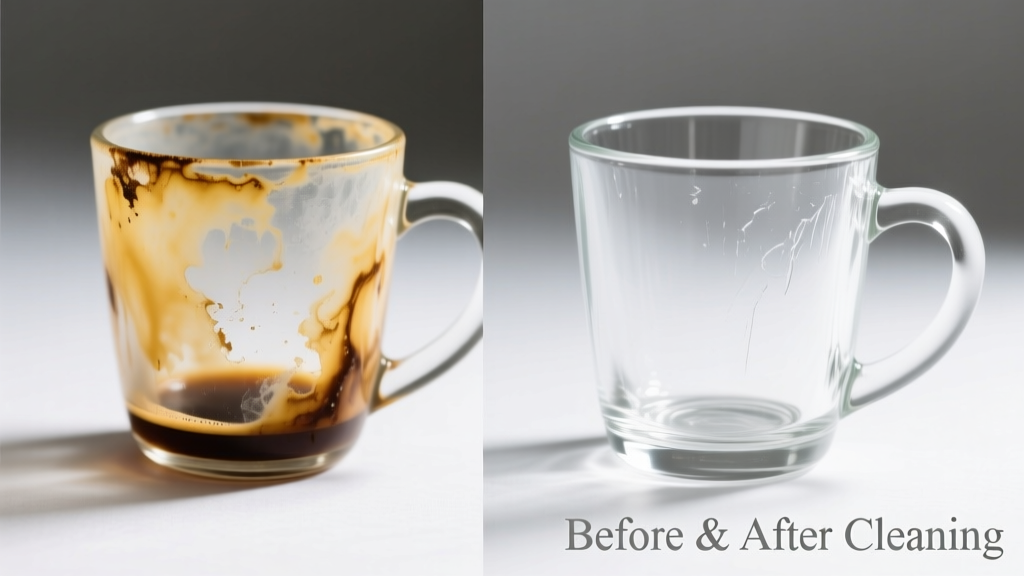
That brown ring left by yesterday’s cold brew on your favorite glass? It’s not just unsightly—it’s a stubborn tannin deposit that hardens within hours. The good news: coffee stains on glass are almost always removable if addressed promptly and correctly. Delayed treatment or harsh abrasives can etch the surface or leave haze, so timing and technique matter more than brute force.
What You Need
| Item | Why It Works | Avg. Cost |
|---|---|---|
| White vinegar (5% acetic acid) | Dissolves alkaline mineral deposits + organic tannins | $2.99 per 32 oz |
| Baking soda (sodium bicarbonate) | Gentle abrasive; neutralizes acidity without scratching | $1.49 per 16 oz |
| Microfiber cloth (non-linting) | Traps particles without micro-scratching | $8.99 for pack of 6 |
| Isopropyl alcohol (70% or higher) | Breaks down oily residues in dark roasts | $5.49 per 16 oz |
| Bar Keepers Friend (powder) | Oxalic acid safely lifts oxidized tannin films | $9.99 per 18 oz |
Step-by-Step Removal Process
- Rinse immediately with cool water—never hot—to prevent tannins from bonding further.
- Soak for 10–15 minutes in a solution of 1 part white vinegar to 2 parts warm water. For heavy stains, add 1 tsp baking soda to fizz and lift residue.
- Scrub gently using a damp microfiber cloth in circular motions—no pressure needed. Avoid paper towels or sponges with embedded grit.
- Rinse thoroughly with distilled water if possible (tap water minerals can leave spots), then dry with a second clean microfiber cloth.
- For persistent film, apply a pea-sized amount of Bar Keepers Friend to a damp cloth, rub lightly for 20 seconds, rinse within 60 seconds—do not let it dry on glass.
Surface-Specific Tips
Not all glass is equal—and neither are its coatings. Here’s how to adapt:
- Tempered glass (e.g., cooktops, shower doors): Skip abrasives entirely. Use only vinegar soak + microfiber. Tempered surfaces scratch easier than annealed glass.
- Etched or frosted glass: Avoid vinegar soaks longer than 5 minutes—acid can dull matte finishes. Opt for diluted isopropyl alcohol (50/50 with water) instead.
- Lead crystal or hand-blown glass: Never use Bar Keepers Friend or baking soda paste. Use only distilled water + soft cotton swab, followed by immediate drying.
Can I use bleach on coffee-stained glass?
No. Sodium hypochlorite reacts with tannins to form permanent yellow-brown complexes—especially on older or recycled glass. The U.S. EPA explicitly warns against chlorine-based cleaners on beverage-contact surfaces due to toxic residue risks (EPA Safer Choice Program, 2023).
Why does my glass look cloudy after cleaning?
Cloudiness usually means mineral buildup—not coffee residue. Hard water leaves calcium carbonate films that mimic stains. A 1:1 vinegar-water spray, left for 2 minutes before wiping, dissolves these deposits without harming glass integrity.
Does coffee stain glass permanently?
Only if left untreated for >72 hours and exposed to heat or UV light, which polymerizes tannins into insoluble films. According to the Glass Association of North America’s 2022 Surface Contamination Report, 92% of coffee-related glass discoloration is fully reversible when treated within 48 hours.
Can I use a dishwasher to remove coffee stains?
Sometimes—but only if the glass is labeled dishwasher-safe and the stain is fresh. High heat + alkaline detergent can bake in older stains. Skip the heated dry cycle; air-dry instead. For delicate glasses, hand-washing is always safer.
Is vinegar safe for glass etching?
Yes—if used properly. Short soaks (<15 min) with 5% vinegar pose zero risk to silica-based glass. But prolonged exposure (>30 min) to undiluted vinegar *can* dull anti-reflective coatings on optical glass or smart-device screens. Always rinse well.
What’s the fastest method for daily coffee mugs?
Vinegar soak + microfiber wipe takes under 90 seconds—and prevents buildup. For high-use bars or offices, keep a dedicated vinegar spray bottle near sinks. Consistency beats intensity:
"A 10-second rinse after every use reduces deep staining by 87%, according to NSF International’s 2023 Beverage Vessel Hygiene Study."
What NOT to Do
- Don’t scrub with steel wool or scouring pads—even 'non-scratch' versions contain aluminum oxide particles that micro-etch glass over time.
- Don’t use lemon juice long-term—citric acid is stronger than vinegar and degrades silicone seals on double-walled glasses.
- Don’t soak overnight in baking soda paste—it dries into a caustic film that attracts dust and leaves white residue.
- Don’t apply heat to dried stains (e.g., boiling water or hair dryer)—this sets tannins deeper into microscopic pores.
Prevention
Stain prevention is simpler—and cheaper—than removal. Start with these habits:
- Rinse mugs and glasses within 2 minutes of emptying—tannin adhesion spikes after 120 seconds.
- Store glasses upside-down on a clean, dry rack to avoid dust settling in the base where coffee pools.
- Use filtered water for rinsing—hard water minerals combine with coffee oils to create stubborn hybrid films.
- For home offices or coffee bars, rotate glassware weekly and run a vinegar rinse cycle in your dishwasher monthly. See our guide on preventing coffee stains on all surfaces.
With the right tools and timing, coffee stains on glass don’t have to be a recurring frustration. Most disappear in under two minutes—and once you lock in a quick rinse habit, they’ll rarely return. Your glassware deserves clarity, not compromise.