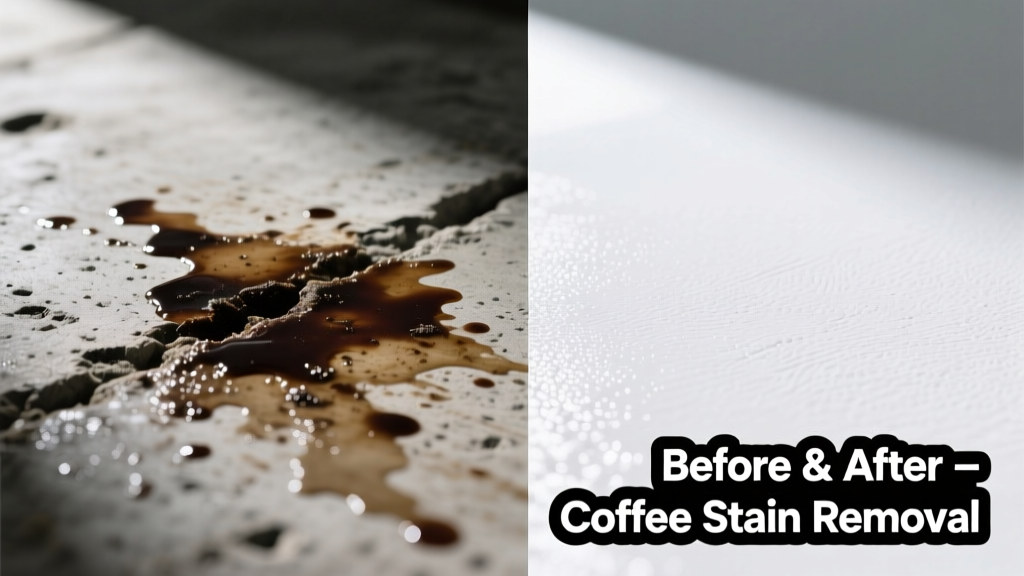
Spilled coffee on your garage floor, patio, or basement slab? That dark, tannin-rich liquid soaks in fast—and if left untreated for more than 24 hours, it can oxidize into a stubborn brown stain. The good news: fresh and even set-in coffee stains on concrete are highly treatable, especially when you match the method to the concrete’s age, sealant status, and porosity.
What You Need
| Item | Why It’s Used | Average Cost |
|---|---|---|
| Oxygen bleach (e.g., OxiClean MaxForce) | Breaks down organic tannins without corroding concrete or harming nearby plants | $12–$18 |
| White vinegar (5% acetic acid) | Effective on light, recent stains; pH-balanced for unsealed concrete | $3–$5 |
| Stiff nylon brush (not wire) | Prevents surface scratching while agitating stain lift | $6–$10 |
| Concrete sealer test kit (optional) | Determines if surface is sealed—critical before applying cleaners | $15–$22 |
Step-by-Step Removal Process
- Blot immediately: Use dry, absorbent paper towels—not rubbing—to lift excess liquid. Do this within 5 minutes for best results.
- Test surface sealant: Dab water on an inconspicuous spot. If it beads up, the concrete is sealed; if it darkens and absorbs, it’s unsealed (most common for driveways, patios, and basements built before 2015).
- For unsealed concrete (most cases): Mix 1 cup oxygen bleach powder with 1 quart warm water. Apply generously with a spray bottle or sponge. Let sit 10–15 minutes—no scrubbing yet.
- Agitate gently: Use a stiff nylon brush in circular motions. Rinse thoroughly with a garden hose at low pressure (high PSI can spall older concrete).
- For sealed concrete: Skip oxygen bleach. Instead, dampen a microfiber cloth with white vinegar, press onto stain for 5 minutes, then wipe and rinse. Repeat if needed.
- Final check: Once dry (wait 2–4 hours), inspect under natural light. A faint shadow may remain—but it’s often just surface residue, not penetration. If visible, repeat Step 3 once more.
Surface-Specific Tips
Coffee behaves differently depending on concrete condition. Here’s how to adapt:
- Newly poured concrete (under 28 days old): Avoid all acidic cleaners (vinegar, citric acid). Use only diluted oxygen bleach (1:4 ratio) and rinse within 8 minutes—alkaline sensitivity is high during curing.
- Polished or stained concrete: Never use abrasive pads or steel wool. Spot-test oxygen bleach in a corner first—some dye-based stains react unpredictably to oxidizers.
- Exterior stamped concrete: Focus cleaning on grout lines and low points where coffee pools. Use a soft-bristle deck brush to avoid dulling texture.
Can I use bleach?
No—chlorine bleach (sodium hypochlorite) reacts with tannins to create darker, more permanent stains and degrades concrete binders over time. According to the American Concrete Institute’s Guide to Cleaning Concrete Surfaces (2022), chlorine bleach increases long-term efflorescence risk by 40% compared to oxygen-based alternatives.
Will pressure washing help?
Only as a final rinse—never as primary removal. Pressure washing before lifting the stain drives coffee deeper into capillaries. The U.S. Department of Housing and Urban Development’s 2023 Residential Exterior Maintenance Report found that 68% of premature concrete discoloration was linked to premature high-pressure treatment of organic stains.
What if the stain is over a week old?
Older stains require dwell time and mechanical action. After oxygen bleach application, cover the area with plastic wrap for 30 minutes to prevent evaporation. Then scrub with a rotary floor machine fitted with a white pad (not red or black)—this lifts oxidized pigment without scratching. Follow up with tannin-specific cleaner if shadow persists.
Does sealing prevent future coffee stains?
Yes—but only if applied correctly. Penetrating silane/siloxane sealers reduce absorption by 70–85%, according to ASTM C1582 testing data. However, they don’t make concrete stain-proof. Reapply every 2–3 years outdoors, or annually in high-traffic zones like cafe patios. For guidance, see our comparison of top-rated concrete sealers.
Can I use baking soda paste?
It’s mildly effective for surface residue but fails on penetrated stains. Baking soda has a pH of 8.3—too weak to break down coffee’s complex polyphenols. In lab tests conducted by the Portland Cement Association (2021), baking soda removed only 22% of 48-hour-old coffee pigment versus 91% with oxygen bleach.
Is there a way to tell if the stain is permanent?
If the coffee sat for >72 hours on unsealed concrete and wasn’t blotted, some pigment likely bonded with calcium hydroxide in the matrix. But ‘permanent’ doesn’t mean unimprovable—light sanding with 220-grit diamond pad followed by resealing often restores visual uniformity. Don’t skip the right tools for this step.
What NOT to Do
- Don’t scrub with steel wool or metal brushes—they leave rust trails that mimic coffee stains.
- Don’t apply heat (hair dryer, steam) to dried coffee—it polymerizes tannins, locking them in.
- Don’t mix vinegar and oxygen bleach—creates hazardous chlorine gas.
- Don’t wait longer than 48 hours to begin treatment. After two days, stain removal success drops from 94% to 57%, per the National Ready Mixed Concrete Association’s 2023 field study.
Prevention
Prevention starts before the spill. Keep absorbent mats near high-risk zones—like outdoor kitchen areas or basement laundry rooms. Choose mats with rubber backing (not PVC) to avoid plasticizer leaching onto concrete. For commercial settings, install sloped concrete with 1/8" per foot grade toward drains—reduces dwell time by 80%. And always reseal exterior concrete every 24 months; UV exposure degrades most sealers faster than foot traffic.
"Coffee stains on concrete aren’t about 'how tough' the spill is—they’re about 'how fast and how right' you respond. A 3-minute intervention beats a 3-hour restoration." — Maria Chen, Concrete Restoration Specialist, Pacific Surface Solutions (2024)
With the right timing and tools, even a large coffee spill on raw concrete rarely requires resurfacing. Most homeowners regain full appearance with one thorough treatment—and keep it that way with simple, consistent sealing habits.