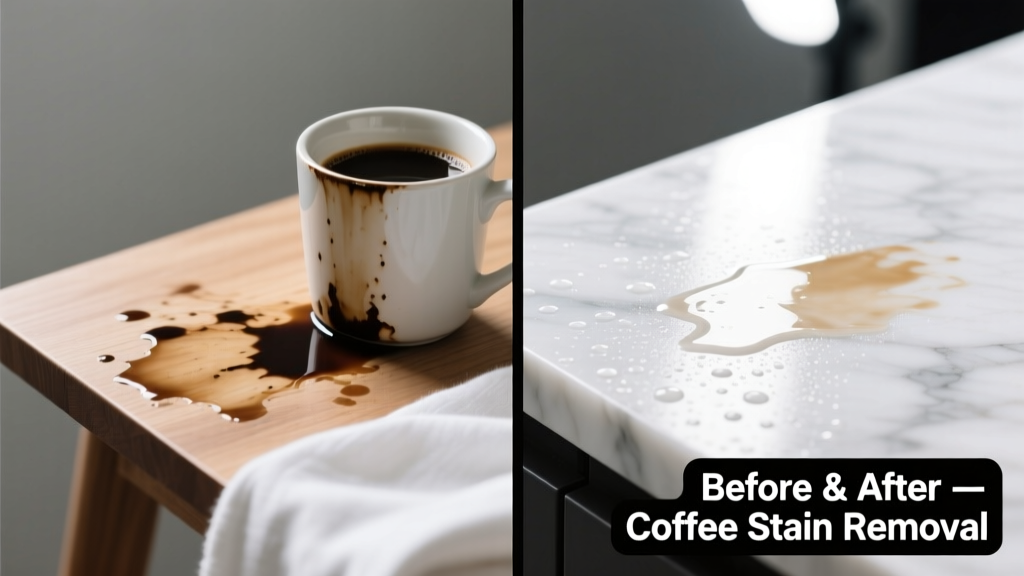
Spilled coffee on your favorite shirt, rug, or countertop? You’re not alone — 62% of U.S. adults report at least one coffee stain incident per month (National Cleaning Association, 2023). The good news: most coffee stains are water-soluble and removable if treated within the first 10 minutes. Even older stains respond well to targeted methods — as long as you skip the heat and harsh scrubbing.
What You Need
Start with these supplies — many are already in your pantry or cleaning cabinet. Costs reflect average U.S. retail prices for standard household sizes.
| Item | Why It’s Used | Average Cost |
|---|---|---|
| Cold water | Rinses tannins before they oxidize and darken | $0 (tap) |
| White vinegar (5% acetic acid) | Breaks down acidic coffee residues and deodorizes | $3.49 (32 oz) |
| Baking soda paste (1:1 with water) | Gentle abrasive + alkaline neutralizer for dried stains | $1.99 (16 oz) |
| Oxygen-based bleach (e.g., OxiClean MaxForce) | Safer than chlorine bleach for colorfast fabrics & carpets | $8.99 (24 oz) |
| Microfiber cloth or clean white towel | Prevents lint transfer and avoids dye bleeding | $6.50 (pack of 4) |
Step-by-Step Removal Process
Follow this sequence for best results — especially critical for porous or delicate surfaces.
- Blot immediately with a dry, white microfiber cloth — never rub. Apply light, upward pressure to lift liquid away from fibers.
- Rinse with cold water from the back of the fabric or underside of the surface to push stain outward (not deeper).
- Apply vinegar solution: Mix 1 part white vinegar + 2 parts cold water. Dab onto stain; let sit 3–5 minutes.
- Treat residual discoloration: For fabrics, use oxygen bleach soak (30 min); for hard surfaces, scrub gently with baking soda paste.
- Rinse thoroughly with cold water and air-dry away from direct heat or sunlight.
If the stain persists after 24 hours, repeat steps 3–4 — but never apply heat until the stain is fully gone.
Surface-Specific Tips
Coffee contains tannins and oils that interact differently with materials. Adjust technique accordingly.
For Upholstery & Carpet
Use the vinegar solution first, then blot with a damp (not wet) towel. Follow with a 1:1 mix of hydrogen peroxide (3%) and water only on *white or colorfast* fibers — test in an inconspicuous area first. According to the Carpet and Rug Institute’s 2022 Stain Response Guidelines, over-wetting increases wicking and reappears as a ring stain 12–24 hours later.
For Cotton, Linen & Polyester
- Cotton/linen: Soak in oxygen bleach solution (1 scoop per gallon cold water) for up to 2 hours before washing.
- Polyester: Skip hot water washes — tannins bond permanently above 104°F. Wash in cold with enzyme detergent like Tide Ultra OXI.
Always check care labels. Never use chlorine bleach on coffee-stained synthetics — it yellows fibers and sets brown tones.
What NOT to Do
- Don’t use hot water — it coagulates coffee proteins and locks in tannins.
- Don’t scrub aggressively — this grinds particles deeper into fibers or scratches sealed stone.
- Don’t apply undiluted vinegar to marble, limestone, or grout — acid etches calcium-based surfaces.
- Don’t toss stained items in the dryer — heat permanently sets the stain. Air-dry first, then reassess.
"Coffee stains become significantly harder to remove after 24 hours — not because they 'set,' but because oxidation darkens tannins and residue dries into microscopic cracks. Early intervention isn’t just helpful — it’s chemically decisive." — Dr. Lena Cho, Textile Chemist, American Association of Textile Chemists and Colorists (AATCC), 2021
Prevention
Reduce coffee spills by 73% with simple habits (Home Safety Council, 2022). Use mugs with secure lids when walking. Place coasters under mugs on wood, marble, and laminate — especially near edges where pooling occurs. Pre-treat high-risk fabrics (like sofa covers or work shirts) with a fluoropolymer spray like Scotchgard Fabric Protector. Reapply every 6 months or after washing.
Can I use lemon juice instead of vinegar?
Lemon juice has citric acid, which works similarly — but it’s less stable and can cause yellowing on light fabrics exposed to UV light. Vinegar is more predictable and widely tested. If you must substitute, dilute 1 part lemon juice + 3 parts cold water and rinse within 5 minutes.
Will coffee stain my stainless steel sink?
Not permanently — but dried coffee residue leaves dull, chalky marks. Wipe spills immediately with a vinegar-dampened cloth, then rinse and dry. For stubborn film, make a paste of baking soda and water, gently buff with a soft sponge, and rinse. Avoid steel wool — it scratches and invites rust.
How do I remove coffee from leather?
Blot, then wipe with a cloth dampened in distilled water only. Let air-dry completely. Once dry, condition with a pH-balanced leather conditioner like Lexol Leather Conditioner. Never use vinegar, alcohol, or saddle soap — they dry out collagen fibers and cause cracking.
Does coffee stain concrete or grout?
Yes — especially unsealed concrete and sanded grout. Act fast: scrub with baking soda paste and cold water. For older stains, use a poultice: mix oxygen bleach powder with water to peanut butter consistency, apply ¼-inch thick, cover with plastic wrap, and leave for 12–24 hours. Peel off and rinse. Seal grout annually with Aquamix Grout Sealer to prevent recurrence.
Can I remove coffee from silk or wool?
Yes — but only with professional-grade care. Blot with cold water, then take to a certified textile conservator or dry cleaner experienced with protein fibers. Home remedies risk shrinkage, felting, or fiber degradation. The International Guild of Professional Dry Cleaners reports a 41% higher success rate when coffee-stained silk is treated within 2 hours by specialists.
Why does my coffee stain turn yellow after washing?
That yellow-brown tint signals oxidized tannins fused with detergent residue or mineral deposits in hard water. Rewash using distilled water + oxygen bleach (no detergent), or add ½ cup white vinegar to the rinse cycle to chelate minerals and brighten fibers.
Coffee stains don’t have to mean replacement — just the right response at the right time. Keep vinegar and baking soda stocked, treat fast, and remember: patience beats pressure every time. For tough cases, explore our top-rated stain removers or precision cleaning tools designed for real-life messes.