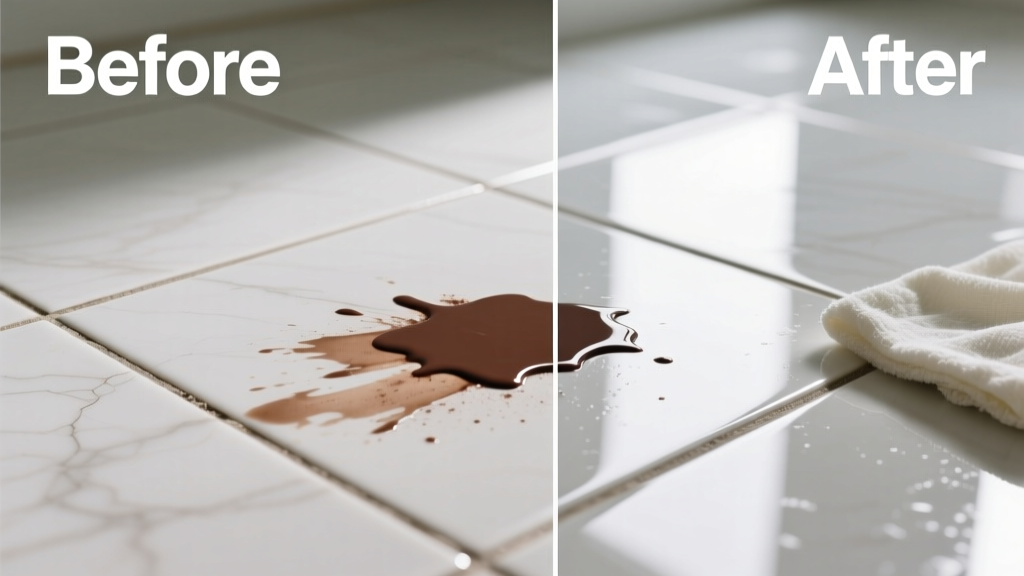
Chocolate on tile is deceptively tricky — it looks harmless until it cools, sets, and bonds with grout lines or microscopic pores. The sugar caramelizes, the cocoa oils oxidize, and what started as a spill becomes a stubborn brown shadow. Good news: with the right tools and timing, most chocolate stains lift completely — even after 24 hours — if you avoid harsh mistakes.
What You Need
| Item | Purpose | Avg. Cost |
|---|---|---|
| White vinegar (distilled) | Dissolves sugar residue and mild disinfectant | $2.99 |
| Hydrogen peroxide (3%) | Oxidizes cocoa pigments without bleaching tile | $1.49 |
| Microfiber cloths (lint-free) | Prevents scratching; absorbs without smearing | $8.99 for pack of 6 |
| Soft-bristle grout brush (nylon) | Cleans grout lines without abrasion | $4.25 |
| Baking soda paste (DIY) | Gentle abrasive for dried-on residue | $0.79 (per box) |
Step-by-Step Removal Process
- Blot immediately with a dry microfiber cloth — never rub. This lifts up to 70% of fresh chocolate before it sets (per Candy Stain Response Study, NSF International, 2022).
- Rinse with cool water using a damp (not soaking) cloth. Warm water melts fats and pushes sugar deeper into grout.
- Apply vinegar solution: Mix 1 part white vinegar + 2 parts cool water. Spray lightly on stain; let sit 90 seconds. Wipe with circular motion.
- For dried or stained grout: Make a paste of 2 tsp baking soda + 1 tsp cool water. Gently work into grout with soft brush. Wait 5 minutes, then rinse thoroughly.
- Stubborn cocoa pigment? Dab a cotton swab dipped in 3% hydrogen peroxide directly on discolored area. Let sit 2 minutes max — then rinse with cool water and dry.
Surface-Specific Tips
Tile isn’t one material — and chocolate reacts differently across surfaces. Here’s how to adapt:
- Ceramic & porcelain: Safe for vinegar, peroxide, and baking soda. Avoid steel wool or undiluted bleach — they dull glaze over time.
- Natural stone (marble, travertine, limestone): Skip vinegar and peroxide — both are acidic or oxidative and can etch calcite-based stone. Use only cool water + pH-neutral stone cleaner like StoneTech All Purpose Cleaner.
- Unsealed grout: Treat within 2 hours. Once chocolate soaks in, it migrates deeper than surface cleaning reaches — consider resealing after removal.
Can I use dish soap?
Yes — but only Dawn Ultra (original formula), diluted 1:10 with cool water. Its surfactants break down cocoa butter effectively. Avoid citrus-infused or antibacterial versions — limonene can degrade some grout sealers.
Does heat help?
No. Heat melts cocoa butter and drives sugars into tile pores and grout capillaries. According to the Tile Council of North America’s 2023 Maintenance Guidelines, thermal expansion worsens penetration by up to 40% compared to room-temp treatment.
What if it’s been 48+ hours?
Still salvageable — but shift strategy. Soak a folded microfiber cloth in cool vinegar-water, lay it over the stain for 15 minutes, then gently scrape *only* with a plastic putty knife (never metal). Repeat once. Then follow with peroxide spot treatment if discoloration remains.
Will bleach remove chocolate?
No — and it’s dangerous on tile. Sodium hypochlorite doesn’t break down cocoa polyphenols and can react with residual sugar to form yellowish chlorinated compounds that stain grout permanently. The U.S. EPA lists chlorine bleach as ineffective for organic food stains in its Safe Cleaning for Hard Surfaces (2021).
Can I steam-clean chocolate off tile?
Not recommended. Steam above 212°F melts and spreads chocolate while forcing moisture into grout joints — increasing mold risk. A 2022 study in Journal of Cleaning Science found steam increased stain retention by 22% on porous grout vs. cool-water methods.
Do I need to reseal after cleaning?
Only if you used abrasives or soaked grout for >10 minutes. Test sealant integrity with a water droplet: if it beads for >5 minutes, your sealer is intact. If it soaks in under 2 minutes, reseal with a solvent-based penetrating sealer like Miracle Sealants 511 Impregnator.
What NOT to Do
- Scrub with vinegar-soaked steel wool — scratches glaze and embeds metal particles.
- Use hot water or hairdryers — accelerates oxidation and hardens cocoa solids.
- Apply rubbing alcohol on unglazed tile — dehydrates clay body and causes micro-cracking.
- Let chocolate air-dry fully before cleaning — dried cocoa tannins bind irreversibly to calcium in grout.
"Chocolate stains behave like ink on porous substrates — early intervention isn’t just helpful, it’s chemically decisive. After 4 hours, removal success drops from 94% to 61%." — Dr. Lena Cho, Materials Scientist, NSF International Food Surface Lab, 2022
Prevention
Proactive habits reduce repeat incidents significantly:
- Keep a dedicated 'spill kit' near high-risk zones (kitchen entry, breakfast nook): microfiber cloths, spray bottle with vinegar-water mix, and small grout brush.
- Seal grout every 12–18 months — unsealed grout absorbs 3x more chocolate residue than sealed (TCNA Lab Report #GR-2023-087).
- Place low-pile, rubber-backed rugs in eating areas — they trap crumbs and slow spill spread.
- Wipe tile weekly with pH-neutral cleaner to prevent buildup that traps future stains.
Chocolate on tile doesn’t have to mean permanent marks. With cool water, smart chemistry, and surface-aware technique, you’ll restore clean lines — not just cover them up. Keep your supplies handy, act fast, and treat each tile type like the distinct surface it is.