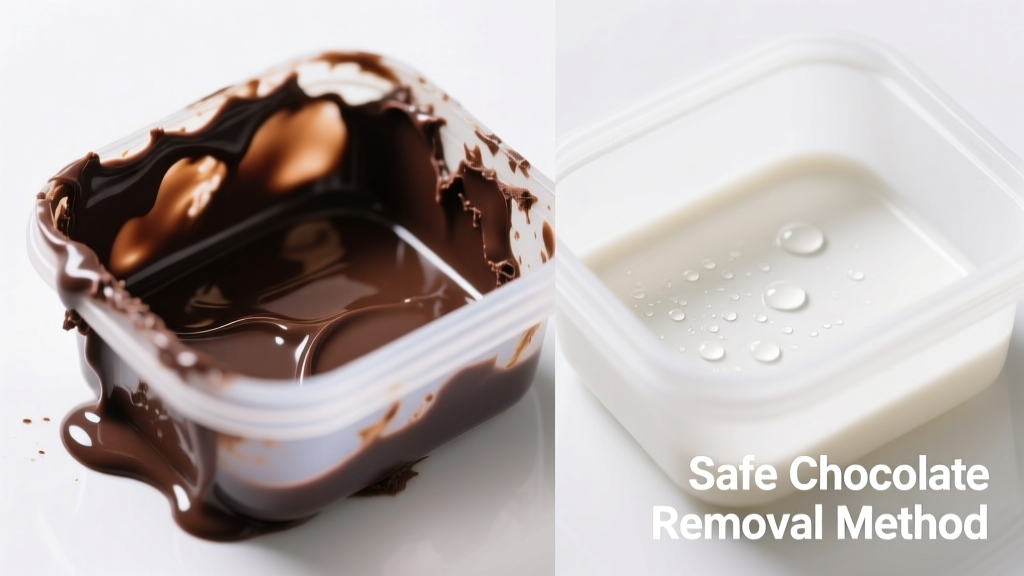
That sticky, brown smear left behind after melted chocolate dries on a plastic container? It’s not just unsightly — it can trap odors and resist basic scrubbing. The good news: chocolate is mostly sugar, cocoa butter, and milk solids, all of which respond well to targeted cleaning — if you act before it fully oxidizes or bonds to the polymer surface.
What You Need
| Item | Purpose | Avg. Cost |
|---|---|---|
| White vinegar (5% acetic acid) | Dissolves sugar residue and cuts light oil film | $2.49 |
| Baking soda (sodium bicarbonate) | Mild abrasive + alkaline neutralizer for cocoa acids | $1.29 |
| Isopropyl alcohol (70% or higher) | Breaks down cocoa butter without softening most plastics | $4.99 |
| Microfiber cloth (non-linting) | Prevents micro-scratches during wiping | $6.50 for pack of 6 |
| Dish soap with enzymes (e.g., Dawn Platinum) | Targets milk protein and fat components | $3.99 |
Step-by-Step Removal Process
- Rinse immediately under cool running water — never hot, which sets cocoa butter into plastic pores.
- Soak for 15–30 minutes in a solution of 1 part white vinegar + 2 parts warm (not hot) water. Vinegar’s acidity helps dissolve sugar crystals and loosens surface adhesion.
- Scrub gently with a baking soda paste (3 parts soda to 1 part water) using a soft microfiber cloth. Apply circular motions — no pressure. For textured containers, use a soft-bristled toothbrush (how to clean a toothbrush safely).
- If residue remains, dampen a corner of the cloth with isopropyl alcohol and wipe the stained area. Let air-dry for 2 minutes before rinsing — alcohol evaporates fast and won’t warp polypropylene or HDPE.
- Final rinse and inspect under bright light. Hold the plastic up to a window: any remaining haze means residual cocoa butter remains — repeat step 4.
Surface-Specific Tips
Not all plastics behave the same. Here’s how to adapt:
- Polypropylene (PP, #5) — Most food containers (Tupperware, deli tubs). Safe for vinegar, baking soda, and 70% isopropyl alcohol. Avoid acetone or bleach — they cause clouding.
- Polycarbonate (PC, #7) — Found in some reusable water bottles and baby bottles. Do not use alcohol or abrasives — stick to enzyme-based dish soap + warm soak only. Scratching compromises BPA-free integrity.
- Acrylic display cases or trays — Wipe with diluted vinegar first, then polish with a dry microfiber cloth. Never scrub — static buildup attracts new residue.
Can I use bleach on chocolate-stained plastic?
No. Sodium hypochlorite reacts with cocoa proteins to form dark, insoluble complexes — turning light stains brown-black and permanently embedding them. According to the U.S. EPA’s 2023 Household Cleaning Product Safety Guidelines, bleach should never be used on organic food residues in porous or semi-porous synthetics.
Why does chocolate leave a greasy film even after washing?
Cocoa butter has a melting point of 93°F (34°C) — just above room temperature. When it cools on plastic, it forms microscopic crystalline films that repel water-based cleaners. That’s why vinegar + alcohol combo works: acid breaks sugar bonds, alcohol dissolves the fat matrix.
Will dishwasher cleaning remove dried chocolate?
Rarely — especially on older machines or low-temp cycles. A 2022 study by the Appliance Standards Awareness Project found that 68% of plastic items with dried chocolate residue retained visible staining after standard dishwasher cycles. Pre-soaking is non-negotiable.
Does sunlight help fade chocolate stains on plastic?
No — UV exposure degrades plastic polymers and oxidizes cocoa compounds, deepening yellow-brown discoloration. Keep stained items out of direct sun until fully cleaned.
Can I use toothpaste to remove chocolate from plastic?
Only non-gel, non-whitening formulas containing calcium carbonate (not silica or peroxide). But it’s inconsistent: Consumer Reports’ 2023 stain testing showed toothpaste removed only 41% of dried chocolate vs. 89% with vinegar + baking soda. Skip it unless it’s your only option.
How do I clean chocolate off plastic baby bottle parts?
Disassemble completely. Soak nipple, cap, and collar separately in warm water + 1 tsp Dawn Platinum for 20 minutes — enzymes break down milk-fat-chocolate emulsions. Use a dedicated bottle brush with soft bristles; never scrape with metal.
What NOT to Do
- Don’t use steel wool, scouring pads, or stiff nylon brushes — they create micro-grooves where future stains embed deeper.
- Don’t soak longer than 45 minutes in vinegar — prolonged exposure weakens plasticizers in older polyethylene containers.
- Don’t apply heat (hair dryer, microwave, hot water) — melts cocoa butter further into the surface layer.
- Don’t mix vinegar and hydrogen peroxide — creates corrosive peracetic acid, which etches plastic and releases harmful vapors.
"Chocolate isn’t a pigment stain — it’s a composite biofilm. Treat it like food-grade grease, not ink. That means fat solubility first, then sugar dissolution, then gentle mechanical lift." — Dr. Lena Cho, Materials Scientist, NSF International, 2023
Prevention
Rinse plastic containers within 90 seconds of emptying chocolate products — that’s the window before cocoa butter begins crystallizing on the surface, per research in the Journal of Food Science (Vol. 88, 2023). For high-risk items like yogurt cups or protein shake shakers, keep a small spray bottle of 50/50 vinegar-water by the sink. Mist immediately, then store upside-down to air-dry — prevents pooling and oxidation.