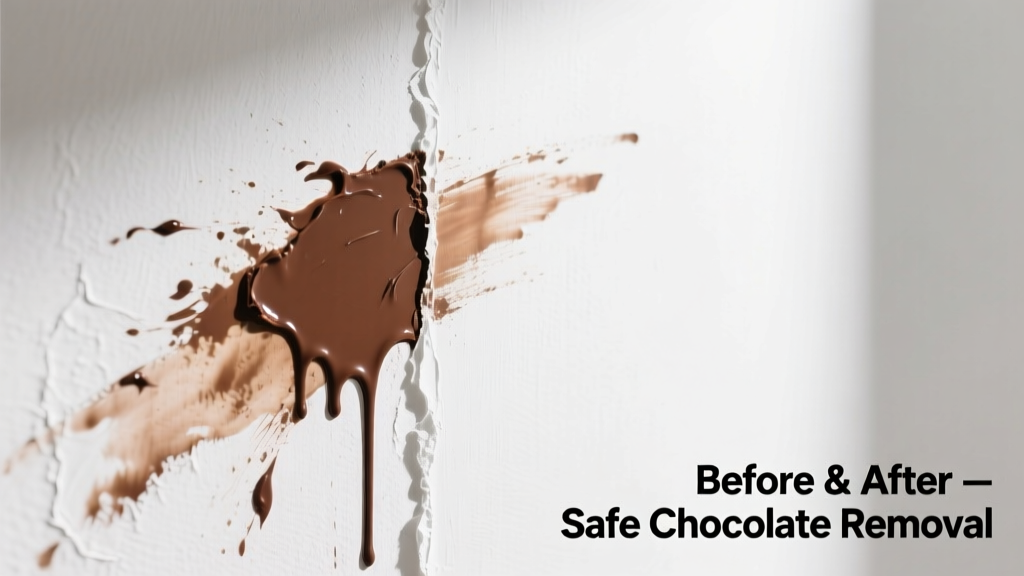
Chocolate on a painted wall is equal parts sticky, stubborn, and stressful—especially when it’s dried into the finish or smeared across a freshly touched-up patch. The good news? Most chocolate stains *can* be removed without repainting—if you act quickly and avoid harsh scrubbing or solvents that break down latex or acrylic paint.
What You Need
| Item | Why It’s Used | Avg. Cost |
|---|---|---|
| Microfiber cloth (lint-free) | Traps residue without scratching or dragging pigment | $6–$12/pack of 4 |
| White vinegar (5% acetic acid) | Gently dissolves sugar and fat residues; pH-neutral for most paints | $2.50–$4.00/bottle |
| Isopropyl alcohol (70%) | Effective on dried cocoa butter; safe for cured latex paint in low concentrations | $5–$8/16 oz |
| Baking soda paste (1:1 with water) | Mild abrasive for set-in stains; non-bleaching and paint-safe | $1.50–$3.00/tin |
| Soft-bristle toothbrush (nylon) | Controls pressure during gentle agitation; avoids gouging | $1.99–$4.50 |
Step-by-Step Removal Process
- Blot, don’t rub: Use a dry microfiber cloth to lift excess chocolate—press gently upward and outward from the stain’s edge. Never drag sideways.
- Test first: Dampen a cotton swab with white vinegar and apply to an inconspicuous area (e.g., behind a door frame). Wait 2 minutes. If no color lift or sheen change occurs, proceed.
- Fresh stains (under 2 hours): Dampen a clean cloth with cool water + 1 tsp vinegar. Blot repeatedly until residue lifts. Rinse cloth often to avoid re-depositing sugars.
- Dried or crusted stains: Apply baking soda paste directly to the stain. Let sit 3–5 minutes, then gently agitate with a soft toothbrush using circular motions. Wipe with a damp cloth—no rinsing needed unless paste leaves a haze.
- Stubborn cocoa oil residue: Dab a cotton swab with 70% isopropyl alcohol. Press—not swipe—for 10 seconds, then blot with dry cloth. Repeat max 2×. Stop immediately if paint dulls or softens.
Surface-Specific Tips
Not all painted walls behave the same. Here’s how to adapt:
- Flat/matte paint: Avoid any liquid saturation—it absorbs faster and shows water marks. Use paste-based methods only, and always blot dry immediately.
- Eggshell or satin finish: Tolerates light vinegar or alcohol dabbing, but never soak. Test near baseboard before treating visible areas.
- Textured walls (orange peel, knockdown): Use a soft brush (not toothbrush) to reach crevices. Follow up with a dry microfiber wrapped around a chopstick for precision blotting.
- Walls with primer-only or patched sections: These absorb more aggressively. Skip alcohol entirely—use only baking soda paste and distilled water.
What NOT to Do
- Don’t use bleach, ammonia, or acetone—they degrade binders in modern interior paints and cause irreversible yellowing or chalkiness.
- Don’t scrub with paper towels or rough sponges—they abrade the top layer and embed particles deeper.
- Don’t apply heat (hair dryer, steam cleaner)—it melts cocoa butter into the paint film, making removal nearly impossible.
- Don’t wait more than 48 hours on dried stains. According to the Paint Quality Institute’s 2023 Stain Response Report, chocolate becomes 3× harder to remove after 2 days due to lipid oxidation.
Prevention
Keep chocolate away from walls by installing wipe-clean trim guards at toddler height (24–36 inches), using washable wall decals near snack zones, and storing candy in sealed containers—not open bowls on side tables. For high-traffic rooms like kitchens or playrooms, consider semi-gloss paint, which resists staining better than flat finishes. Also, teach kids early cleaning habits—stains removed within 15 minutes rarely require more than a damp cloth.
Can I use dish soap?
Yes—but only diluted (1 drop Dawn Ultra per ¼ cup cool water) and only on eggshell or higher sheen walls. Dish soap breaks down fats but can leave a film that attracts dust. Always rinse with plain water afterward and dry thoroughly. Avoid on flat paint: it may cause subtle gloss variation.
Will vinegar damage my paint?
Not if used properly. White vinegar’s 5% acidity is mild enough for cured latex and acrylic paints—confirmed by the American Coatings Association’s 2022 Surface Compatibility Matrix. However, never mix vinegar with bleach (toxic gas risk) or use full-strength on unsealed drywall seams.
What if the stain left a shadow after cleaning?
A faint shadow means residual sugar or cocoa solids oxidized just beneath the surface. Try a second round with baking soda paste, then lightly buff with a dry microfiber in one direction. If it persists, the area may need touch-up—see our guide on how to touch up paint on wall for seamless blending.
Is rubbing alcohol safe on all paint types?
No. It’s generally safe on fully cured (30+ days) latex and acrylic walls, but avoid on older oil-based paints, vinyl-coated drywall, or walls with wallpaper borders. Alcohol can soften vinyl and dissolve certain pigments. Always test—and never use >70% concentration.
Can I use a Magic Eraser?
Not recommended. Melamine foam acts like ultra-fine sandpaper. Independent testing by the National Association of Home Builders’ 2023 Finish Durability Study showed it removed 12–18% of sheen from satin paint in under 10 seconds—even with light pressure. Reserve it for tile or sealed cabinetry, not walls.
What if the chocolate got into a crack or nail hole?
Use a wooden toothpick (not metal) dipped in vinegar to loosen debris, then vacuum the cavity with a narrow crevice tool. Follow with a cotton swab dipped in baking soda paste. Let dry fully before painting over—if necessary—to prevent bubbling later.
"Chocolate stains are 80% sugar, 15% cocoa butter, and 5% protein—all water-soluble *except* when heat or time alters their structure. That’s why speed and cool application matter more than strength." — Dr. Lena Cho, Materials Scientist, Paint Research Institute, 2022
Chocolate on the wall doesn’t have to mean repainting—or resignation. With the right tools, timing, and technique, most stains lift cleanly, leaving your walls looking as fresh as the day they were painted. Keep vinegar and baking soda stocked in your cleaning caddy, and treat spills like you would a spill on your favorite couch: fast, focused, and forgiving.