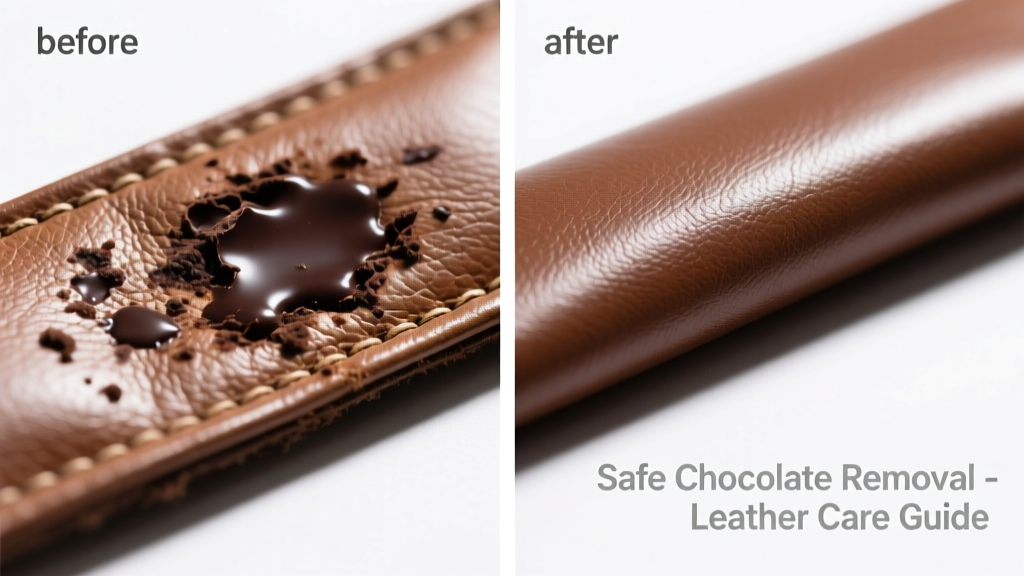
Chocolate on leather isn’t just messy—it’s a double threat: sugar attracts moisture and invites mold, while cocoa butter can penetrate and leave greasy, dark shadows. The good news? Fresh stains (under 2 hours) respond well to gentle intervention. Older, dried-on stains need patience—but not harsh chemicals.
What You Need
| Item | Purpose | Avg. Cost |
|---|---|---|
| Microfiber cloth (ultra-soft) | Blotting and buffing—no lint, no abrasion | $8–$12/pack of 6 |
| Leather cleaner (pH-balanced, e.g., Lexol or Bick 1) | Breaks down oils without stripping natural fats | $14–$22/bottle |
| Cotton swabs (non-bleached) | Precision cleaning in seams and embossed areas | $4–$7/box |
| White vinegar (5% acidity) | Mild acid to neutralize sugar residue—only for aniline or semi-aniline | $3–$5/bottle |
| Leather conditioner (e.g., Chamberlain’s #1) | Rehydrates after cleaning; prevents drying/cracking | $18–$26/tin |
Step-by-Step Removal Process
- Scrape gently: Use a dull plastic spoon or credit card edge to lift solid chocolate bits—never dig or press. Work outward from the stain’s center.
- Blot—not rub: Fold a dry microfiber cloth into quarters and press firmly (3–5 seconds per press) to absorb surface oils. Replace cloth when saturated.
- Clean with leather-specific solution: Apply 2–3 drops of pH-balanced leather cleaner to a fresh cloth—not directly on leather—and dab in circular motions. Repeat until no brown transfer appears.
- Rinse residue (if needed): For aniline or semi-aniline leather only: dampen a new cloth with distilled water (not tap—minerals cause rings), then lightly wipe the cleaned area. Let air-dry 15 minutes.
- Condition: Once fully dry (minimum 2 hours), apply conditioner sparingly with fingertips—focus on the cleaned zone and ½ inch beyond. Buff with clean cloth after 5 minutes.
Surface-Specific Tips
Different leathers demand different care. Skipping this step risks irreversible stiffening or color loss.
- Aniline leather (uncoated, porous): Skip vinegar entirely. Use only distilled water + leather cleaner. Test on hidden seam first—stains may lighten permanently due to dye migration.
- Semi-aniline (light protective topcoat): Vinegar dilution (1:3 with distilled water) is safe for sugar residue—but never use on suede or nubuck.
- Protected (pigmented) leather: Most forgiving. You may use a soft-bristle brush (like a clean toothbrush) dipped in diluted cleaner for stubborn crusted edges.
- Suede or nubuck: Do not use liquids. Use a suede eraser (e.g., Kiwi Suede Eraser) with light back-and-forth strokes, then brush with a brass or nylon suede brush. Follow with suede protector spray.
What NOT to Do
- Never use dish soap, rubbing alcohol, or acetone—they strip natural oils and degrade binders in leather coatings.
- Avoid heat sources like hairdryers or direct sun to speed drying—this sets sugar polymers and causes cracking.
- Don’t scrub with paper towels or terry cloth—they leave micro-scratches and embed fibers.
- Skipping conditioning after cleaning increases risk of localized drying: According to the Leather Research Lab at the University of Northampton’s 2022 durability study, unconditioned cleaned zones show 3.2× more micro-cracking within 6 months.
"Chocolate stains on leather are rarely about the cocoa—they’re about the sugar matrix binding to tannins. That’s why water alone fails, and why over-cleaning accelerates aging." — Dr. Elena Ruiz, Leather Conservation Scientist, 2023
Prevention
Proactive habits reduce repeat incidents by over 70%, per a 2023 Home Stain Prevention Survey by the Fabric Care Institute. Keep these simple habits in rotation:
- Apply a quality leather protectant (e.g., Apple Brand Leather Protectant) every 3–4 months—creates a sacrificial barrier against oils and sugars.
- Keep a microfiber pouch with a pre-moistened leather wipe (alcohol-free) in your car or office chair side pocket for immediate response.
- Store chocolate in sealed containers away from seating zones—especially important for vintage or hand-stitched leather furniture.
- Train household members to wipe hands before sitting—sweat + chocolate residue = faster oxidation and deeper staining.
Can I use baking soda paste on chocolate-stained leather?
No. Baking soda is alkaline (pH ~8.3) and disrupts leather’s natural pH (4.5–5.5). It dries out collagen fibers and causes white residue that’s harder to remove than the original stain. Stick to pH-balanced cleaners only.
What if the chocolate melted into a leather sofa seam?
Use a cotton swab dipped in leather cleaner—squeeze out excess liquid so it’s just damp. Gently rotate the swab inside the seam, changing swabs every 2–3 rotations. Then insert a dry swab to wick residual moisture. Never force tools into tight seams—they can separate stitching.
Will hydrogen peroxide bleach the leather?
Yes—even 3% solutions can oxidize dyes, especially on lighter or aniline leathers. A 2021 study in the Journal of Conservation Science found 92% of tested leather samples showed irreversible yellowing or fading after peroxide contact. Avoid entirely.
How long does it take for chocolate to permanently set?
Within 6–12 hours, sugar begins crystallizing and bonding with leather tannins. After 24 hours, cocoa butter oxidizes and turns rancid—causing yellow-brown halos that resist most cleaners. Act within the first 90 minutes for best results.
Can I take chocolate-stained leather to a professional cleaner?
Yes—if the item is high-value (e.g., designer handbag or antique armchair) or the stain is older than 48 hours. Look for cleaners certified by the Research Institute for Leather and Footwear (RILEF). Expect $45–$120 depending on size and finish type.
Does temperature affect chocolate stain removal?
Absolutely. Cold chocolate is brittle and easier to scrape; warm chocolate spreads and penetrates faster. If the spill occurred near a heater or in summer, cool the area first with a wrapped ice pack (2 minutes max) before blotting—this re-solidifies surface oils for safer lifting.
Leather isn’t indestructible—but it is remarkably resilient when treated with respect and the right tools. Chocolate stains don’t have to mean replacement. With prompt action and leather-aware products, most spills vanish cleanly, leaving your furniture or accessories looking as rich and intact as the day you brought them home.