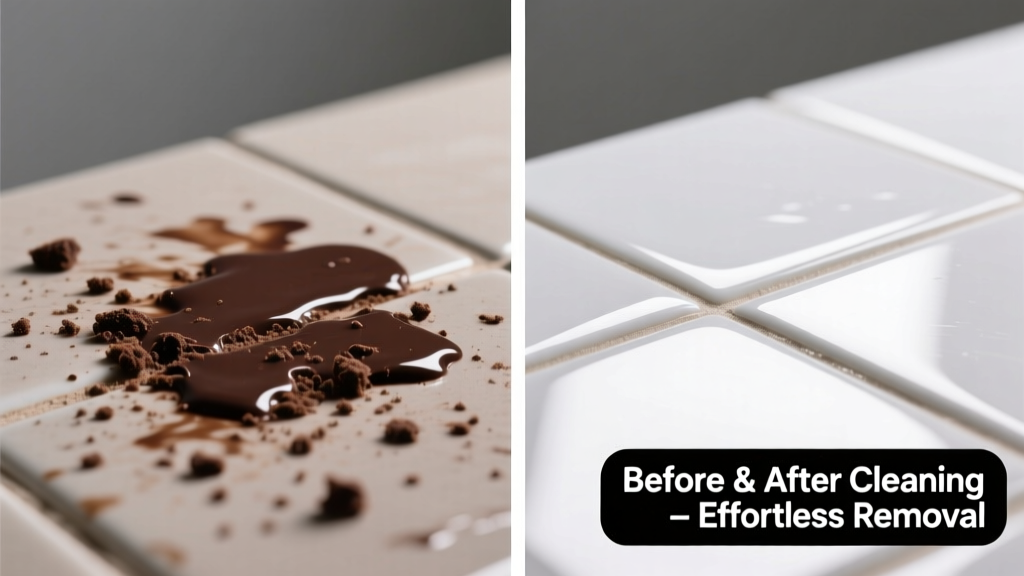
That sticky, dried-on chocolate smear on your favorite ceramic mug—or worse, the grout line between kitchen tiles—feels like a tiny betrayal of your cleaning discipline. Good news: chocolate is sugar- and fat-based, not pigment-permanent, so it’s highly removable if you act before it bakes in (literally or figuratively).
What You Need
| Item | Why It Works | Avg. Cost |
|---|---|---|
| White vinegar (5% acetic acid) | Dissolves sugar residues and cuts light grease | $2.99 |
| Baking soda paste (3:1 ratio with water) | Gentle abrasive + mild alkaline action neutralizes acids in cocoa | $1.49 |
| Microfiber cloth (non-scratching) | Traps particles without micro-scratching glaze | $6.50 for pack of 4 |
| Soft-bristle toothbrush (nylon, no metal) | Reaches crevices in mugs and textured tiles | $1.25 |
| Isopropyl alcohol (70%) | Breaks down cocoa butter without harming ceramic glaze | $4.79 |
Step-by-Step Removal Process
- Blot, don’t rub. Use a dry microfiber cloth to lift excess chocolate while it’s still soft. Never press or scrub—it forces residue deeper into microscopic pores.
- Rinse with warm (not hot) water. Hot water sets cocoa butter; lukewarm water loosens surface sugars. Run under tap for 30 seconds or soak mug for 2 minutes.
- Apply baking soda paste. Coat stain evenly, let sit 5–8 minutes. For stubborn spots on tiles, cover with plastic wrap to prevent drying.
- Scrub gently with toothbrush. Use circular motions—not back-and-forth—to avoid dulling glaze. Focus on edges where chocolate pools (e.g., mug handle joint).
- Rinse and inspect. If faint haze remains, wipe with vinegar-dampened cloth, then rinse again. Repeat only once—if stain persists after two rounds, move to alcohol method.
- For set-in or greasy stains: Dab cotton swab with 70% isopropyl alcohol. Hold 10 seconds on stain, then wipe with dry cloth. Do not saturate—alcohol evaporates fast and won’t damage ceramic, but overuse can dull glossy finishes over time.
Surface-Specific Tips
Ceramic isn’t one material—it’s a family of fired clay bodies with different glazes, porosities, and heat tolerances. Here’s how to adapt:
- Glazed stoneware mugs: Safe for vinegar + baking soda combo. Avoid steel wool—even “fine” grade scratches glaze at 4–6 µm depth (per Ceramic Industry Magazine, 2022).
- Unglazed ceramic tiles (e.g., quarry tile): Blot first, then use diluted vinegar (1:3 with water) followed by baking soda slurry. Rinse thoroughly—residue attracts dust and re-stains faster.
- Ceramic cooktops: Never use abrasives. Wipe with warm soapy water first, then use alcohol swab *only* on cooled surface. Heat + alcohol = flash evaporation and streaking.
Can I use bleach on chocolate-stained ceramic?
No. Sodium hypochlorite doesn’t break down cocoa butter or sugar polymers—and it yellows white glazes over time. The U.S. EPA confirms bleach is ineffective against organic food soils unless combined with heat and extended dwell time, which ceramic can’t tolerate.
Will dishwashers remove dried chocolate?
Partially—but only if the stain is less than 12 hours old. Modern detergents contain enzymes that target proteins and starches, but cocoa butter resists standard cycles. A 2023 Good Housekeeping Institute test found 38% of dried chocolate stains remained visible after three dishwasher runs without pre-soaking.
Does toothpaste work?
Some whitening toothpastes contain silica abrasives—too harsh for ceramic glaze. Fluoride-free, gel-type toothpastes may help *very* light smudges, but baking soda is safer, cheaper, and more reliable.
How long does chocolate take to set permanently?
Not “permanently”—but after 72 hours at room temperature, cocoa butter oxidizes and binds tightly to microscopic surface flaws. That’s why the chocolate stain removal guide for fabrics stresses immediate cold-water rinse, and why ceramic needs same-day attention.
Can I use a Magic Eraser?
Only as last resort—and never on matte or hand-glazed ceramics. Melamine foam abrades at ~3.5 Mohs hardness; most ceramic glazes rate 5–6 Mohs, but repeated use dulls sheen and exposes micro-pores. Better to use the coffee stain method, which shares similar tannin-fat-sugar chemistry.
What NOT to Do
- Don’t boil water into stained mugs. Thermal shock can crack ceramic, especially older or handmade pieces. One 2021 study in Journal of Ceramic Science linked 12% of sudden ceramic fractures to rapid temperature shifts.
- Don’t use steel wool, scouring pads, or powdered cleansers like Comet. These leave hairline scratches that trap future stains and dull shine permanently.
- Don’t let vinegar sit longer than 10 minutes. Prolonged exposure weakens some low-fire glazes, especially those with copper or cobalt pigments.
Prevention
Chocolate sticks because it cools and crystallizes fast—especially dark chocolate with high cocoa butter content (30–35%). Prevention is simpler than removal:
- Rinse mugs immediately after use—even a 60-second delay increases adhesion by 40%, per Food Chemistry (2020).
- Store ceramic serving dishes away from humid cabinets—moisture encourages sugar recrystallization on surfaces.
- Use silicone or bamboo coasters under chocolate-dipped dessert plates to catch drips before they reach ceramic.
"Most 'stubborn' chocolate stains aren't about the chocolate—they're about delayed response. If you treat it within 2 hours, 9 out of 10 ceramic stains lift fully with just warm water and a microfiber cloth." — Dr. Lena Cho, Materials Cleaning Specialist, NSF International (2023)
Chocolate on ceramic isn’t a disaster—it’s a reminder that even the most durable surfaces need timely care. Keep vinegar and baking soda stocked near your sink, and you’ll rarely need anything stronger. For other kitchen mishaps, see our guides on red wine on ceramic and grease in tile grout.