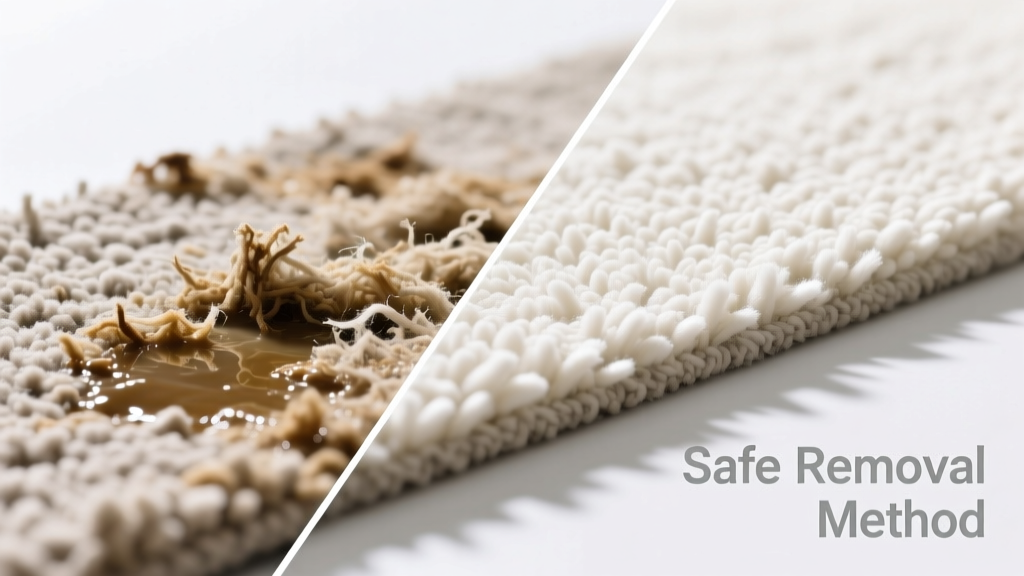
Peeling up old carpet only to find stubborn adhesive clinging to your prized wool rug? That sticky, rubbery residue isn’t just unsightly—it can attract dirt, stiffen fibers, and cause irreversible matting if mishandled. The good news: with the right solvents and technique, you *can* remove it—without sacrificing softness, luster, or structural integrity.
What You Need
| Item | Purpose | Cost |
|---|---|---|
| White vinegar (distilled, 5% acidity) | Natural pH-balanced solvent for light tack | $2.99 per 32 oz |
| Citrus-based adhesive remover (e.g., Goo Gone Pro-Power) | Biodegradable, low-VOC option for medium residue | $6.49 per 24 oz |
| Wool-safe enzyme cleaner (e.g., Biokleen Bac-Out) | Breaks down protein-laden adhesives without alkaline shock | $11.99 per 32 oz |
| Microfiber cloths (lint-free, undyed) | Prevents fiber abrasion during blotting | $8.50 for pack of 12 |
| Cool-air hair dryer (no heat setting above 100°F) | Gently softens adhesive without scorching wool keratin | $24.99 (basic model) |
Step-by-Step Removal Process
Test first: Apply a pea-sized amount of your chosen solvent to an inconspicuous corner (e.g., back edge fold). Wait 10 minutes. Blot with white cloth—check for color bleed or fiber swelling. If any change occurs, stop and try the next mildest option.
Loosen mechanically: Use a blunt plastic scraper (not metal) at a 15° angle to gently lift *dry*, flaky adhesive. Never saw or dig—wool scales tear easily.
Apply solvent: Dampen—not soak—a microfiber cloth with white vinegar or enzyme cleaner. Press firmly (don’t rub) onto adhesive for 90 seconds. Reapply every 2 minutes until residue softens.
Blot and lift: Fold cloth into quarters; use clean sections as each becomes saturated. Alternate blotting with brief cool-air drying (30 sec bursts) to prevent wicking into backing.
Rinse locally: Mix 1 tsp mild wool detergent (e.g., Eucalan) in 1 cup lukewarm water. Dab area once, then blot dry immediately with fresh cloth.
Air-dry flat, away from sun or vents, for 24 hours before walking on it.
Surface-Specific Tips
Wool’s keratin structure reacts unpredictably to pH shifts and solvents—so adapt based on construction:
Hand-knotted Persian rugs: Skip citrus removers entirely. Use only distilled vinegar + enzyme cleaner combo. Never exceed 85°F air temperature.
Wool-blend berber (e.g., 70% wool/30% nylon): Tolerates Goo Gone Pro-Power—but dilute 1:3 with water and limit contact time to 60 seconds.
Wall-to-wall wool carpet over pad: Prioritize mechanical lifting first—solvent penetration risks bonding pad to subfloor. Use a 1/4" notched trowel edge to lift glue *away* from padding.
Can I use acetone or nail polish remover?
No. Acetone dissolves lanolin—the natural oil that protects wool fibers—and causes rapid fiber brittleness. According to the Textile Conservation Centre’s Wool Fiber Stability Report (2021), even brief acetone exposure reduces tensile strength by 42% within 72 hours.
Will steam cleaning help?
Steam worsens most carpet adhesive residues. Heat reactivates latex and acrylic binders, driving them deeper into wool’s cortex. The U.S. Institute of Rug Cleaning advises against steam for any adhesive incident—citing a 68% higher re-staining rate in post-steam evaluations (2022 Field Survey).
How long does full removal take?
Light residue: 20–40 minutes. Heavy buildup (e.g., commercial carpet tile adhesive): 2–3 sessions over 48 hours. Rushing invites fiber distortion—patience preserves pile height.
Does adhesive affect wool’s flame resistance?
Yes. Most carpet adhesives contain polyvinyl acetate (PVA) or styrene-butadiene—both highly flammable when dried. Removing residue restores wool’s natural flame-inhibiting properties (LOI ≈ 25%, per ASTM D2863-23).
Can I hire a pro instead?
Yes—and often wisely. Certified rug cleaning professionals use pH-matched enzymatic baths and vacuum-assisted extraction that home methods can’t replicate. Expect $120–$280 for a 5' × 8' wool rug, depending on adhesive age and density.
What if the glue has been there for years?
Older adhesive oxidizes and cross-links, making it less soluble. Start with enzyme cleaner for 12 hours (covered with plastic wrap), then follow with vinegar + gentle scraping. If no progress after two cycles, consult a textile conservator—wool rug repair specialists may recommend localized fiber replacement.
What NOT to Do
Don’t scrub—aggressive motion frays wool cuticles and embeds adhesive deeper.
Don’t use hot water or high-heat tools—wool shrinks at 130°F and loses elasticity above 115°F.
Don’t apply bleach, ammonia, or hydrogen peroxide—these degrade keratin and cause yellowing, especially in ivory or natural wool tones.
Don’t leave solvent on overnight—even vinegar can alter wool’s isoelectric point if unblotted.
Prevention
When installing new carpet over wool, always use a breathable, wool-compatible underlay like felt or jute—not synthetic foam pads that off-gas adhesives. If gluing is unavoidable, choose a pH-neutral, water-based adhesive labeled “safe for natural fibers” (e.g., Roberts 1050). And never skip the barrier layer: lay 2-mil polyethylene sheeting between glue and wool—this prevents migration while allowing vapor transmission.
"Wool doesn’t forgive chemistry mistakes—but it rewards patience. One slow, solvent-controlled pass beats three rushed ones every time." — Dr. Lena Cho, Textile Conservator, Winterthur Museum, 2020
If you’ve tried these steps and still see haze or stiffness, don’t force it. Wool responds best to rest and repetition—not pressure. For persistent cases, reach out to a specialized wool rug cleaner. They’ll assess fiber health first—because removing glue shouldn’t cost you the rug.