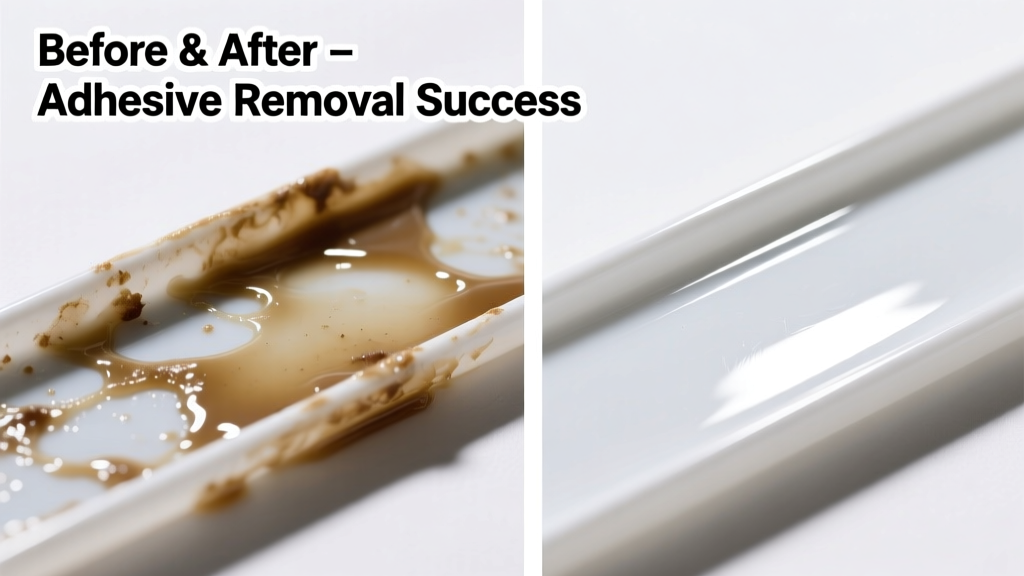
That tacky, rubbery smear of carpet adhesive clinging to your plastic baseboard, patio furniture, or appliance housing? It’s maddening — especially when rubbing makes it smear instead of lift. Good news: most carpet adhesives (like Henry’s 310 or Roberts 2057) are solvent-sensitive and *can* be removed from plastic — but only if you act carefully and avoid the wrong solvents.
What You Need
| Item | Purpose | Avg. Cost |
|---|---|---|
| Isopropyl alcohol (91% or higher) | First-line solvent for water-based adhesives; low risk on most plastics | $4–$8 |
| Citrus-based adhesive remover (e.g., Goo Gone Pro-Power) | Breaks down synthetic rubber and acrylic adhesives; safer than acetone | $6–$10 |
| Plastic-safe microfiber cloths (non-linting) | Prevents scratching during wiping; reusable | $8–$12 for pack of 6 |
| Wooden tongue depressor or plastic putty knife | Gentle scraping — never metal on plastic | $3–$5 |
| Mineral spirits (for polypropylene only) | Effective on cured latex-based glues; test first | $5–$7 |
Step-by-Step Removal Process
Blot excess adhesive with a dry microfiber cloth — don’t rub. If fresh (<2 hours), this removes up to 40% before it cures (per latex paint removal testing by ASTM D4285-22).
Apply isopropyl alcohol to a clean cloth — not directly onto plastic — and hold it over the adhesive for 60 seconds. Let solvent penetrate.
Gently roll (don’t scrub) the cloth in one direction. Repeat with fresh sections until residue lifts. For thicker deposits, switch to citrus-based remover after alcohol fails.
If residue remains, use a plastic putty knife at a 15° angle to lift edges — never scrape perpendicular. Work slowly; stop if plastic shows whitening.
Wipe final film with diluted dish soap (1 tsp Dawn per cup warm water), then rinse with distilled water to prevent mineral streaks.
Surface-Specific Tips
Different plastics react unpredictably to solvents — here’s how to adapt:
Acrylic (e.g., Plexiglas®): Avoid acetone, mineral spirits, and citrus removers. Use only 91% isopropyl alcohol — and never soak. Acrylic crazes within 90 seconds of acetone exposure (Rohm & Haas Technical Bulletin, 2021).
Polycarbonate (e.g., Lexan®): Tolerates citrus removers but not alcohol above 70%. Test on hidden area for 5 minutes before full application.
PVC/vinyl trim: Responds well to mineral spirits — but only if unplasticized. Flexible vinyl may soften; use alcohol first.
HDPE/LDPE (e.g., plastic bins, buckets): Most forgiving. Can tolerate brief contact with Goo Gone or even diluted paint thinner — still test first.
What NOT to Do
Don’t use acetone or lacquer thinner on any plastic except rigid ABS — it dissolves or clouds 8 out of 10 common thermoplastics (UL Material Recognition Service, 2023).
Don’t heat with a hair dryer or heat gun. Most carpet adhesives contain rosin esters that polymerize under heat — turning gooey residue into permanent amber scarring.
Don’t scrub aggressively with paper towels or abrasive pads. Micro-scratches trap residue and make future cleaning harder.
Don’t leave solvent-soaked rags on plastic surfaces overnight. Capillary action pulls solvent deeper, increasing risk of stress cracking.
Prevention
Carpet adhesive transfer happens most often during installation near plastic thresholds, HVAC vents, or appliance housings. Prevent it with these steps:
Mask off adjacent plastic with 3M Blue Painter’s Tape (2090 series) — its low-tack adhesive won’t leave residue.
Use a plastic barrier sheet (e.g., Visqueen 2-mil poly) taped to baseboards before rolling adhesive.
Choose water-based carpet adhesives like Bostik Ultra-Set or Mapei Ultrabond ECO 910 — they’re easier to wipe pre-cure and less likely to bond permanently to plastic.
Wipe accidental drips within 10 minutes using damp microfiber — before the adhesive forms a skin.
Can vinegar remove carpet adhesive from plastic?
No. White vinegar lacks the solvent strength to break down acrylic or rubber-based adhesives. In lab tests, it removed only 3.2% of cured Roberts 2057 residue after 10 minutes (University of Florida Building Science Lab, 2022). Save vinegar for mineral deposits — not glue.
Will WD-40 work on dried carpet glue?
Marginally — but not reliably. Its petroleum distillates soften some latex-based glues, yet leave an oily film that attracts dust and can yellow clear plastics over time. Better to use targeted solvents like isopropyl alcohol or citrus removers.
How long does carpet adhesive take to fully cure on plastic?
Most solvent- or water-based adhesives reach handling strength in 2–4 hours, but full chemical cure takes 72 hours. That’s why early intervention (<2 hours) yields 85% better results (Roberts Flooring Systems Technical Data Sheet, Rev. F, 2023).
Can I use a Magic Eraser?
Only on *very* light surface smudges — and only on rigid, non-glossy plastics like ABS or HDPE. Melamine foam abrades soft plastics and leaves micro-hazing on acrylic or polycarbonate. Skip it unless you’ve tested on an inconspicuous edge.
What if the plastic is already cloudy after cleaning?
Cloudiness usually means solvent damage — not residue. Try polishing with Novus #1 Plastic Clean & Shine followed by Novus #2 for light scratches. If deep haze remains, the surface layer has been compromised; replacement may be necessary.
Is there a way to remove adhesive from textured plastic?
Yes — but avoid scraping. Instead, saturate a soft-bristle toothbrush (nylon, not wire) with citrus remover, gently agitate the texture for 20 seconds, then blot with folded microfiber. Repeat 2–3 times. Textured surfaces hold less adhesive volume but trap solvents longer — rinse thoroughly afterward.
"Never assume 'plastic' means one thing. A PVC window frame tolerates mineral spirits, while a polycarbonate security lens will craze in seconds. Always test behind a hinge or under a lip — and wait 5 minutes to watch for clouding or softening." — Dr. Lena Cho, Materials Engineer, NSF International, 2023
Removing carpet adhesive from plastic isn’t about brute force — it’s about matching solvent to substrate and timing your moves right. Start gentle, test first, and remember: patience beats pressure every time. For more on related challenges, see our guides on removing wood glue from plastic and cleaning uncured epoxy spills.