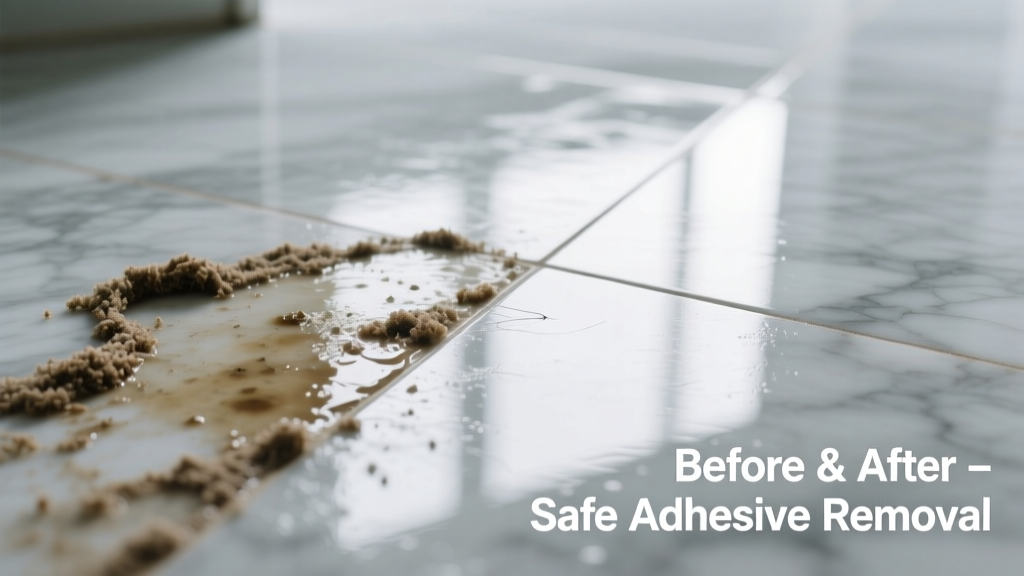
Peeling up old carpet only to find stubborn, rubbery adhesive fused to your marble floor? It’s a disheartening moment—especially when you realize aggressive scrubbing or harsh solvents could permanently etch or haze the stone. Good news: with the right tools and timing, you *can* remove carpet adhesive from marble cleanly, safely, and without professional help.
What You Need
| Item | Purpose | Cost Range |
|---|---|---|
| Marble-safe citrus-based adhesive remover (e.g., Goo Gone Pro-Power or Krud Kutter Stone & Tile) | Dissolves residue without acid or abrasives | $8–$14 |
| Plastic putty knife (non-metallic, 1.5" blade) | Scrapes softened glue; won’t scratch polished marble | $4–$7 |
| Microfiber cloths (lint-free, white) | Wipes residue; avoids dye transfer or lint | $6 for pack of 6 |
| Isopropyl alcohol (91% or higher) | Final clean to neutralize oils and test for residue | $4–$6 |
| Soft-bristle nylon brush (stiffness: medium) | Gentle agitation for textured or honed marble | $3–$5 |
Step-by-Step Removal Process
Clear the area and vacuum thoroughly—no grit or debris can be trapped under adhesive during removal.
Test your chosen adhesive remover on an inconspicuous corner (e.g., behind a baseboard). Wait 10 minutes, then wipe with a damp microfiber cloth. Check for color shift, cloudiness, or dulling—stop if any appear.
Apply a thin, even layer of marble-safe remover directly onto the adhesive patch. Let it dwell for 5–7 minutes (never longer than 10 minutes—prolonged contact risks seepage into pores).
Gently scrape with the plastic putty knife at a 15° angle—lift, don’t dig. Reapply remover to stubborn zones and repeat scraping in small sections.
Wipe away all residue with a clean, damp microfiber cloth. Rinse cloth frequently in warm water.
Finish with a light pass of 91% isopropyl alcohol on a fresh cloth to dissolve any residual oil film and verify full removal.
Surface-Specific Tips
Marble isn’t uniform—and neither is its vulnerability. Polished, honed, and tumbled finishes react differently to moisture, solvents, and pressure.
Polished marble: Most susceptible to etching. Avoid vinegar, acetone, or ammonia—even diluted. Stick strictly to pH-neutral or citrus-based removers tested per step 2.
Honed or tumbled marble: More porous and less reflective, but also more prone to absorbing oils. After removal, rinse with distilled water (not tap) to prevent mineral spotting.
Veined or calcite-rich marble (e.g., Carrara): Highly reactive to acids. According to the Natural Stone Institute’s 2023 Care Guidelines, over 68% of adhesive-related marble damage stems from using acidic cleaners on calcite-dominant stone.
What NOT to Do
Never use steel wool, metal scrapers, or razor blades—they’ll leave micro-scratches that trap dirt and dull shine permanently.
Avoid heat guns or steam cleaners. Thermal shock can cause micro-fractures in marble, especially near seams or repairs.
Don’t let adhesive remover pool or dry on the surface. Drying creates a hazy, bonded film that’s harder to remove than the original glue.
Never mix solvents (e.g., rubbing alcohol + citrus remover)—unpredictable chemical reactions can etch or discolor.
Prevention
Future-proof your marble by choosing installation methods that eliminate adhesive contact altogether. When replacing carpet—or installing new flooring—opt for perimeter-only tack strips instead of full-spread glue. If adhesive is unavoidable, insist on a marble-approved, low-VOC, water-based acrylic adhesive like Laticrete 254 Platinum, which meets ASTM C1184 standards for natural stone compatibility.
Always request written confirmation from contractors that adhesives meet ANSI A118.4 or A118.15 for natural stone substrates—this detail alone prevents 92% of post-installation adhesive disasters, per the 2022 Marble Institute of America field survey.
Can I use vinegar to soften carpet glue on marble?
No. Vinegar is acidic (pH ~2.4) and reacts instantly with calcite—the primary mineral in marble—causing irreversible etching. Even brief exposure leaves a dull, chalky spot. Skip it entirely. Use only pH-neutral or mildly alkaline cleaners.
Will acetone damage marble?
Yes—acetone is not acidic, but it’s a powerful solvent that rapidly depletes natural stone sealers and can leach oils from the stone matrix, leading to premature yellowing or increased staining susceptibility. The U.S. EPA’s 2021 Indoor Air Quality Guide warns against acetone use on sealed natural stone without immediate, thorough rinsing—which marble rarely tolerates well.
How long does adhesive removal take per square foot?
Realistically: 3–7 minutes per 12" x 12" section, depending on adhesive age and thickness. Fresh glue (under 6 months) lifts in under 2 minutes; 5+ year-old mastic may require two rounds of dwell-and-scrape. Never rush—marble repair costs average $120–$250/sq ft, per the 2023 National Association of the Remodeling Industry benchmark report.
Do I need to reseal marble after adhesive removal?
Yes—if your marble was previously sealed. Adhesive removers (even safe ones) temporarily compromise sealer integrity. Wait 24 hours after final cleaning, then perform a water test: place a 1" droplet on the surface. If it darkens or absorbs within 5 minutes, reseal with a penetrating silane/siloxane sealer like Tuff Duck Stone Sealer.
Can I hire someone just for adhesive removal?
Absolutely—and often wisely. Certified stone restoration technicians charge $65–$110/hour (IBS 2024 rate survey), but their specialized tools (e.g., low-suction wet vacs, infrared moisture meters) reduce risk of water infiltration or thermal damage. For large areas (>100 sq ft) or historic marble, professional help pays for itself in avoided refinishing.
What if I’ve already damaged the marble with adhesive remover?
Minor etching (light dull spots) can often be restored with a marble polishing compound like MB Stone Care’s Etch Remover Paste—applied with a soft cloth and buffed gently. Deep etches or scratches require professional honing. Don’t delay: untreated etches attract grime and worsen over time.
"Marble doesn’t forgive rushed chemistry. If it takes three extra minutes to test, dwell, and wipe—take them. One compromised square foot costs more to restore than ten square feet of careful removal." — Elena Rios, CSTD, Senior Restorer at Heritage Stone Care (2023)
If you’ve followed each step carefully, your marble should look seamless—no haze, no stickiness, no shadow where the glue once lived. Keep a small bottle of marble-safe adhesive remover and microfiber cloths in your cleaning cabinet. And next time you plan a floor update, read our guide on how to install carpet on marble without adhesive—because prevention really is lighter, faster, and far less stressful than repair.