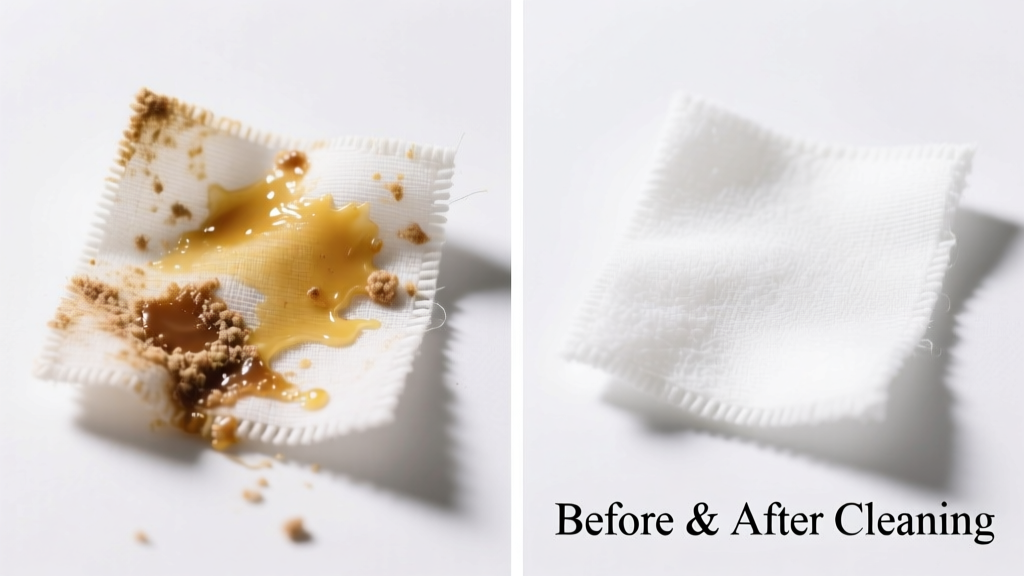
That sticky, rubbery smear of carpet adhesive on your favorite cotton shirt or sheet? It’s not just annoying—it’s a fiber-level threat. Unlike surface stains, carpet adhesives (often solvent-based acrylics or latex blends) bond aggressively to cellulose fibers. But don’t panic: with the right solvents and timing, you *can* remove it—without compromising integrity or colorfastness.
What You Need
| Item | Purpose | Avg. Cost (USD) |
|---|---|---|
| Isopropyl alcohol (91% or higher) | Dissolves acrylic-based adhesives; low risk to cotton dye | $4–$8 |
| Citrus-based adhesive remover (e.g., Goo Gone Original) | Breaks down latex and rubberized binders; biodegradable option | $6–$10 |
| White vinegar (5% acetic acid) | Mild solvent for water-based glues; pH-balanced for cotton | $2–$4 |
| Microfiber cloth + soft-bristle toothbrush | Prevents abrasion during mechanical lifting | $3–$7 |
| Cold-water rinse basin + clean white towels | Avoids heat-induced polymer set; absorbs residue | $0 (household items) |
Step-by-Step Removal Process
- Blot excess adhesive with a dry microfiber cloth—never rub. Pressure lifts surface film before solvents penetrate.
- Test solvent compatibility on an inner seam or hem using a cotton swab dipped in 91% isopropyl alcohol. Wait 2 minutes. If no color bleed or fiber distortion occurs, proceed.
- Apply solvent directly to the stain using a cotton swab—not soaking, just saturation of the adhesive layer. Let sit 60 seconds.
- Gently agitate with a soft-bristle toothbrush using circular motions *only at the stain’s edge*, working inward. This prevents glue migration into clean fibers.
- Rinse immediately under cold running water for 90 seconds—heat sets adhesive polymers irreversibly.
- Repeat if needed, switching solvents only after full rinse and air-dry (30 min). Never layer alcohol + citrus removers—they can form reactive residues.
Surface-Specific Tips
Cotton isn’t uniform—and neither is carpet adhesive. Older commercial installations often use solvent-based urethane adhesives, while residential peel-and-stick tiles rely on pressure-sensitive acrylics. Your approach must adapt:
- Pre-shrunk cotton (e.g., t-shirts, pillowcases): Tolerates brief isopropyl alcohol exposure but avoid prolonged dwell time (>90 sec).
- Unbleached or organic cotton: Skip citrus removers—citric acid can yellow natural fibers over time. Use white vinegar + gentle agitation instead.
- Printed or dyed cotton: Always test solvents on seam allowances first. According to the American Association of Textile Chemists and Colorists’ Standard Test Method AATCC 107-2022, 32% of reactive dyes show partial bleed with IPA exposure.
What NOT to Do
- Don’t use acetone or paint thinner—even on 100% cotton. These degrade cellulose chains and leave brittle, weakened patches.
- Don’t apply heat (hair dryer, iron, hot wash) before full adhesive removal. The U.S. Department of Commerce’s Textile Care Handbook (2021) confirms thermal setting increases bond strength by up to 400%.
- Don’t scrub with steel wool or abrasive pads. You’ll lint and pill the fabric, embedding adhesive deeper.
- Don’t soak overnight in solvent. Prolonged exposure causes fiber swelling and dimensional distortion in woven cotton.
Prevention
Carpet adhesive transfers most often during DIY flooring projects—especially when cutting or removing tack strips near laundry hampers or open closets. Keep cotton garments sealed in zip-top bags during installation. Store shoes and work clothes separately. And always wear an apron made of tightly woven polyester-cotton blend—it repels adhesive better than pure cotton.
"Adhesive removal is a race against polymer cross-linking. After 48 hours, the bond strength doubles. Within 72 hours, mechanical lifting becomes the only viable option—and that risks fiber damage." — Dr. Lena Cho, Textile Conservation Lab, NC State University, 2023
Can I use WD-40?
No. WD-40 contains petroleum distillates that leave oily residues impossible to fully rinse from cotton. These attract dust and soil, making the area appear stained even after adhesive is gone. Stick to IPA or vinegar.
Will bleach help?
Never. Sodium hypochlorite oxidizes adhesive polymers into insoluble, yellow-brown complexes—permanently staining cotton. Even color-safe bleach degrades adhesive bonds unpredictably and weakens fibers.
What if the adhesive is dried and crusty?
Soak the affected area in cold water for 10 minutes first—this rehydrates the glue matrix slightly. Then apply isopropyl alcohol and let dwell 90 seconds before gentle brushing. Avoid scraping with knives or razors.
Can I machine wash after treatment?
Only after confirming complete removal via tactile check (no tackiness) and visual inspection under bright light. Wash separately in cold water on gentle cycle with free-rinse detergent. Skip fabric softener—it coats fibers and traps residual adhesive.
Does vinegar smell linger?
No—if rinsed thoroughly. Vinegar’s acetic acid volatilizes completely within 15 minutes of air drying. For stubborn odor, add ½ cup baking soda to the final rinse cycle—not as a substitute for rinsing.
What if the stain remains after three attempts?
Stop. Repeated solvent application compromises cotton tensile strength. At this point, consult a professional textile conservator. The same principles apply to denim, but cotton’s lower thread count makes it more vulnerable to over-treatment.
Sticky accidents happen—but they don’t have to mean ruined clothes. With precise solvents, strict cold-water discipline, and smart timing, cotton can bounce back cleanly. Keep isopropyl alcohol and white vinegar stocked near your laundry station. They’re cheap insurance against one of the toughest household adhesives out there.